
· return item chargeback · Shopify chargebacks · payment disputes · return fraud · risk management
Return Item Chargeback Guide for Shopify Merchants
Learn what a return item chargeback is, how to respond to Shopify disputes, and how to prevent returns, payment failures, and unnecessary losses.
The order looked paid, your warehouse shipped it, and now your bank has taken the money back. Before you refund the customer or build a dispute response, identify what happened. A return item chargeback on a bank statement isn't automatically a customer-filed card chargeback, and responding through the wrong process won't recover the payment.
Table of Contents
- What a Return Item Chargeback Means
- How Returned Payments Differ From Card Chargebacks
- How to Respond to a Shopify Dispute
- Build Evidence That Proves the Return Outcome
- Prevent Return Items and Reduce Dispute Exposure
- Where Securify Fits
- Common Return Item Chargeback Questions
What a Return Item Chargeback Means
In the U.S. electronic-payments context, a return item chargeback can describe a disputed or unauthorized electronic fund transfer that reverses a previously credited payment. The relevant consumer error-resolution framework is explained in the CFPB's electronic fund transfer guidance. But the statement label alone doesn't tell you which payment rail, rules, or recovery process applies.
For a Shopify merchant, the immediate question is practical: Did your bank reverse a deposited payment, or did your payment provider receive a card-network dispute? Don't assume the word “chargeback” answers that question.
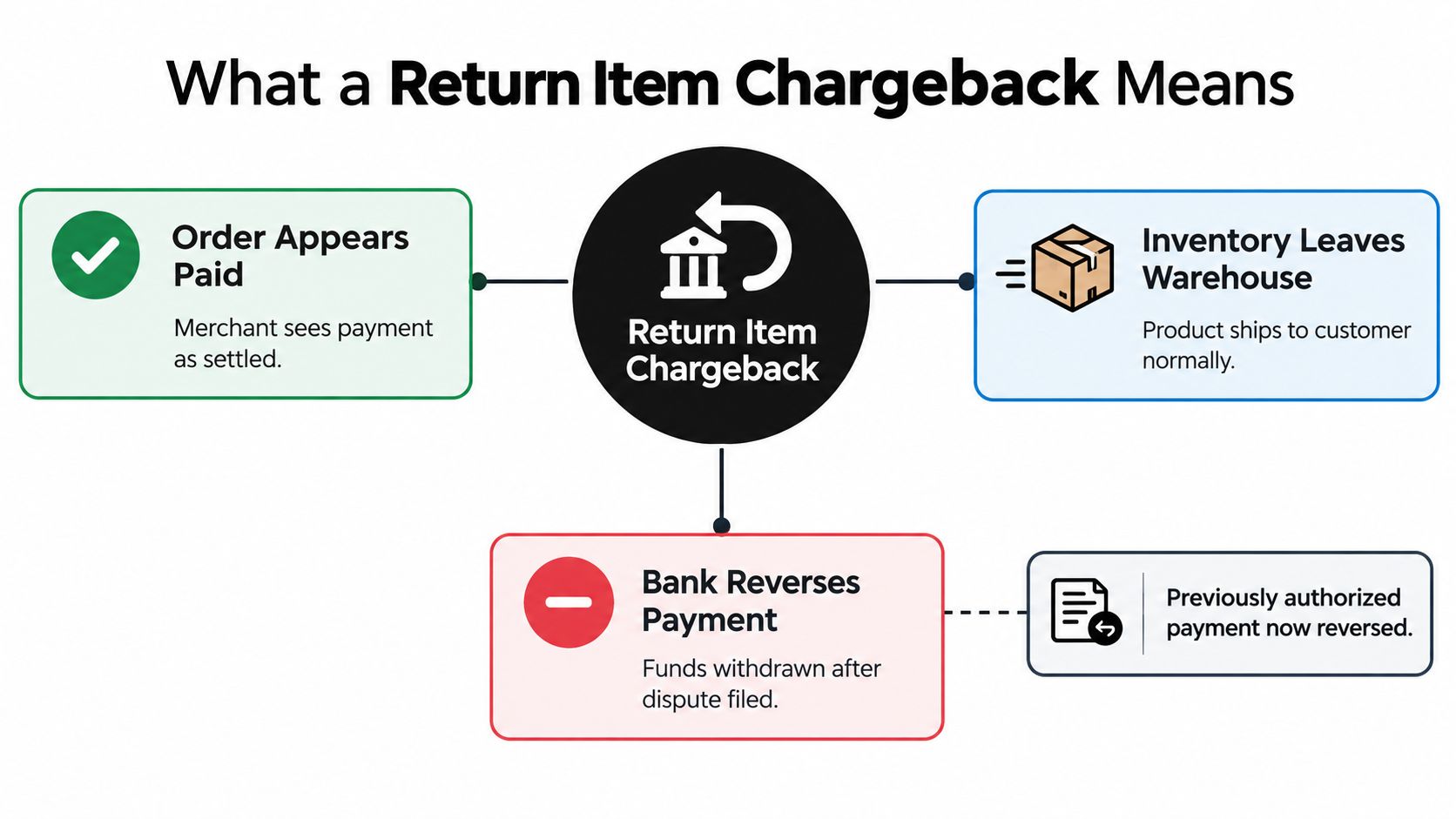
Apparent payment success isn't final certainty
Treat the diagram as an operational sequence, not a universal legal definition. A reversal doesn't necessarily mean someone filed a card dispute, and an account credit doesn't establish that the underlying payment was authorized or irreversible.
Your exposure also extends beyond the reversed amount. Once you've fulfilled the order, you may have inventory, shipping, customer-support work, bank fees, and fraud-review labor tied to a payment you no longer hold.
Practical rule: Identify the payment rail before assigning the case to your dispute team.
Separate the recovery paths
Start with the notice and transaction identifiers, then assign the right owner:
- Returned bank payment: Finance should reconcile the reversal, obtain the return reason, and coordinate customer payment recovery.
- Merchandise-return card dispute: Operations should establish what happened to the returned goods and whether the required credit was issued.
- Suspected unauthorized activity: Preserve authorization and customer records without assuming that suspicious traffic proves the payment was fraudulent.
For terminology beyond a bank statement label, PlatformDTC's explanation of chargeback meaning in ecommerce provides useful context. Keep that vocabulary separate from your actual bank notice.
Your broader chargeback fraud prevention process belongs upstream. Once money has been reversed, the priority is matching the event to the correct records, deadline, and recovery route.
How Returned Payments Differ From Card Chargebacks
A returned deposited item is generally a bank-account adjustment, not a card-network dispute initiated by a customer. The bank may reverse the full provisional credit even when the depositor acted in good faith, as described in this explanation of returned checks and bank chargebacks.
That distinction changes who owns the response. Finance shouldn't wait for a Shopify dispute notification to investigate a bank reversal, and customer support shouldn't send a warehouse evidence packet to the bank without understanding the return reason.
Bank return compared with a card chargeback
| Issue | Bank return item | Card chargeback | Merchant response |
|---|---|---|---|
| Trigger | A previously credited bank payment is returned or reversed | An issuer submits a reason-coded dispute through the card network | Identify the original transaction and payment rail |
| Controlling institution | The bank and applicable payment process | Issuer, acquirer, and card-network rules | Contact the institution responsible for the notice |
| Evidence question | Why was the payment reversed, and was that action correct? | Does the evidence answer the stated dispute reason? | Collect records that address the actual claim |
| Deadline source | Bank notice and applicable rules | Provider notice, network rules, and Shopify admin where applicable | Record the operative deadline immediately |
| Operational owner | Finance, with support or risk assistance | Dispute owner, with warehouse, finance, and support input | Assign a named case owner |
Authorization, settlement, and reversal are different events. Build your reconciliation around those events rather than a single “paid” status.
For card disputes, Mastercard's chargeback workflow describes a rules-based process in which the issuer sends the claim to the acquirer, which can accept liability or respond through second presentment with evidence. Consumer bank-error investigation periods don't replace those network deadlines.
Answer the right evidence question
Consider a customer claiming that returned merchandise wasn't refunded. The merchant provides tracking showing the original order reached the customer, but nothing showing what happened afterward.
That evidence answers an outbound-delivery question, not the return claim. The missing records concern return receipt, inspection, eligibility, and the credit calculation.
Keep Shopify high-risk orders in a separate screening workflow. Likewise, your Shopify chargeback-rate review shouldn't become a substitute for classifying each financial event correctly.
How to Respond to a Shopify Dispute
Open the notice and record the deadline before investigating the customer's story. Shopify Payments usually gives merchants 7–21 days after a chargeback or inquiry is filed; the exact deadline appears in the Shopify admin, and additional evidence isn't allowed afterward, according to Shopify's chargeback management guidance.
The admin uses your store's time zone. If no time is displayed, Shopify specifies 11:59 p.m. on the deadline date in that same guidance. Set your internal cutoff earlier so missing warehouse records don't become a last-minute emergency.
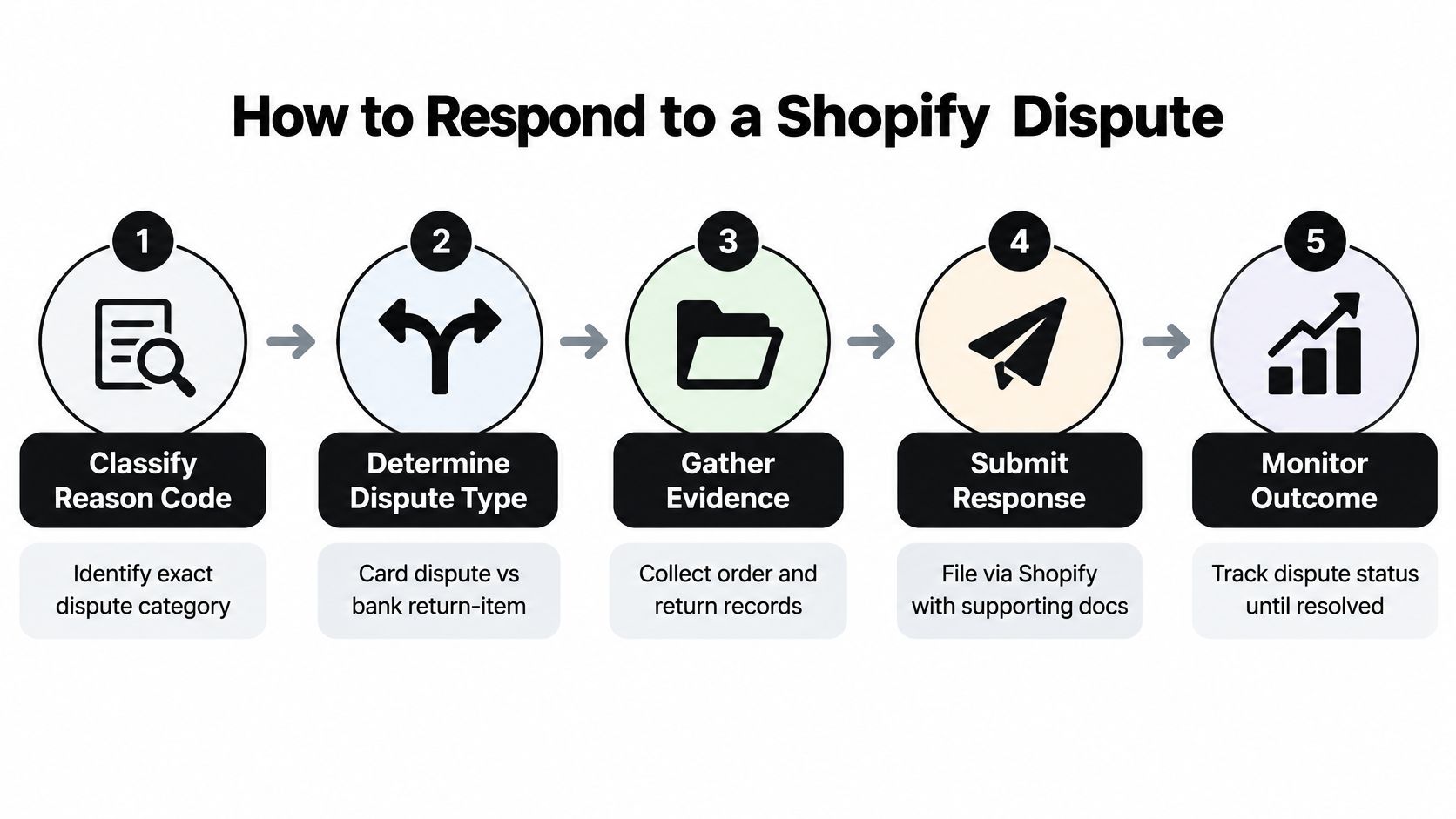
Classify the notice and preserve the records
Read the exact reason code and allegation. A merchandise-return claim requires a different response from an unauthorized-payment claim, even when both involve the same order.
Confirm that you're dealing with a card dispute rather than a bank return-item event. Then assign a case owner and preserve the relevant records before staff edit notes, close tickets, or lose access to tracking details.
- Order records: Match the Shopify order, payment transaction, customer identity, and disputed amount.
- Return records: Locate the authorization, label, carrier events, warehouse receipt, and inspection result.
- Financial records: Reconcile refunds, partial credits, transaction references, and any outstanding balance.
- Customer communications: Preserve the messages that establish what the customer requested and what your team promised.
Don't let each department prepare a separate version of events. Ask finance, support, and the warehouse to work from one chronology.
Establish the outcome before writing the response
Resolve contradictions first. If support promised a refund but finance has no matching transaction, that's an operational exception to investigate, not something to hide behind a return-policy screenshot.
If the warehouse received a parcel but can't identify its contents, state what the records establish and what they don't. Don't present a carrier delivery scan as proof of an inspection nobody documented.
A persuasive response connects the claim to the records. A large attachment pile doesn't do that by itself.
When conversations are scattered across channels, merchants can find ecommerce support solutions through SupportGPT's resource. The operational requirement remains simple: export a readable conversation history linked to the order.
Submit the chronological response through Shopify Payments or the relevant acquirer route. Check that attachments are readable, amounts reconcile, and the explanation directly answers the reason code. After submission, assign someone to monitor the outcome and any further action shown in the account, including representment or a later dispute stage.
Build Evidence That Proves the Return Outcome
A return label proves that a label was created. It doesn't prove the merchandise came back. Shopify recommends return-tracking evidence connecting the return to the order and showing the carrier, tracking number, delivery status, and whether the disputed goods were received in its chargeback evidence guidance.
Build the file around the return outcome, not everything you know about the customer. The reviewer needs a coherent record of the obligation, the returned item, and the credit decision.
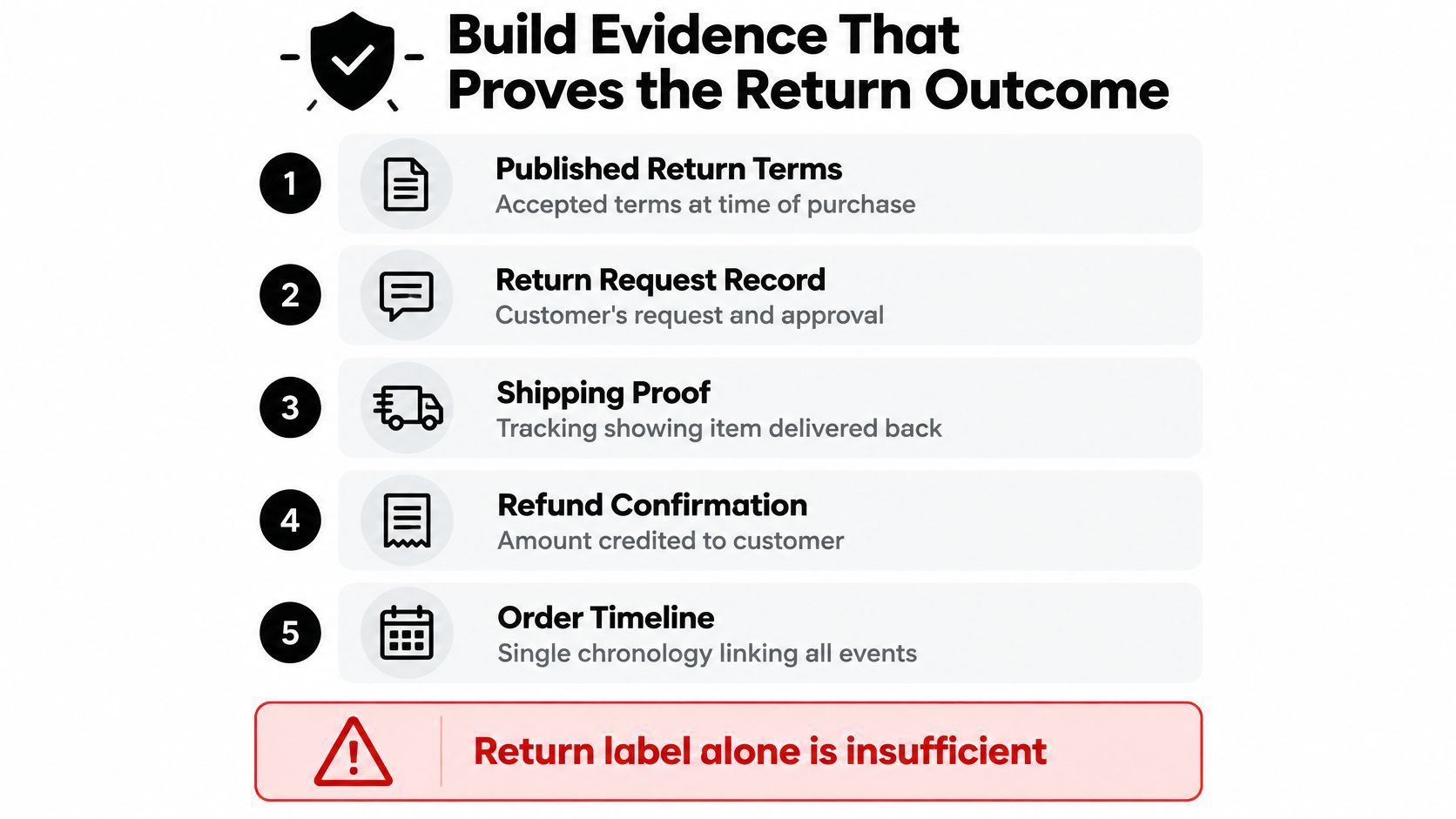
Connect each record to a specific question
Preserve the return terms in effect when the customer purchased, together with the available record of acceptance. A current policy page may not establish the terms that applied to an earlier order.
Next, connect the return authorization to the carrier record and warehouse intake. Where condition or product identity matters, include SKU records, inspection notes, and relevant photographs.
- Eligibility: Which published term governed the return, and what record supports applying it?
- Receipt: Which returned parcel corresponds to this order, and when did the warehouse receive it?
- Condition: What did staff inspect, and what did they record?
- Credit: What amount was issued, when was it sent, and which transaction reference proves it?
Document the financial conclusion
For a full refund, provide the amount, processing date, and transaction reference. Connect that credit to the disputed purchase rather than attaching an unrelated account screenshot.
For a partial refund, explain the calculation and support each deduction with the applicable terms and condition evidence. Don't expect the reviewer to reconstruct the arithmetic from warehouse notes.
For a denied return, identify the relevant policy and the facts supporting the denial. For an accepted return awaiting credit, escalate the uncompleted refund internally rather than describing acceptance as if it were completed payment.
Evidence test: Could someone unfamiliar with the order explain why the customer received that refund amount?
Export screenshots and records before the response cutoff, with filenames that identify their contents. Use Shopify Fraud Analysis for Shopify-native risk context, not as a replacement for these records. A broader merchant chargeback protection process should preserve this distinction: suspicious-session evidence doesn't establish whether your return obligation was performed.
Prevent Return Items and Reduce Dispute Exposure
Don't treat every payment exception as a traffic problem. A legitimate customer can encounter a failed bank payment, and a legitimate return can become a dispute because your warehouse and refund ledger don't agree.
Build prevention around the specific failure you want to stop. Payment screening, shipment release, return intake, and refund completion need separate controls and accountable owners.
Make fulfillment and refund decisions auditable
For unsettled bank payments, use shipment holds where the potential loss justifies waiting. Confirm the payment's status with the provider before release, but don't describe a hold or a settlement status as a guarantee against later reversal.
For returns, publish understandable terms and carry the same order and return identifiers through support, carrier records, warehouse intake, and finance. Have warehouse staff record receipt and condition before closing the return.
- Shipment release: Define who can approve fulfillment when payment certainty remains unresolved.
- Return intake: Record the parcel, associated order, received contents, and condition findings.
- Refund completion: Send the customer confirmation only after staff can identify the actual credit transaction.
- Exception review: Reconcile provisional credits and unresolved returns on a fixed operating schedule.
Card refunds also have a distinct legal timeline. Under federal Regulation Z, a merchant or creditor accepting a return or forgiving a service debt must transmit a credit statement through normal channels within seven business days, and the issuer must credit the consumer's account within three business days of receipt, according to the CFPB's credit-card refund guidance.
Those are separate obligations for separate parties. Preserve your transmission reference so your team can establish when it completed its part.
Use traffic signals without overstating them
Compare incidents by payment method, geography, device session, and final order outcome. Look for patterns that justify review or payment restrictions, rather than treating a VPN connection or unfamiliar location as proof of fraud.
The Shopify fraud and bad traffic guide provides adjacent screening context. Use ecommerce fraud prevention practices to decide which orders need additional scrutiny, while finance retains responsibility for payment reconciliation.
Blocking suspicious traffic isn't the same as securing settlement. It can reduce exposure to abusive activity, but it can't establish that every apparently legitimate bank payment will remain collectible.
Where Securify Fits
Securify belongs upstream of payment reconciliation and return evidence. It is a Shopify-first security and traffic-quality option for identifying and mitigating bot traffic, VPN abuse, fake visitors, and related fraud pressure.
A merchant can use traffic filtering alongside order review and fulfillment controls. Geo-blocking rules can restrict visits from locations the store doesn't serve, while suspicious-session visibility helps staff assess activity before committing operational resources.
Screening rather than dispute handling
Its role is different from a refund ledger or warehouse intake system:
- Traffic quality: Distinguish non-genuine activity from real visitors.
- Access controls: Apply bot, VPN, proxy, and geographic restrictions.
- Connected workflows: Help keep bots out of connected email, support, and review systems.
These controls don't prove that returned merchandise arrived, guarantee bank-payment settlement, or provide dispute handling or reimbursement. Evaluate Securify on the Shopify App Store as a screening layer, while keeping finance, warehouse, and dispute-response responsibilities explicit.
Common Return Item Chargeback Questions
Does a return item chargeback appear in Shopify like a card chargeback?
Not necessarily. A bank-account reversal should first be traced through the bank statement and original payment record, while a Shopify Payments card dispute follows the admin dispute process.
Don't search only by the statement description. Match the amount, transaction reference, payment method, and original credit date, then ask the responsible institution to explain any unmatched entry.
How long should a merchant keep return and refund evidence?
Set retention requirements with your payment provider and applicable legal obligations rather than choosing an arbitrary deletion date. Keep the complete case accessible while a payment exception, dispute, or recovery effort remains unresolved.
Consumers generally have 60 days after the relevant statement is sent to report an alleged error, and an institution may have up to 45 days for an extended investigation under specified conditions, as explained in the electronic fund transfer FAQ summary. Those periods aren't a universal merchant record-retention schedule.
Does issuing a return label prove the customer returned the item?
No. It establishes the availability of a return method, not completion of the return.
If tracking never shows carrier acceptance, investigate that gap. If the carrier reports delivery but warehouse intake is missing, reconcile the parcel before claiming either that the customer completed the return or that nothing arrived. Preserve the distinction between what the carrier recorded and what warehouse staff verified.
What should I reconcile after a bank reverses a payment?
Separate the reversed principal from any bank fee, then track recovery and operating costs independently. A fee waiver doesn't restore the missing purchase payment, and recovering the principal doesn't automatically resolve a separately assessed charge.
- Principal: Match the reversal to the original credited transaction.
- Fee: Obtain the description and applicable account terms before accepting or contesting it.
- Recovery: Record replacement payments without counting the original reversed credit as collected revenue.
- Retry: Confirm the appropriate next action before presenting the payment again.
If the reversal or fee appears incorrect, request a documented explanation and review rather than treating every deduction as unavoidable.
Securify offers Shopify traffic screening and controls for bots, masked access, and unsupported locations before suspicious activity becomes an order-review burden. Visit Securify to assess that upstream layer, while keeping bank reconciliation and return-outcome evidence under your operations team's control.