
· shopify chargeback rate · shopify fraud · chargeback prevention · shopify disputes · bot traffic
Shopify Chargeback Rate: What It Means and How to Lower It
Learn what a Shopify chargeback rate really measures, how card networks monitor it, the hidden costs of high rates, and proven ways
Another chargeback email lands while you're checking orders that haven't shipped. You open Shopify, see the dispute rate climbing, and wonder whether you have a fraud problem, a fulfillment problem, or both. The first move isn't to block more customers. It's to establish what that rate includes, then connect the disputes to the orders and sessions behind them.
Table of Contents
- When Your Shopify Chargeback Rate Starts Climbing
- What the Shopify Chargeback Rate Actually Measures
- How Card Networks Actually Monitor Shopify Chargebacks
- Where Bad Traffic Meets Chargeback Pressure
- Operational Moves That Lower the Shopify Chargeback Rate
- Monitoring the Rate So It Never Sneaks Up on You
- Where Securify Fits
- Chargeback Rate Questions Shopify Merchants Actually Ask
When Your Shopify Chargeback Rate Starts Climbing
For a US DTC store, a chargeback spike creates competing jobs. Someone needs to review unfulfilled orders, someone needs to preserve evidence, and someone needs to check whether the same pattern is still coming through checkout.
Don't turn those jobs into one blanket response. Stopping shipments may contain an active fraud pattern, but it won't fix customer complaints about delayed delivery. Tightening access rules won't resolve an unclear statement descriptor.
Separate containment from diagnosis
Start with a short incident checklist:
- Identify the payment route. Establish which provider processed each disputed transaction before comparing reports.
- Group the affected orders. Look for shared products, acquisition channels, destinations, and fulfillment exceptions.
- Protect the open queue. Review unfulfilled orders that resemble the disputed cohort rather than holding every order.
- Assign evidence ownership. Give someone responsibility for preserving order records and checking the applicable response path.
Keep the investigation concrete. A campaign that brought suspicious visitors deserves scrutiny, but so does a warehouse delay affecting otherwise ordinary customers.
Practical rule: Contain the pattern you can identify. Don't punish your entire customer base because the aggregate rate changed.
Diagnose more than the dashboard
The Shopify-displayed rate and your total dispute exposure aren't necessarily the same measurement. Treat the dashboard as a starting point, not a complete reconciliation of every payment method your store accepts.
The other distinction is between suspicious traffic and actual disputes. Traffic quality can help explain how questionable orders entered the store, but the chargeback investigation still needs payment, delivery, refund, and customer-service records. Your working question should be specific: which orders became disputes, what did they share, and which controllable failure happened before the customer contacted their bank?
What the Shopify Chargeback Rate Actually Measures
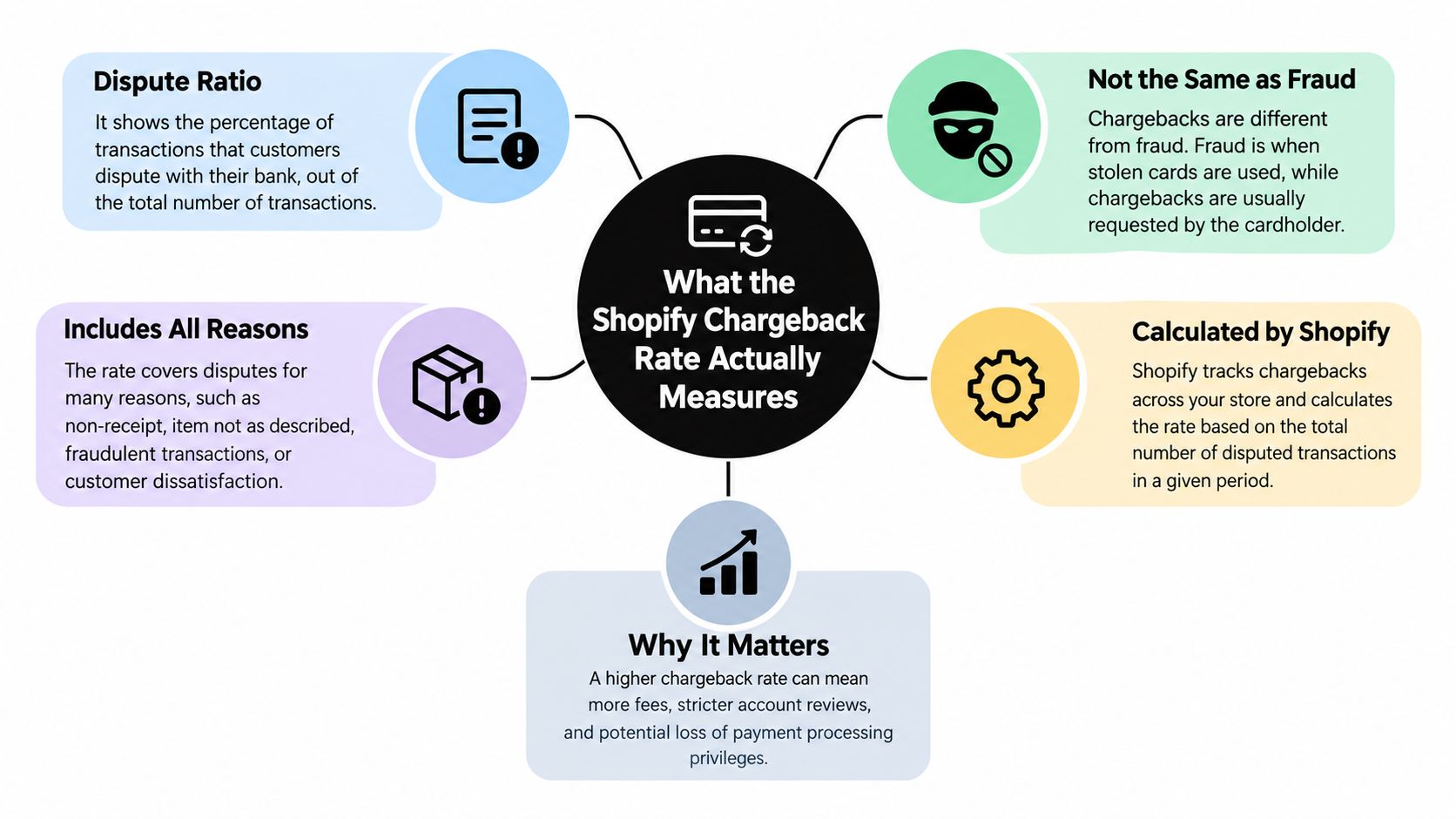
A chargeback rate expresses chargebacks as a share of the relevant transactions. For an operational calculation, use settled card transactions in a defined measurement window, not visits, checkout attempts, or every order created in the admin.
For example, 10 disputes among 1,000 orders equals a 1.0% rate, assuming those orders represent the relevant transaction population. That's arithmetic, not a recommended operating target, as illustrated in this explanation of Shopify chargeback percentages.
Know what Shopify includes
Shopify's standard rate uses chargebacks divided by chargeback-eligible transactions processed through Shopify Payments. Third-party payment-provider transactions are excluded and follow their providers' separate dispute processes.
Shopify also distinguishes an NDRP-inclusive rate, which includes disputes automatically resolved through eligible network programs. That metric can affect monitoring, reserves, account standing, and feature eligibility, so a lower standard rate doesn't necessarily describe all the exposure Shopify evaluates. These definitions and consequences are explained in Shopify's chargeback-process documentation, which also states that every filed dispute counts regardless of outcome.
Before comparing reports, label each calculation:
- Population. Which payment routes and eligible transactions are included?
- Dispute type. Does the numerator include formal chargebacks, automatically resolved disputes, or both?
- Window. Which transaction and dispute dates does the report use?
Not every dispute has an evidence window
A network dispute-resolution program can resolve an eligible dispute before it becomes a formal chargeback, automatically reimbursing the customer. Shopify says merchants can't contest these cases or submit evidence, and the normal evidence-submission window doesn't apply. See Shopify's network dispute-resolution explanation.
That creates a real trade-off: an earlier resolution path isn't the same thing as an opportunity to prove the transaction was valid.
Keep fraud-coded disputes visible separately from general disputes as well. A store's delivery complaints and suspected unauthorized purchases may require completely different controls, even when both contribute to a dispute metric. A percentage becomes useful only after you understand its numerator, denominator, and reporting window.
How Card Networks Actually Monitor Shopify Chargebacks
There isn't a standalone, universal Shopify chargeback-rate limit for every merchant. Card networks and acquiring partners apply their own monitoring rules. Keep the rate as low as possible and confirm the applicable program with your acquirer rather than treating an online benchmark as your store's rule.
Visa's monitoring calculation can combine TC40 fraud reports and TC15 disputes over TC05 settled transactions. Issuer-reported fraud can therefore change the picture even when your internal chargeback count appears manageable. The calculation structure and program distinctions appear in Moneris's fraud and chargeback monitoring guidance.
How card networks monitor Shopify chargebacks
| Network | Calculation shape | Threshold reference | Key nuance |
|---|---|---|---|
| Visa | Applicable monitoring can combine fraud reports and disputes over settled transactions | Confirm the region and program with your acquirer | A disputes-only report can miss issuer-reported fraud |
| Mastercard | Current-month chargebacks against preceding-month captured payments | Confirm the applicable Excessive Chargeback Program requirements | The numerator and denominator come from different months |
| Shopify Payments reporting | Eligible Shopify Payments transactions, with standard and NDRP-inclusive views | Review account-specific communications | The displayed metric isn't a consolidated report across every provider |
The monthly timing matters. Visa uses disputes or fraud from the same calendar month against payments in that month, while Mastercard uses the current month's chargebacks against the previous month's captured payments. Networks generally count financial disputes regardless of reason; an inquiry that never escalates to a financial dispute is excluded, according to card-network monitoring documentation.
Counts matter alongside the ratio
Mastercard's Excessive Chargeback Program combines rate requirements with minimum dispute counts. Shopify's published explanation describes standard and higher tiers with escalating fines, demonstrating why merchants need to watch absolute volume as well as percentage. Review Shopify's explanation of chargebacks and network consequences with your acquiring partner rather than using a generic health band.
A blended storewide rate can conceal a concentrated problem on one card network.
For a growing store, track the network denominator carefully. A rising order count doesn't make a concentrated dispute cohort harmless, and a falling transaction count can change a ratio without an equivalent increase in disputes. Build your merchant chargeback protection process around the applicable calculation, not just the headline dashboard.
Where Bad Traffic Meets Chargeback Pressure
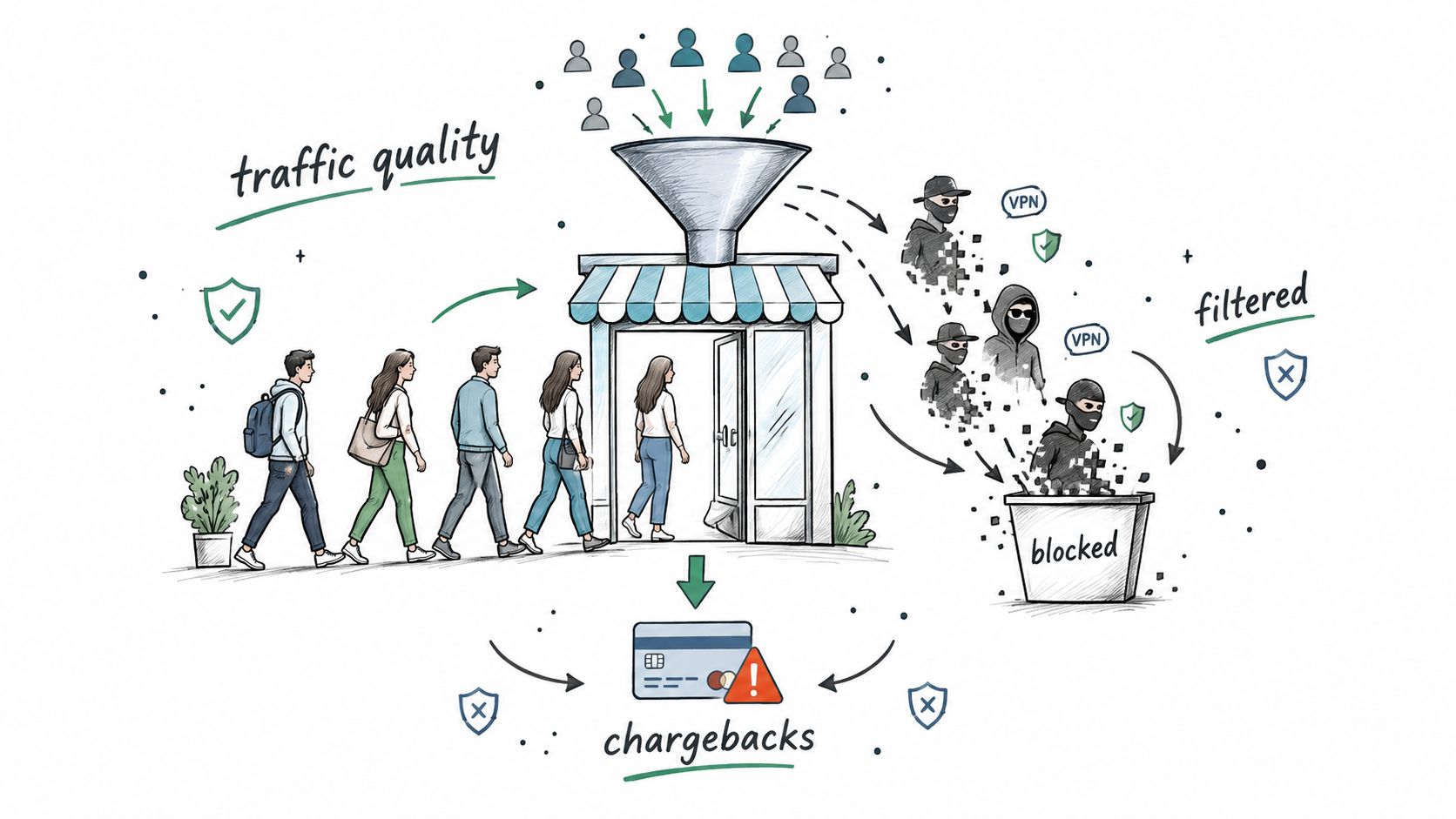
A suspicious storefront session isn't a chargeback. An automated visitor, VPN-masked connection, or visit from a country you don't serve is an upstream signal, not proof that a payment will become a dispute.
The useful connection is at the order level. Preserve the session context, link it to the completed transaction, and compare disputed orders with genuine orders from the same campaign or product cohort.
Compare patterns before writing rules
Suppose disputed orders share masked access, inconsistent device behavior, and repeated delivery details. That combination gives an ops team a stronger reason to investigate than a VPN flag alone.
Use these connections when reviewing a cohort:
- Session continuity. Does the browsing and checkout behavior form a coherent customer journey?
- Payment and address consistency. Do the billing, shipping, and order details support the purchase?
- Post-purchase records. Do delivery proof, support messages, and refund history explain the customer's complaint?
- Reason-code alignment. Does the alleged problem match what happened before checkout or after fulfillment?
The deeper reads on Shopify fraud analysis, Shopify high-risk orders, and bot traffic and VPN abuse help separate those review tasks.
Clean-looking customers can still dispute
First-party misuse, often called friendly fraud, involves legitimate-looking purchases that are later disputed. It's distinct from using stolen card details, as discussed in the Federal Reserve Bank of Kansas City's payments research.
That's why obvious-bot blocking isn't a complete chargeback strategy. A real customer can pass the storefront checks and still create a downstream dispute.
Review principle: Use traffic signals to narrow an investigation, not to declare every masked or international visitor fraudulent.
A Shopify traffic checker belongs in that upstream investigation. The decision to restrict access should still reflect your service area, documented abuse patterns, and the cost of excluding genuine buyers.
Operational Moves That Lower the Shopify Chargeback Rate
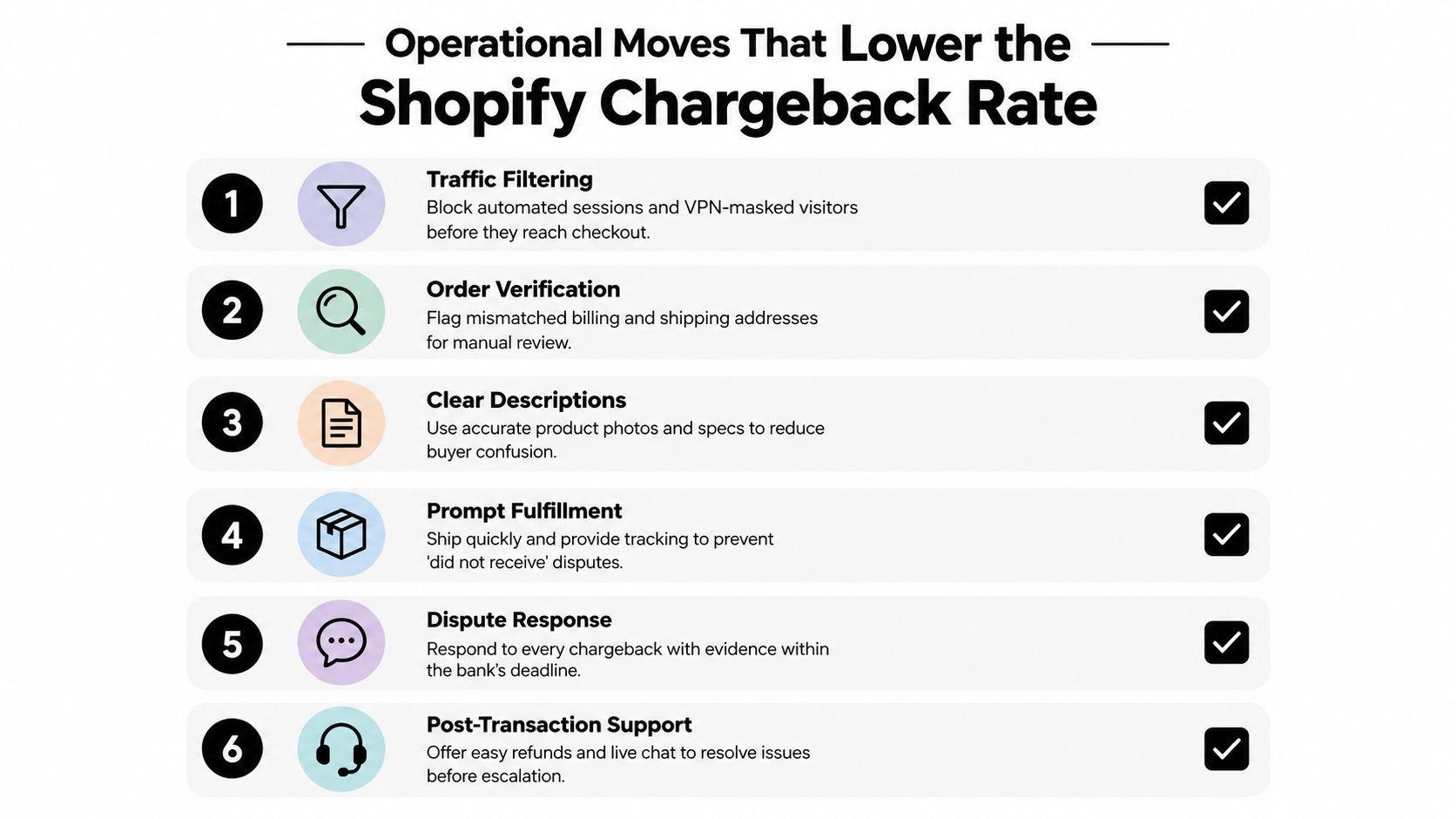
Match the control to the dispute reason. If customers are disputing missing deliveries, spend your first effort on fulfillment exceptions and support. If unauthorized-purchase claims cluster around suspicious checkout behavior, review access and transaction controls.
Don't deploy every restriction at once. You'll struggle to tell which change helped, and the team won't know whether legitimate customers are being rejected.
Tighten access and order review deliberately
Use traffic filtering and geographic rules where you have a defensible reason, such as documented automated abuse or destinations your store doesn't ship to. Avoid using geography as a substitute for reviewing the transaction.
For payment checks, ask your provider which AVS, CVV, 3DS, and velocity controls your configuration supports. Treat check results as evidence for a decision, not a guarantee of customer intent. A billing-shipping mismatch deserves context, especially when the purchase could reasonably be a gift.
Write the review policy down. Specify what triggers a hold, what evidence clears it, and who can release the order. A structured customer risk assessment is more useful than asking reviewers to make unexplained judgment calls.
Remove avoidable post-purchase friction
- Preserve delivery records. Keep tracking, delivery confirmation, and the destination attached to the order.
- Make the purchase recognizable. Review product descriptions, specifications, and the statement descriptor against the brand customers remember.
- Resolve support exceptions. Give delayed shipments and refund requests an owner instead of leaving them between support and fulfillment.
- Record refunds clearly. Keep the customer communication and payment record together so the team can reconstruct what happened.
Use the chargeback fraud prevention guide to organize prevention work, and the manual fraud review burden guide when holds are overwhelming the fulfillment queue.
Keep recovery separate from prevention
For contestable disputes, assemble evidence that addresses the actual claim and work to the deadline shown for that case. Don't submit a generic pile of documents or assume every dispute permits a response.
For a separate legal perspective on seller recovery, LA Law Group, APLC's LA Law Group seller recovery resource provides an additional reading path. It isn't a substitute for your Shopify case requirements.
Winning may recover disputed funds, but it doesn't undo the filed-dispute count described earlier. Measure the recovery workflow separately from the work that prevents the next dispute.
Monitoring the Rate So It Never Sneaks Up on You
Build a repeatable weekly review rather than another dashboard nobody owns. The review should answer whether new disputes are concentrated, whether transaction volume changed, and whether the last operational adjustment addressed the intended pattern.
Start with a ledger that connects each dispute to its original transaction. Keep the filing date for monitoring and the purchase date for cohort analysis; those are different questions.
Reconcile before comparing
Separate payment provider, payment method, and checkout experience in your records. For example, don't assume a Shop Pay label represents a separate processor denominator. Trace the actual processed transaction before combining reports.
For Shopify Payments, PayPal, buy-now-pay-later routes, and other gateways, use provider-level records to construct a consolidated view. Deduplicate by transaction identity rather than adding every order total and every processor total together.
Then run a compact review:
- Check count and rate. Look at new disputes alongside the applicable transaction denominator.
- Slice the activity. Review card network, geography, product line, acquisition channel, and payment route.
- Read the reasons. Separate suspected unauthorized purchases from delivery, product, billing, and refund complaints.
- Connect the cohort. Pull session, device, fulfillment, and support records for the concentrated group.
- Record the action. Name the rule or workflow change, its owner, and what you'll examine next.
Set alerts against applicable rules
Ask your acquirer which monitoring requirements apply, then set alerts using those requirements and meaningful changes in your own activity. Don't create an invented good-or-bad percentage band.
Keep a separate recovery view for case outcomes and recovered funds. The operational review should prioritize new dispute incidence, not let a strong representment result hide a continuing prevention problem. A simple, reconciled report that someone acts on is more valuable than an aggregate rate the team checks only after a warning email.
Where Securify Fits
Securify is a Shopify-first traffic-quality and access-control option, listed as Country Blocker Fraud Securify. Securify on the Shopify App Store describes the upstream layer: bot blocking across storefront sessions, VPN and proxy detection, geo-blocking rules, and catalog and price-scraping protection.
It operates before or alongside Shopify Fraud Analysis, not as an integration with that feature. Traffic classification distinguishes bad bots, suspicious sessions, and real visitors, while the no-signup Store X-Ray scan offers an initial traffic-quality assessment.
A different job from transaction review
Shopify's native order-review tools support transaction decisions; upstream access controls address who reaches the storefront. Native integrations with Shopify, Klaviyo, Gorgias, and Judge.me extend filtering to connected email, support, and review workflows.
Use this layer when questionable traffic is part of the investigation. It doesn't replace fulfillment records, customer support, or reason-specific evidence, and it doesn't provide chargeback guarantees, insurance, dispute handling, or reimbursement.
Chargeback Rate Questions Shopify Merchants Actually Ask
Why is my Shopify chargeback rate lower than my processor's dispute report?
Check whether the reports cover the same payment routes, dispute populations, and dates. Shopify's standard reporting scope is narrower than a consolidated storewide ledger, so reconcile individual transactions before concluding that either report is wrong. Also check whether one report includes network-resolved disputes while the other excludes them.
What does NDRP-inclusive mean for my account?
It broadens the dispute population beyond formal chargebacks alone. As explained earlier, Shopify can use that metric when evaluating account standing and related controls. Read the account communication and confirm the dispute path instead of assuming automatically resolved cases have no operational consequence.
Can friendly fraud happen even when checkout looks normal?
Yes. A normal-looking session doesn't establish what the customer will claim after purchase. Preserve the transaction, delivery, and communication records, and avoid treating every dispute as evidence that your traffic filtering failed.
What should I do first when chargebacks spike in a week?
Review the affected orders and any similar orders awaiting fulfillment. Assign someone to check case deadlines while another person investigates shared acquisition, payment, and delivery patterns. Make targeted containment decisions rather than applying storewide blocks before you know the cause.
Where should I start if I need to resolve a payment dispute?
Start with the provider that processed the transaction and the instructions attached to the case. For an additional dispute-resource page, AmaJova's resolve a payment dispute is a separate reference. Don't assume an outside resource changes your provider's evidence requirements or makes an automatically resolved case contestable.
Securify offers traffic classification, bot blocking, VPN and proxy detection, and geographic access controls for Shopify stores. Visit Securify to run the no-signup Store X-Ray scan, then compare the suspicious traffic it identifies with your disputed-order cohorts before changing access rules.