
· chargeback protection · merchant chargeback protection · Shopify chargeback · fraud prevention · dispute representment
Merchant Chargeback Protection for Shopify Stores
A practical guide to merchant chargeback protection for Shopify stores. Learn how chargebacks work, service types, evidence rules, and upstream traffic
You usually don't notice merchant chargeback protection until the mess is already real. The orders looked normal enough at first, then a pile of risky checkouts showed up overnight, the same names started disputing cards weeks later, and now you're deciding whether to fight, refund, or eat the loss while tomorrow's orders keep coming in.
That's the job: protect the store before the dispute lands, then be ready to answer it with evidence that fits the reason code. If you treat chargebacks as a payment-page problem only, you'll miss the upstream traffic that caused half the damage.
Table of Contents
- What Merchant Chargeback Protection Actually Means
- How a Chargeback Moves Through the System
- The Three Layers of Chargeback Protection
- Building an Evidence Package Before the Dispute Arrives
- When to Refund, Contest, or Absorb the Loss
- Why Bad Traffic Is a Chargeback Problem
- Metrics Worth Tracking Month by Month
- Where Securify Fits
What Merchant Chargeback Protection Actually Means
The blunt version is this. Merchant chargeback protection is the full stack a Shopify operator uses to keep bad orders from turning into expensive disputes, and to defend the good ones when a chargeback still lands. It is not one app, one score, or one refund policy.
A merchant can get hit in three ways. First, a criminal uses stolen card data. Second, a real customer files a dispute after receiving the order. Third, the buyer abuses refunds, subscriptions, or policies and then escalates anyway. Protection has to cover all three, or it's incomplete.
The stack starts before checkout
The strongest setups don't wait for a chargeback notice. They filter suspicious traffic, apply payment-stage checks, and preserve evidence at order creation so the response file already exists when the dispute arrives. That matters because the October 1, 2015 EMV liability shift changed who eats counterfeit card-present fraud, and it made technology choice part of the liability question, not just an operations detail. The Federal Reserve review also noted that the proposed $25 chargeback threshold would cover 36% of U.S. domestic counterfeit chargeback transactions but only 5% of counterfeit-fraud payment volume, with expected reductions of 4% in transactions and 11% in dollars Visa best practices review.
Practical rule: if the evidence doesn't exist at order time, your odds get worse fast.
The right mental model is simple. Protection starts with traffic quality, then payment authentication, then dispute evidence. If you skip the first layer, the next two end up doing too much damage control.
How a Chargeback Moves Through the System
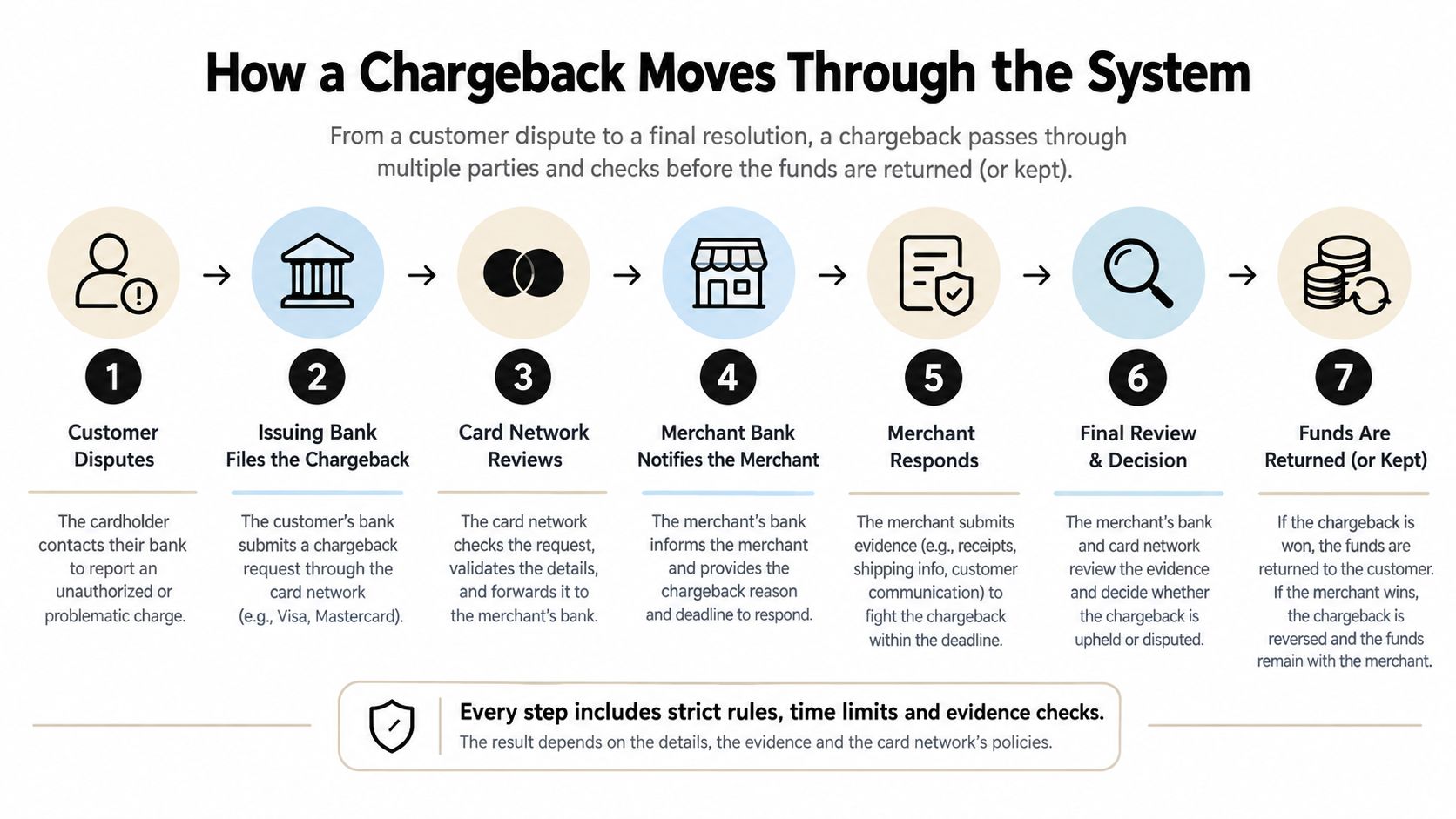
A chargeback starts before it ever reaches your admin. The cardholder contacts the issuer and files a billing-error notice, the issuer assigns a reason code, and the case moves through the network. By the time the acquirer notifies you, the clock is already running.
The merchant window is short
Stripe says merchants usually have 7–21 days to respond, depending on the network, and the issuer's review can take another 60–75 days Stripe dispute timing. Mastercard says the response has to address the reason code directly, and acquirers often give merchants less than 30 days to answer Mastercard dispute guidance.
That is why waiting to pull screenshots later is bad operations. Later is usually too late. If the right records were not stored when the order was created, the case gets rebuilt from scraps.
The reason code is the point
The reason code tells you what the issuer believes went wrong. Fraud, non-receipt, cancellation, or something else. Your rebuttal has to answer that exact claim. A generic paragraph wastes time and usually loses.
Keep the response narrow. Match the code, match the proof, and do not overexplain.
A chargeback is a timed evidence contest. The merchant with cleaner transaction history and better documentation usually has the stronger case.
The Three Layers of Chargeback Protection
A Shopify merchant needs three layers, not one. Payment-stage controls stop bad orders at checkout. Representment tools help answer disputes after they open. Upstream traffic-quality controls reduce the junk that creates the mess in the first place.
| Layer | Where it acts | What it covers | Main trade-off |
|---|---|---|---|
| Payment-stage controls | Checkout | Authentication signals, AVS, CVV, and risk checks like 3DS | More friction for some buyers |
| Representment and evidence services | After the dispute opens | Reason-code-specific rebuttals, records, and deadline management | Labor and process overhead |
| Upstream traffic-quality tools | Before checkout | Bots, VPNs, proxies, geo-mismatched visitors, and card-testing traffic | False positives if rules are too blunt |
Shopify's built-in fraud signal helps at checkout, but it doesn't fix bad traffic coming in through the front door. That's where an upstream filter belongs, alongside the other controls in the stack. If you want a practical angle on blocked payments and downstream billing mess, the involuntary churn failed payments dunning discussion is useful because it shows how payment failures and customer follow-up can shape dispute volume.
Don't overbuy one layer
3DS can help shift liability on eligible fraud cases, but it won't solve subscription failures, non-receipt, or first-party misuse. Representment can win disputes, but it doesn't stop abusive traffic from inflating review queues. Upstream blocking can cut noise, but it doesn't replace evidence or authentication.
For Shopify operators, the smartest move is to connect the layers. Use upstream controls to keep the funnel clean, payment-stage checks to catch risky orders, and evidence discipline to defend the cases worth fighting. The details in Shopify Protect are useful for understanding where checkout-time controls end and broader risk management begins.
Building an Evidence Package Before the Dispute Arrives
Most merchants lose representment before they ever write the rebuttal. They wait until the chargeback lands, then try to assemble proof from systems that no longer line up. By then, the useful trail is scattered or gone.
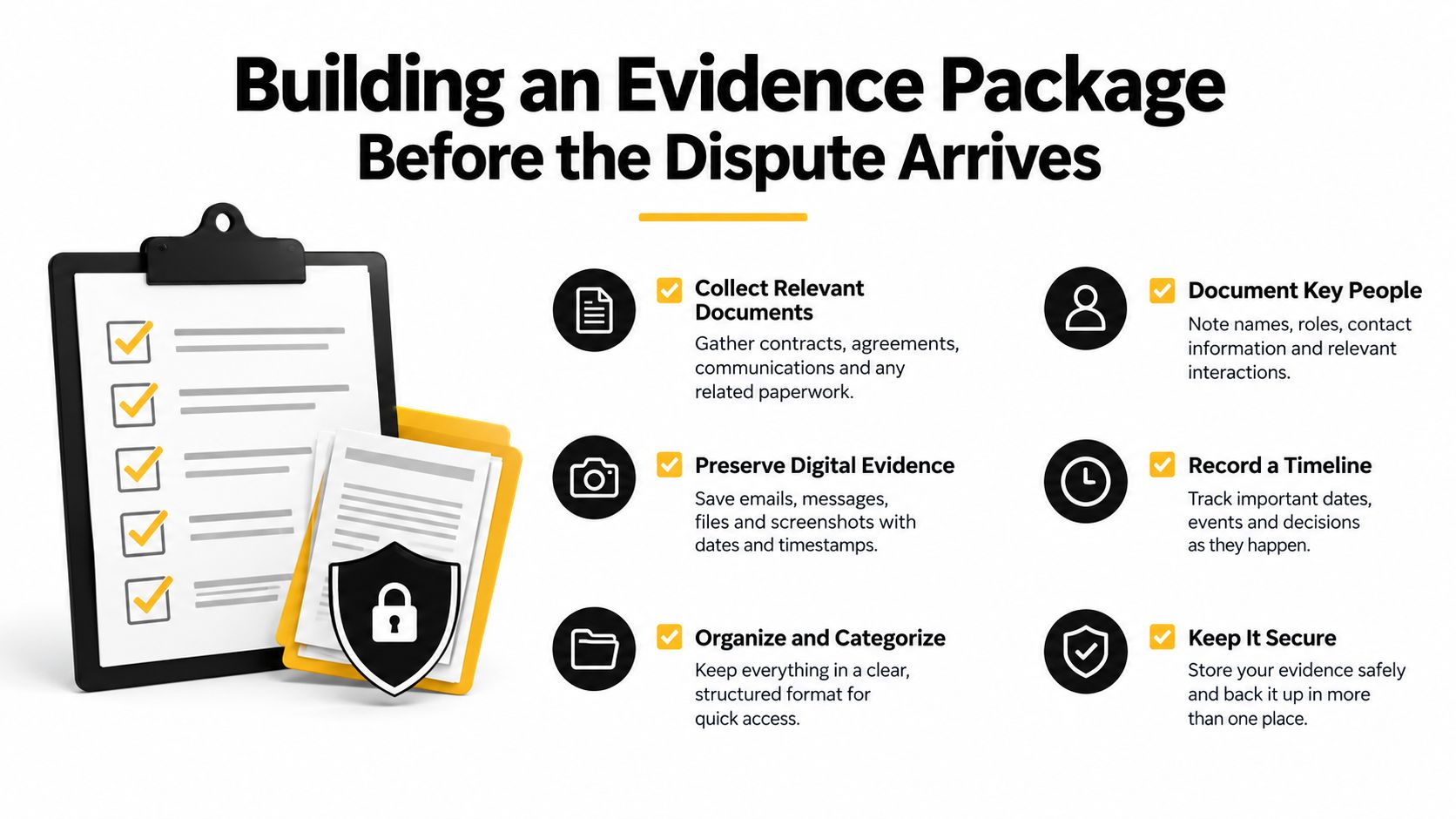
Store the records at order creation
Every order needs a retrievable evidence trail. Capture authorization details, the 3DS authentication result and reference data, AVS and CVV outcomes, IP and device signals, account and login history, customer messages, shipment tracking, delivery confirmation, and prior undisputed transactions with the same card. If those records sit in separate tools and never get tied back to the order, the case starts from a disadvantage.
Operational truth: fulfillment proof helps, but it does not carry the case by itself.
Answer the reason code, not the emotion
Use evidence that matches the dispute reason. For non-receipt, shipping and delivery proof need to be tight. For fraud, authentication and device history matter more. A long explanation does not fix the wrong document set Mastercard dispute guidance.
The billing-error clock also matters. The CFPB says the cardholder generally has 60 calendar days from the statement date to send notice, the issuer generally has 30 days to acknowledge it, and the investigation can run up to 90 days under Regulation Z CFPB billing-error rights. A dispute can easily outlast the shipment, the delivery, and the refund window.
Log the evidence when the order is created. If you wait for memory, you are already behind.
When to Refund, Contest, or Absorb the Loss
The wrong question is, “How do I stop all chargebacks?” The useful question is, “Which disputes are worth fighting, and which ones are cheaper to close out now?” That's the decision merchants make every week.
Use a four-question test
Start with four checks. What is the order value after fulfillment cost? How much labor will representment take? What customer lifetime value are you risking if you fight? And how strong is the reason-code-specific evidence?
If the answer is weak on three of the four, refunding is often cheaper than fighting. If the order is small, the evidence is thin, and the customer is low value, you're usually paying for a bad moral victory. On the other hand, a well-documented high-value order with clean fulfillment proof is a better contest candidate.
The 2025 Merchant Risk Council data reported by The Paypers said six in ten merchants saw first-party misuse increase, and 57% reported rising refund or policy abuse The Paypers on first-party misuse. That's why you can't lump every dispute into “fraud.” Some are straight abuse. Some are buyer confusion. Some are fulfillment failures that should never have become chargebacks.
Fight selectively, not automatically
Blanket representment wastes time. Blanket refunds leak money. The right pattern is segmented response.
If the customer has a clean history and the issue is a service failure, fix it fast. If the story changed after delivery and the evidence is strong, contest it. If the economics are bad either way, absorb the loss and protect the relationship.
For a deeper framework on dispute type and evidence strategy, the chargeback fraud prevention article is a good companion. The goal is not to “win” every case. The goal is to keep your losses rational.
Why Bad Traffic Is a Chargeback Problem
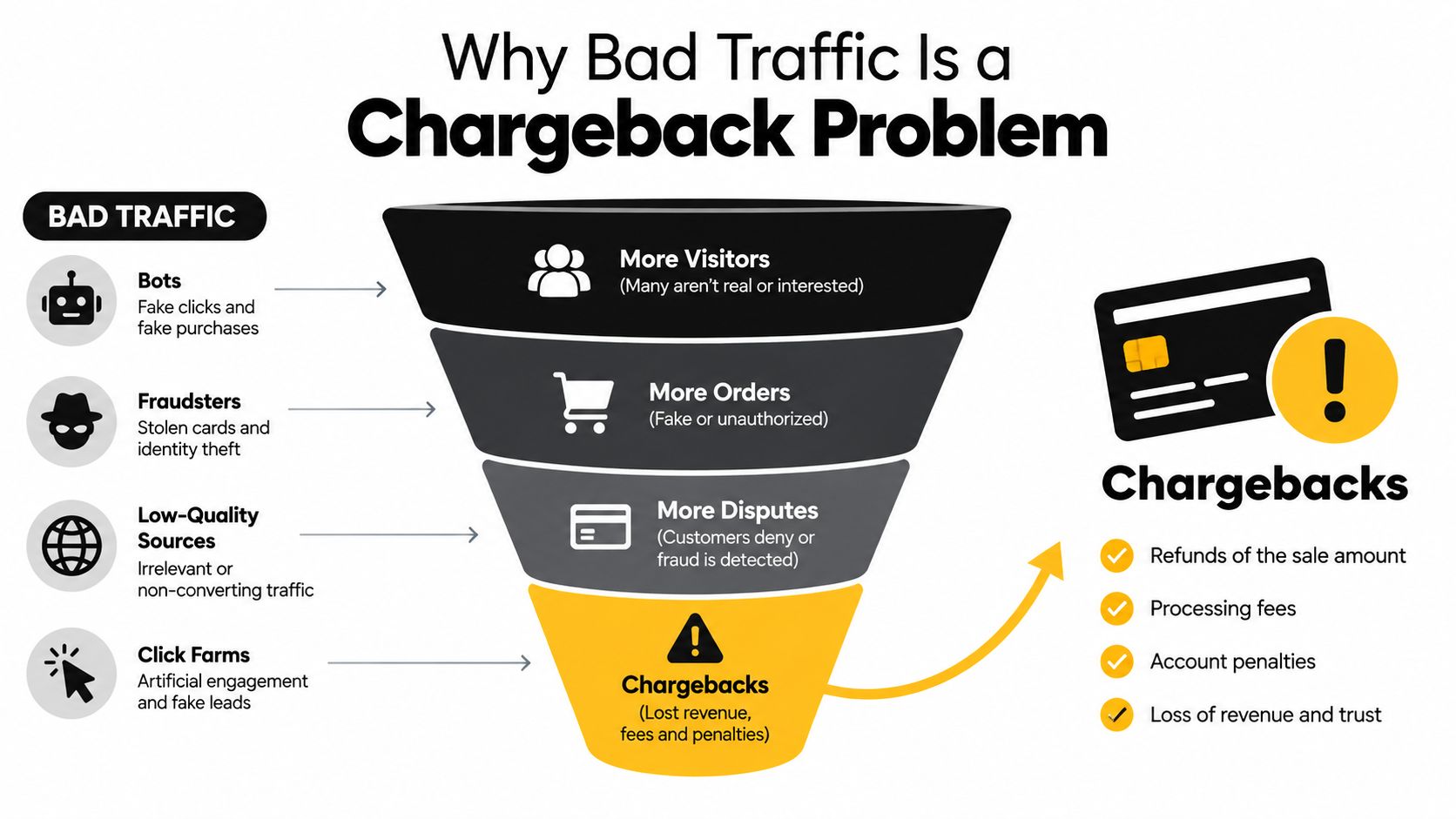
Most merchants treat chargebacks like they begin at the payment gateway. They don't. They begin with the traffic that gets to checkout in the first place.
Bad sessions create bad orders
Bots test cards, proxies hide origin, geo-mismatched visitors show up outside your shipping reality, and automated sessions pollute the funnel so the true risk signals get buried. Not every masked visitor is fraudulent, and not every overseas buyer is a problem, but you still need rules that separate suspicious traffic from legitimate demand.
Upstream filtering saves time. If you stop abusive sessions before checkout, you reduce manual review, keep analytics cleaner, and prevent a chunk of the dispute load from ever existing. That is not a theory, it is how operations teams keep the queue from getting stupid.
Small rate changes can hide big exposure
Sift reported the average chargeback value reached $361.31 at one point in Q3 2025, even as the average rate moved around during the year Sift disputes report. That matters because a small shift in rate can still mean a meaningful dollar problem if the ticket value is high enough.
The other reason to care is measurement noise. If you let abusive sessions into the store, they distort conversion, email capture, and fraud review workload. Then you're making decisions off dirty data. The bots and proxies guide goes deeper on how to separate masked traffic from real shoppers without treating every foreign visitor like a criminal.
Metrics Worth Tracking Month by Month
You don't need a flashy dashboard. You need a few boring metrics that tell the truth.

Track the numbers that change decisions
Watch chargeback-to-order ratio as the headline metric, but don't stop there. Break out dispute volume by reason code so you can tell fraud from friendly fraud from fulfillment failures. Track representment win rate, manual fraud-review workload per week, and the share of sessions flagged as bots, proxies, or geo-mismatched before checkout.
That reason-code split matters more than the headline ratio because it tells you what kind of problem you have. A rising fraud dispute count calls for different controls than a spike in non-receipt or cancellation claims. If the mix changes, your response should change too.
Monitor the trend, then act on the cause. The ratio is the headline, not the diagnosis.
Visa's 1% and Mastercard's 1.5% monthly chargeback-ratio points are monitoring markers, not badges of honor or failure Visa and Mastercard monitoring points. Keep your number as low as possible and use the trend to decide where to tighten controls.
Keep a short monthly review
- Review dispute mix: Separate fraud, first-party misuse, and service issues.
- Check evidence quality: Make sure order, shipment, and auth data are attached.
- Watch review load: If manual reviews are spiking, upstream traffic is probably leaking through.
- Audit clean-session share: If bad traffic rises, your conversion data is getting noisy.
- Compare outcomes: If representment wins fall, your evidence package probably got weaker.
The point is not to chase a perfect score. The point is to build fewer, cleaner disputes with better documentation.
Where Securify Fits
A chargeback rarely starts at the payment stage. It usually starts with bad traffic that reaches checkout in the first place. Securify sits in that upstream control layer. On the Shopify App Store, it appears as Country Blocker Fraud Securify, and its job is to block bot traffic, VPN abuse, fake visitors, and suspicious sessions before they turn into risky orders. If you want to review the listing, start with Securify on the Shopify App Store.
That placement matters because traffic quality shapes everything downstream. When weak sessions never make it to checkout, analytics stay cleaner, manual review stays lighter, and fewer junk orders end up in dispute work later. Securify works before or alongside Shopify's own checkout risk signal, which is the right place to control noise instead of reacting to it after the fact. For support scripts and measurement tips, support scripts and measurement tips is worth keeping on hand when you need to refund or push back on an order.
Does 3DS eliminate chargebacks?
No. 3DS can shift liability for eligible fraud reason codes when the authentication result qualifies, but it does not cover first-party misuse, subscription failures, non-receipt claims, or every card and region.
How long should a merchant keep evidence?
Keep records long enough to cover the dispute and billing-error window. The CFPB says a cardholder generally has 60 days to send the notice, then the issuer generally has 30 days to acknowledge it and up to 90 days to finish the investigation. Hold the order, fulfillment, and communication records well past the shipment date so you are covered end to end.
Will blocking VPN and proxy traffic hurt international revenue?
It can if you are sloppy. Separate masking and abuse from legitimate cross-border demand, then apply rules that target suspicious patterns instead of every overseas visitor. Good filters are selective, not blind.
What if the same customer files multiple disputes?
Treat that as a pattern, not a one-off. Pull the full order history, compare the reason codes, and check shipping, contact attempts, refund history, and device or IP signals. If the evidence points to repeated abuse, tighten controls and document the behavior. If the customer had a real service issue, fix the process instead of stacking more disputes on top of it.
If you want to cut chargebacks without drowning your team in manual review, start with traffic quality, evidence discipline, and tighter upstream controls. Securify helps Shopify merchants filter bad sessions before they become bad orders, which is the part of merchant chargeback protection most stores ignore until it is already costing them.