
· e-commerce fraud prevention · Shopify fraud · chargeback prevention · DTC risk management · bot traffic
E-commerce Fraud Prevention for Shopify
Master e-commerce fraud prevention for your Shopify store. Learn to spot risky orders, reduce chargebacks, and build a layered defense that protects revenue.
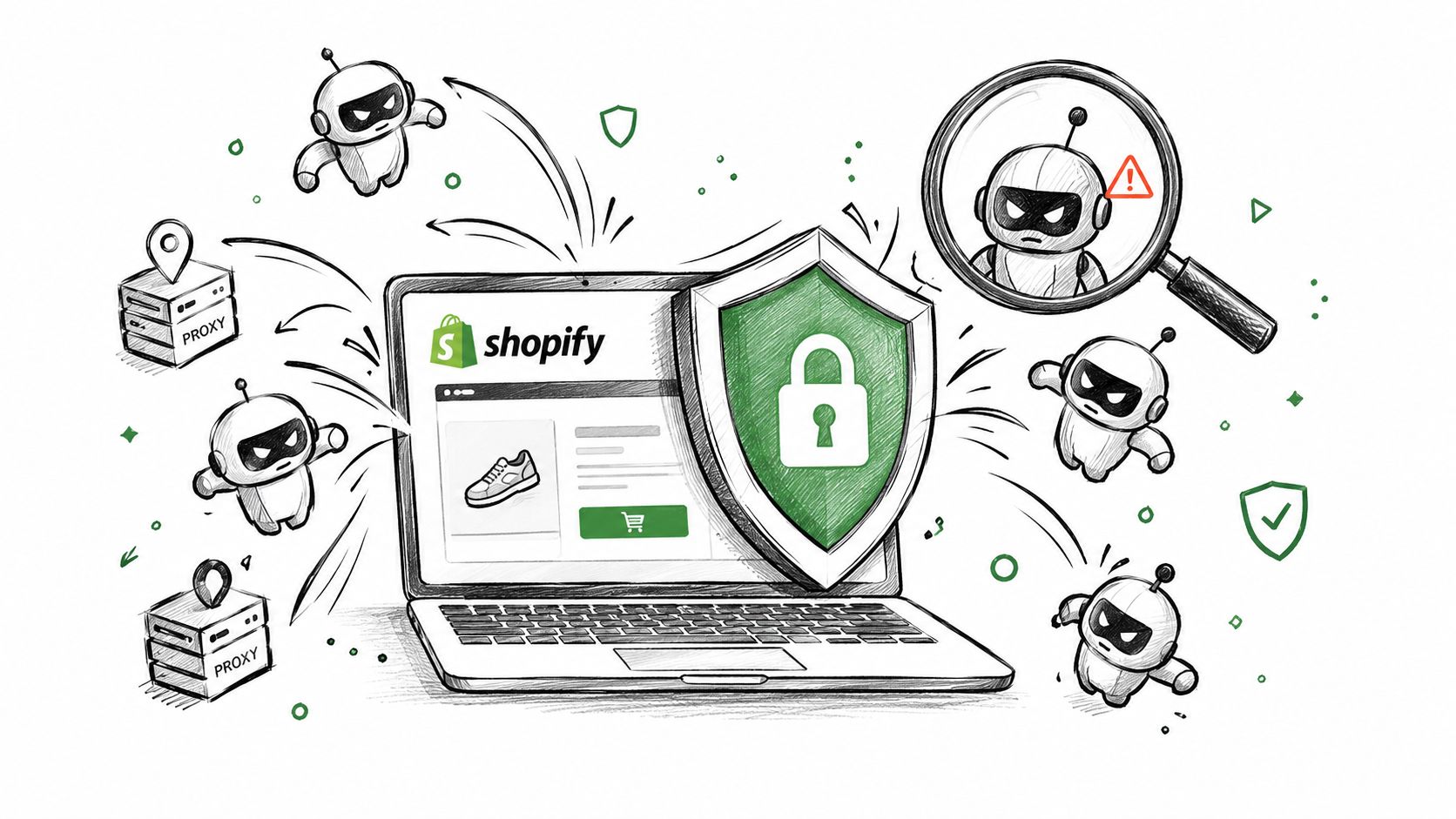
Most merchants are told to treat e-commerce fraud prevention as a checkout problem. That advice is too narrow. By the time a bad order reaches payment, the store may already be dealing with bot sessions, fake accounts, noisy analytics, support waste, and refund abuse that never shows up in a clean loss report.
For Shopify operators, the actual cost starts earlier. Fraud changes traffic quality, pollutes email and review systems, and creates operational drag long before a chargeback lands. The stores that hold margin together don't just block bad cards, they control the conditions that let bad actors keep reaching the funnel.
Table of Contents
- The Hidden Operational Cost of E-commerce Fraud
- Common Fraud Types Targeting Shopify Stores
- Evaluating Shopify Native Fraud Analysis Tools
- Building a Layered E-commerce Fraud Prevention Strategy
- Measuring Traffic Quality and True Conversion Rates
- Where Securify fits
- Frequently Asked Questions About E-commerce Fraud
The Hidden Operational Cost of E-commerce Fraud
A lot of teams only notice fraud when finance flags disputes. That's late. The more expensive damage usually shows up in the work around the order, not just the order itself.
When fake sessions, carding bursts, or coordinated abuse hit a store, they distort the numbers that drive decisions. Marketing reads polluted traffic as demand. Operations over-prepare inventory. Support spends time on strange tickets that should never have been created. Even if a merchant never sees a big monthly loss figure, the business still pays in labor, bad forecasting, and broken signals.
Fraud is not only a payment event
The European Central Bank's data makes the point clearly. In 2021, cards issued in the Single Euro Payments Area generated €5.40 trillion in transactions, and €1.53 billion was fraudulent, which was 0.028% of total transaction value, with card-not-present fraud representing about 84% of total card-fraud value. ECB card fraud report That gap between the percentage and the absolute loss is exactly why merchants can't dismiss fraud as “small.”
Practical rule: if bad traffic can reach your storefront, it can contaminate more than payments.
This is why upstream controls matter. A store that lets bot visits, proxy traffic, and suspicious account creation run unchecked ends up with bad data in analytics, email capture, and review workflows. Fraud prevention that starts only at checkout misses the most expensive part of the mess, the part that wastes human attention.
The operational bill shows up everywhere
The FTC's online-shopping fraud reports show that consumer harm is still material, with more than 387,000 reports in 2024 and reported losses of $434.4 million. FTC online-shopping fraud report Even without turning that into a merchant-specific benchmark, it tells you the problem isn't hypothetical.
On a DTC team, the hidden cost usually lands in five places:
- Support queues fill with suspicious order questions, refund requests, and “where is my order” tickets that trace back to bad actors.
- Fulfillment burns labor on orders that later get disputed or rerouted.
- Analytics get inflated by junk visits and false engagement.
- Email lists absorb fake signups that weaken segmentation and campaign performance.
- Manual review becomes a permanent tax on the ops team.
That's why fraud should be handled as traffic quality plus payment risk, not just payment risk. A merchant who sees the whole funnel can decide where to block, where to challenge, and where to preserve conversion.
Common Fraud Types Targeting Shopify Stores
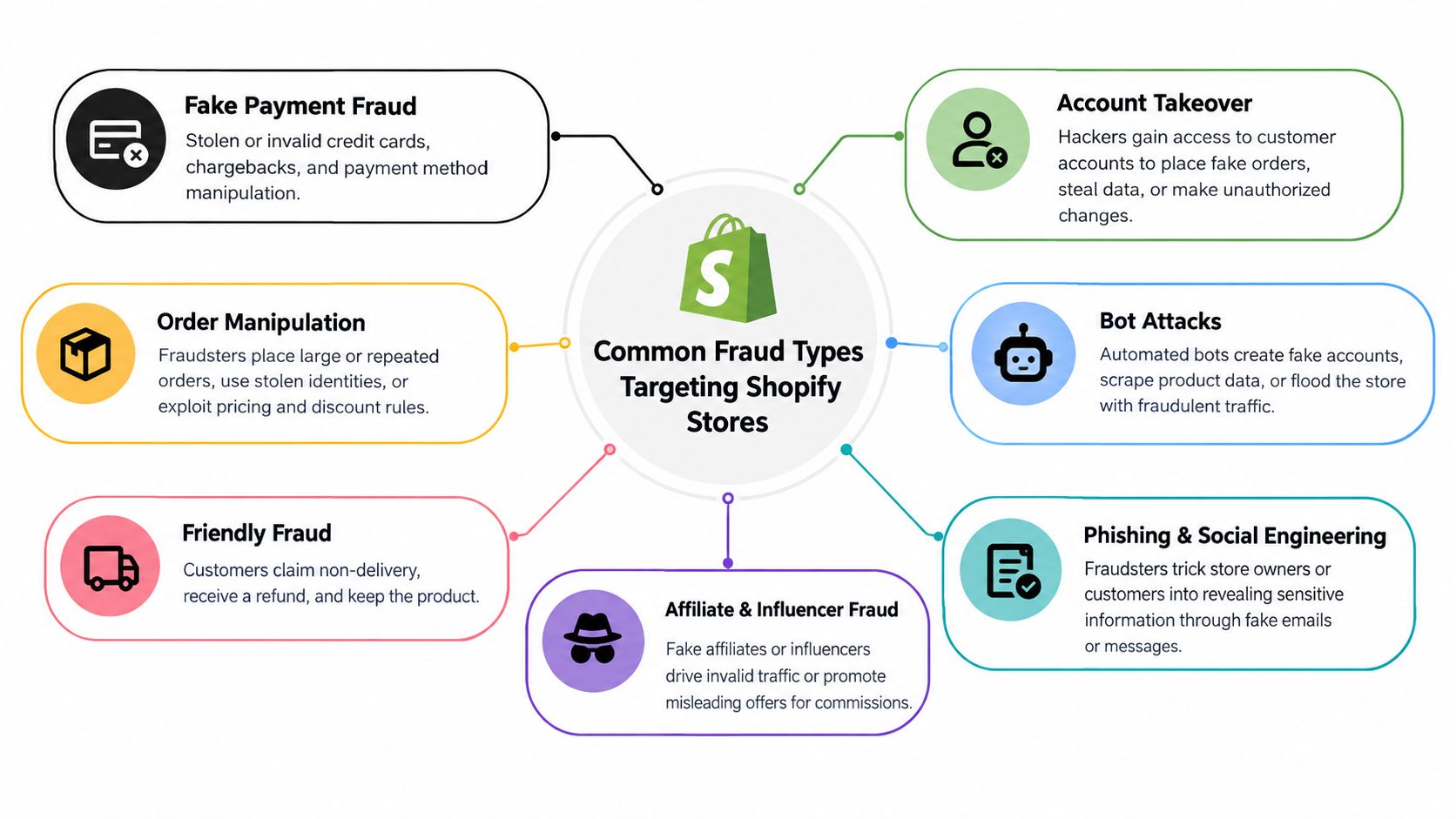
Fraud on Shopify usually shows up as a mix of bad intent, not one clean event. Credential abuse, low-value testing, refund exploitation, and location masking often arrive together. The store owner sees checkout friction, distorted analytics, and extra work in support and fulfillment long before a chargeback lands.
Carding and low-value testing
Carding uses bots to test stolen card data with small transactions. Stripe describes this as small transactions used to check whether a card is active. A burst of low-value checkout attempts can be abuse at scale, not ordinary browsing. Stripe on carding
Repeated checkout starts, multiple payment attempts, and clusters of related devices or sessions deserve review. The goal is to cut off the noise before it turns into payment waste, processor scrutiny, and a pile of false signals in your reporting.
Refund abuse, policy abuse, and fake orders
Post-purchase abuse often slips through because it does not start with a stolen card. In the 2025 Global Payments and Fraud Report, merchants identified refund abuse as their top fraud attack, and many also said refund or policy abuse rose over the prior year. MRC 2025 Global E-commerce Payments and Fraud Report A store can look fine at checkout and still lose money through returns, claims, and avoidable fulfillment work.
Fake orders usually fall into two buckets. Some are placed to validate stolen payment details. Others are built to create shipment costs, support tickets, or return abuse. A clean payments screen will miss one of those paths.
For a practical breakdown of that pattern, see our guide on how to stop fake orders on Shopify.
VPNs, proxies, and masked geography
Masked traffic creates a different kind of risk. A buyer can appear local while routing through another country or network. That matters for shipping rules, regional pricing, and fraud review because the store sees a mismatch between claimed identity and session behavior.
A helpful resource on the broader fraud ecosystem is this white-label monitoring for MSPs article. It gives useful context for how stolen credentials move before they ever reach a storefront.
Traffic that hides its origin deserves more scrutiny than traffic that looks busy.
What the store owner sees
On Shopify, these patterns usually show up as repeatable combinations, not one dramatic signal. You may see multiple names tied to one shipping destination, a failed address check plus unusual network behavior, or a flood of short sessions that never browse like humans. Fraud review works better when you classify those footprints by behavior.
| Fraud type | What it looks like | Where it hurts |
|---|---|---|
| Carding | Small, repeated payment attempts | Processing noise, disputes |
| Refund abuse | Unusual return or policy behavior | Margin, support, fulfillment |
| Fake orders | Low-intent or fabricated checkout activity | Ops workload, analytics |
| Masked access | VPN, proxy, or geo mismatch | Review burden, regional controls |
Evaluating Shopify Native Fraud Analysis Tools
Shopify gives merchants a useful starting point, but the native signals only work if you treat them as evidence, not a verdict. The platform weighs AVS, CVV, location match, unusual device or network activity, and repeated attempts to use more than one card. It then groups orders into low-, medium-, and high-risk buckets after automated analysis. Shopify fraud analysis
Read the signals together
One failed check does not make an order fraudulent. Shopify warns that individual indicators do not define overall risk. A failed AVS check may be a typo. An unfamiliar IP address may belong to a traveling customer. Review the pattern across billing, shipping, device, and payment behavior before you decide.
For a practical reference on the native signals, use the internal guide on Shopify fraud analysis.
Practical rule: approve when the full record makes sense, not when one field happens to look clean.
Build a manual review routine for medium-risk orders
Medium-risk orders are where many stores either overreact or ignore the problem. Both choices cost money.
A repeatable review process keeps emotion out of the decision.
- Check identity consistency. Compare the billing name, shipping name, and account details.
- Review network clues. Look for device or IP behavior that does not fit the customer's normal pattern.
- Inspect purchase shape. A sudden change in order size, quantity, or destination deserves a second look.
- Preserve evidence. Keep the order record, fulfillment record, and customer communication together.
That last step matters because cardholder disputes often become evidence disputes. Visa chargebacks The case is stronger when your team can show what the order looked like at approval, what shipped, and how the customer was handled after purchase.
Don't let tools make you lazy
Native fraud analysis is useful, but it will not rescue weak fulfillment records or sloppy operations. It tells you what looked risky at the moment of approval. It does not explain every dispute after the fact.
For a broader view of how payment data is protected across the stack, see how protects data. Use the native signals as a training baseline. A reviewer who can explain why an order passed is far more effective in a dispute than one who only trusted the risk badge.
Building a Layered E-commerce Fraud Prevention Strategy
Single-point fraud defense breaks under real store pressure. The better model is layered. Traffic quality is screened before checkout, risky payments get extra authentication only when they deserve it, and post-purchase records are preserved so disputes don't become guesswork.
Start upstream, not at payment
The first layer should catch bad sessions before they pollute the storefront. That means blocking known abusive patterns, suspicious geographies, and masked access where the business has a clear reason to do so. If a visitor never belonged in the funnel, there's no reason to let them create noise in analytics or support.
Use checkout friction only where it earns its keep
EMV 3-D Secure is a strong control when it's deployed selectively. The protocol sends issuers far more context than the older version, and it supports risk-based authentication so low-risk orders can stay frictionless while higher-risk orders trigger a challenge. Visa's cited data shows authenticated e-commerce transactions at about 11 basis points of fraud versus 20 basis points for non-authenticated transactions, with authenticated transactions showing roughly 45% lower fraud. EMV 3DS overview
That doesn't mean every order should be challenged. Blanket friction hurts legitimate customers. Use 3DS on the orders that deserve it, such as mismatched billing and shipping data, unusual device or location patterns, or unusually high-value orders.
Keep the dispute file intact
3DS is not a cure for everything. It can help with fraud-related liability shift on eligible transactions, but it won't solve non-fraud disputes or weak fulfillment evidence. The merchant still needs records that show what was checked, what was shipped, and what the customer saw.
Shopify's fraud indicators, especially AVS, CVV, location, and IP details, are useful here because they show what the store knew at approval time. That evidence matters when the dispute process starts.
Fraud control mapping by funnel stage
| Funnel Stage | Control Type | Primary Fraud Mitigated |
|---|---|---|
| Pre-checkout | Traffic filtering, geo rules, bot detection | Bot traffic, masked access, fake sessions |
| Checkout | Risk-based authentication, selective 3DS | Stolen card use, high-risk authorization attempts |
| Post-purchase | Record retention, fulfillment evidence, support logs | Fraud disputes, false claims, fulfillment confusion |
The strongest setup doesn't force every control to do every job. It lets each layer handle the part of fraud it can see.
Measuring Traffic Quality and True Conversion Rates
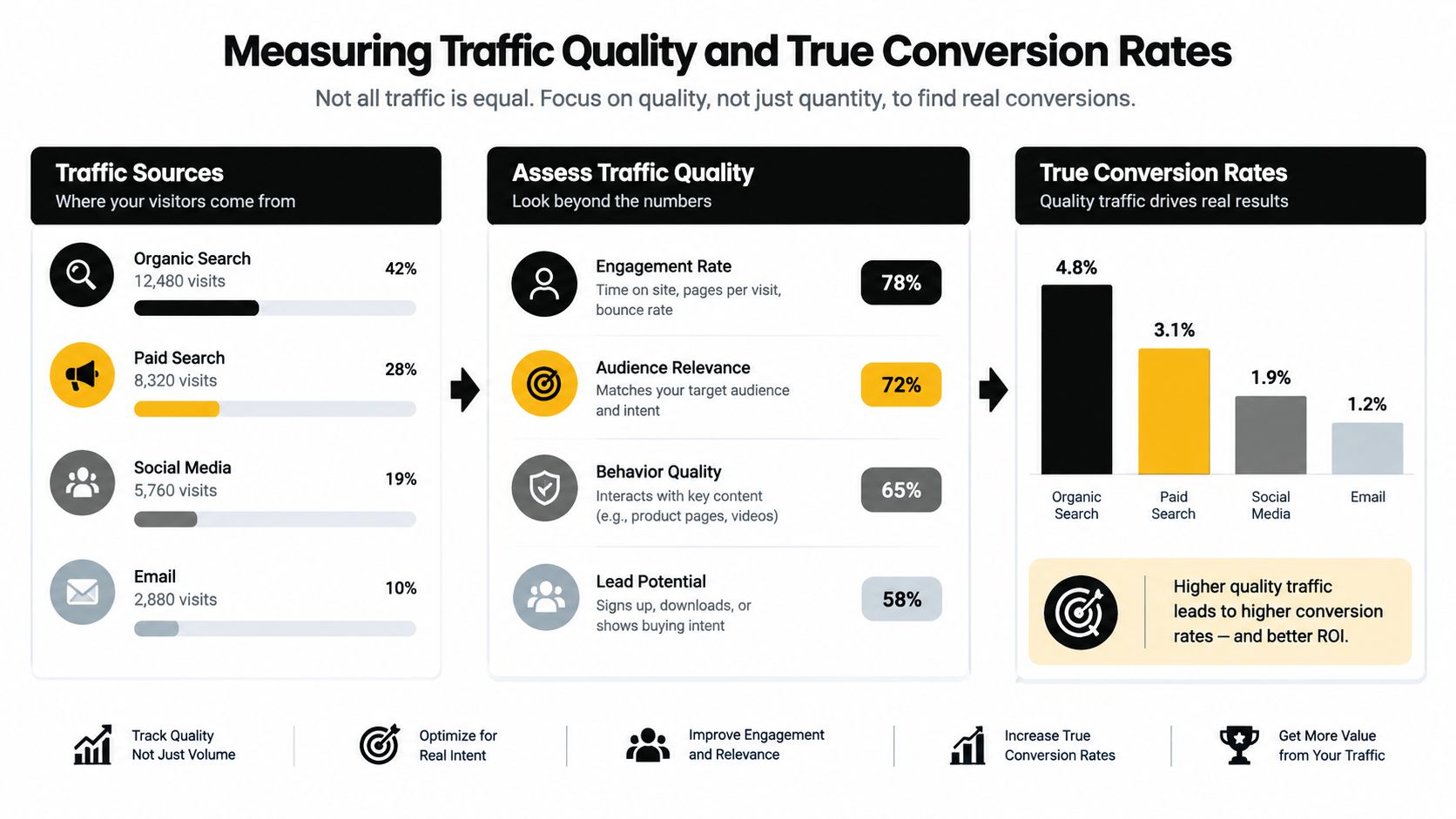
Blocking bad traffic can make a store look better than it is. That's the measurement trap. If you remove a lot of junk sessions, conversion rate may rise only because the denominator changed, not because demand improved.
Measure what changed, not just what got blocked
A stronger model tracks traffic-quality-adjusted conversion. That means you compare performance before and after filters while also watching manual review workload, false positives, and contamination in email and review systems. A store that blocks a lot of bad traffic but also suppresses legitimate international demand hasn't solved the problem, it has hidden part of it.
For a deeper practical view of the reporting problem, the internal guide on Shopify bot traffic analytics noise is a good reference.
Practical rule: never celebrate a higher conversion rate until you know what kind of traffic disappeared.
Separate real demand from automated noise
The FTC data and the ECB data show the scale of the issue, but they don't tell you which sessions in your store are real buyers. That's your job. If the traffic source produces a lot of suspicious visits, the first question is whether those visitors ever had purchase intent.
A useful measurement stack should include:
- Traffic-quality-adjusted conversion so you can compare true buyer performance over time.
- Manual review workload so you know whether risk controls are saving labor or creating it.
- Email list contamination so marketing knows whether list growth is clean.
- Post-purchase loss by cohort so you can see whether a traffic source is profitable after disputes and abuse.
- False-positive rate so legitimate customers aren't being blocked out of the funnel.
That frame keeps the conversation on business quality, not vanity metrics.
Don't let fraud controls distort marketing decisions
When a team blocks bot-heavy traffic, media buyers often look better on paper. That's not automatically bad, but it can hide a weak acquisition channel. The right answer is to track both allowed and blocked traffic over time and to review whether cleaner traffic also improves downstream behavior.
The merchant who can prove that difference can make better budget decisions, better inventory forecasts, and better staffing plans. That's the key upside of fraud prevention done well.
Where Securify fits
Securify sits upstream of payment authorization and helps filter non-genuine activity before it reaches checkout. It can identify bot traffic, VPN and proxy use, high-risk countries, and other bad-traffic patterns, so Shopify merchants spend less time reviewing junk sessions and more time looking at real buyers. It also helps keep fake visitors out of connected tools like Klaviyo and Gorgias, which protects both lists and support queues.
If you want to see how that fits into a Shopify stack, start with Securify on the Shopify App Store. It's a traffic-quality layer, not a dispute system, so it works best alongside your payment and review process rather than pretending to replace them.
Frequently Asked Questions About E-commerce Fraud
What should I do when failed transactions spike?
Check whether the pattern is tied to one country, one device cluster, or one payment method. If the same shape repeats, treat it as a traffic or card-testing problem before you assume it's a checkout bug.
Should I cancel every high-risk order right away?
No. Review the full order record first. Shopify's signals are useful, but one bad indicator doesn't prove fraud on its own.
How do I handle a customer who says a blocked order was legitimate?
Look at the record you had at the time, including billing, shipping, device, and network clues. If the order was blocked by policy, explain the rule plainly and keep the tone neutral.
What if my analytics improve after I block bad traffic?
That's useful, but only if you also track what changed in the traffic mix. Cleaner numbers are good, hidden demand loss is not.
If you're dealing with fake sessions, risky orders, or traffic that keeps polluting your store data, Securify gives Shopify merchants a way to filter bad visitors before they distort checkout and reporting. Visit Securify to see how early traffic control can help protect revenue, reduce review load, and keep your analytics closer to true demand.