
· ip reputation check · shopify fraud · proxy detection · blacklist screening · order review
IP Reputation Check for Shopify Stores
Run a practical IP reputation check on Shopify orders. Learn how to read signals, spot proxy abuse, and turn results into block or review rules.
You're looking at a Shopify order that might be legitimate. The billing details look plausible, but the customer's IP points somewhere unexpected, and a reputation lookup flags the connection. Do you fulfill it, hold it, or risk turning away a real shopper using hotel Wi-Fi?
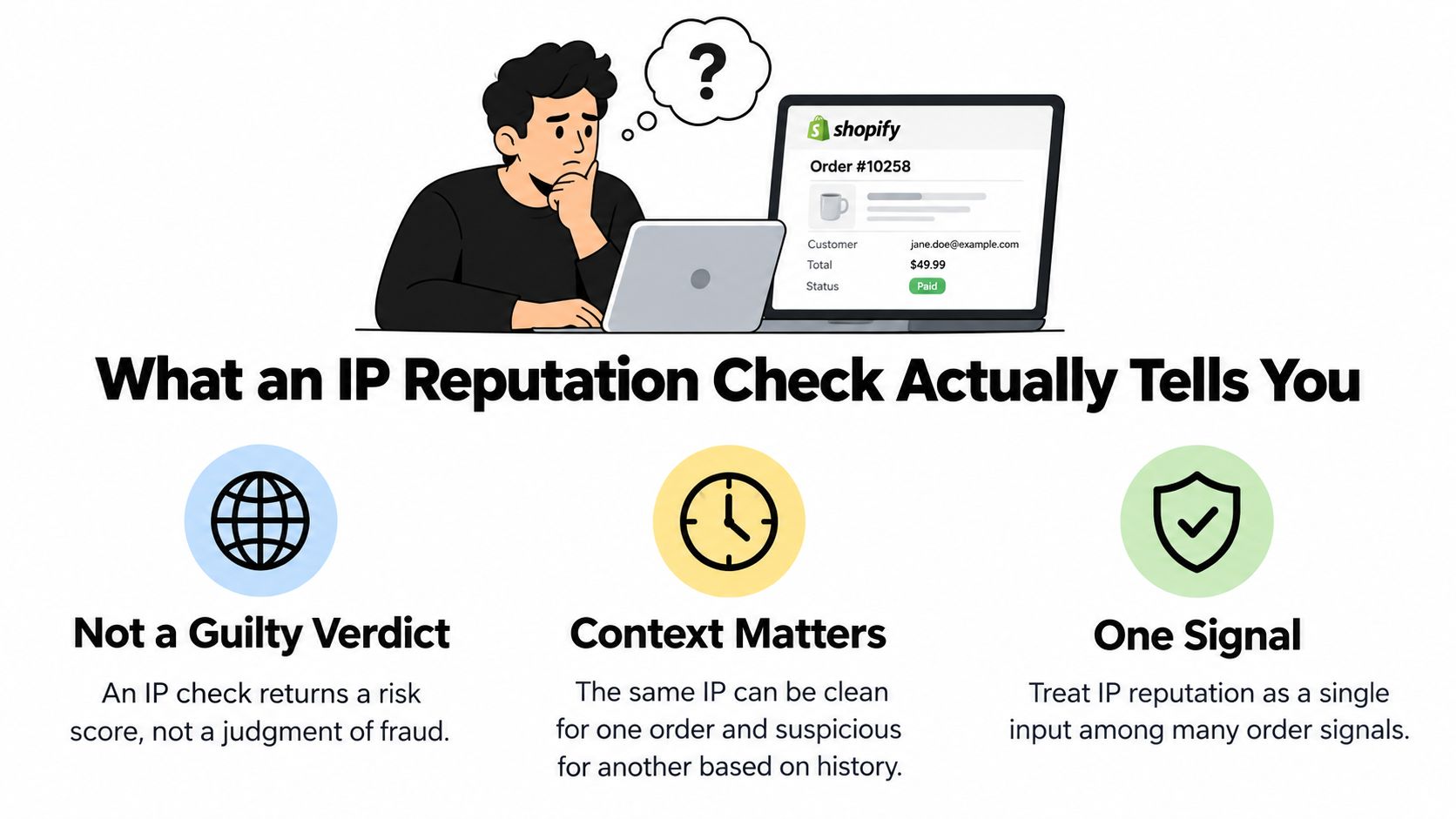
An IP reputation check helps you decide what to investigate. It doesn't decide whether the customer is a fraudster. The useful workflow connects the address's history with the shopper's behavior, then applies a response you can explain and reverse.
Table of Contents
- What an IP Reputation Check Actually Tells You
- The Core Signals Behind an IP Reputation Score
- Running an IP Reputation Check on a Real Order
- Why One IP Rarely Means One Person
- Turning Reputation Output Into Review and Block Rules
- Keeping Reputation Data Fresh After the First Check
- Wiring IP Reputation Into Shopify Order Reviews
- Where Securify fits
- Frequently Asked Questions
What an IP Reputation Check Actually Tells You
An IP reputation check returns evidence associated with an internet address, such as observed abuse, suspected compromise, or a listing tied to malicious infrastructure. Depending on the service, it may also include network classification, proxy indicators, timestamps, and a confidence score.
That's address-level evidence, not proof about the person placing your order. An address can have a concerning history without the current shopper having caused it.
Spamhaus describes its reputation datasets as covering resources associated with activities including malware, phishing, ransomware, and unsolicited bulk email. Its checker can explain a listing, identify remediation, and indicate whether removal can be requested. Those details are more useful than an unexplained red badge.
What a useful result should reveal
Before acting, look for enough detail to answer these questions:
- Reason: Was the address associated with email abuse, compromised equipment, automated attacks, or another category?
- Recency: When was the activity observed, and when did the provider last update the result?
- Scope: Does the finding concern the exact address, a broader network, or an inferred connection type?
- Confidence: Is the result supported by observed behavior, or primarily by network classification?
- Resolution: Can you inspect the listing policy and determine whether the address has been cleared?
Practical rule: A reputation result should tell you what to investigate, not just what color to assign an order.
A clean result doesn't establish that an order is safe. It establishes only that the queried sources didn't return a relevant finding at that moment. Keep the payment, account, and purchasing evidence in view.
The Core Signals Behind an IP Reputation Score
A score becomes useful only when you understand what contributed to it. Don't treat a spam-related listing, a compromised-host finding, and a VPN classification as interchangeable evidence.
Abuse category and history
The Spamhaus ecosystem includes the Spamhaus Blocklist (SBL), Exploits Blocklist (XBL), Combined Spam Sources (CSS), and Botnet Controller List (BCL). XBL addresses signs of compromise, including malware, exploitable vulnerabilities, and abusive proxies. CSS focuses on unsolicited or malicious email, while BCL identifies botnet-controller infrastructure.
Spamhaus's historical-data documentation supports current and historical investigation, with historical listing queries covering a maximum 12-month window. For a merchant, that history helps distinguish a current finding from an old event that needs reassessment.
A repeated, recent pattern deserves different treatment from an isolated historical observation. Neither automatically establishes payment fraud, particularly when the original finding concerns email rather than storefront behavior.
Network context and confidence
An autonomous system number, or ASN, identifies the network context associated with an address. Hosting, mobile, corporate, and residential classifications help you interpret a finding, but they shouldn't become verdicts themselves.
A proxy or VPN indicator means the connection may be masked. It doesn't establish why the shopper masked it. Likewise, a provider's confidence score needs a documented meaning before you attach an enforcement threshold to it.
Keep these distinctions in your customer risk assessment, rather than collapsing every connection flag into the same risk label.
What Each IP Reputation Signal Typically Means
| Signal | What it Indicates | Default Merchant Action |
|---|---|---|
| Current compromise listing | Evidence associated with an infected or exploitable host, not proof of card theft | Inspect session and payment behavior |
| Email-abuse listing | An email-related reputation concern, not a checkout verdict | Check relevance and recency |
| VPN or proxy flag | Masked access, not confirmed abuse | Seek corroborating evidence |
| Hosting-network address | A hosted connection rather than an ordinary access-network classification | Review unusual purchasing activity |
| Mobile or shared-network classification | The address may represent unrelated users | Avoid address-only blocking |
| No relevant listing | No finding returned by the queried sources | Continue normal order assessment |
Running an IP Reputation Check on a Real Order
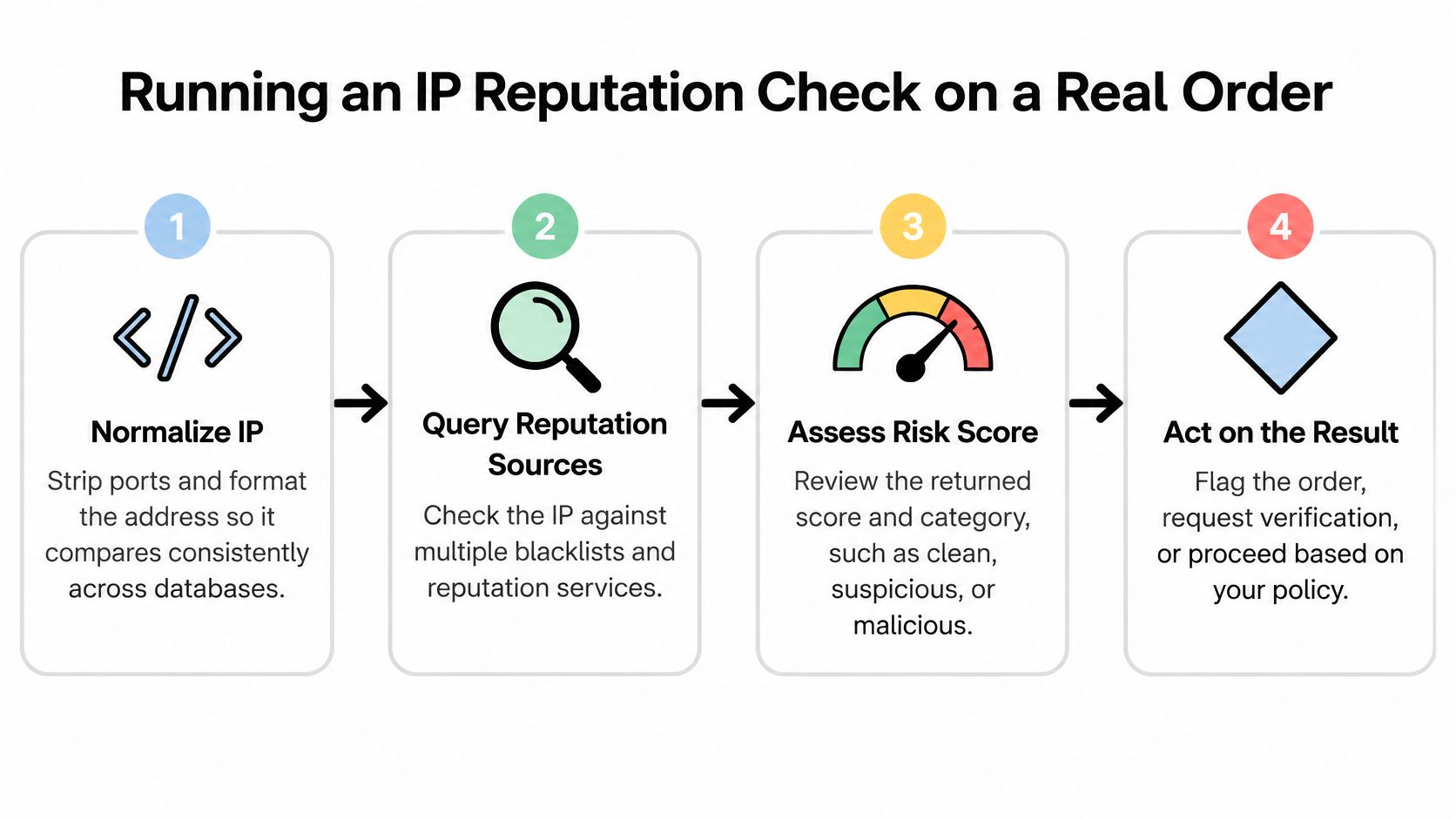
Use a repeatable pipeline rather than opening unrelated lookup pages and making a judgment from whichever result looks most alarming.
For a manual review, begin with the order IP recorded in Shopify. If your team also collects storefront request data, have the developer normalize it before comparing results across systems.
Normalize before querying
Strip incidental formatting and validate the address representation. Handle IPv4 and IPv6 consistently without assuming that different addresses identify the same device.
For forwarded traffic, define which infrastructure you trust. Work backward through trusted forwarding hops to identify the right-most untrusted source, rather than accepting a client-supplied header as authoritative.
Use an auditable runtime workflow
Give your reviewer or developer this operating checklist:
- Capture: Record the order or session reference, normalized address, and observation time.
- Query: Check relevant reputation sources and retain each category, confidence value, timestamp, and response status.
- Enrich: Add ASN, network type, reverse DNS where available, request velocity, and device or cookie continuity.
- Compare: Inspect authentication behavior, account activity, payment indicators, and purchasing patterns.
- Decide: Record the action, supporting evidence, reviewer, and applicable policy.
Choose sources for their relevance and quality, not just their quantity. CAIDA's blocklist evaluation framework separates precision, recall, false positives, timeliness, overlap, churn, and list purity. Its cited scanner-attack findings also caution against assuming that combining lists guarantees broad detection.
For broader operational planning, Grumspot's 2026 fraud prevention guide is a complementary resource to consider alongside your written review procedure.
Keep the original evidence, not merely the final score. A later chargeback follow-up or internal audit should show what your team knew when it made the decision.
Why One IP Rarely Means One Person
A hotel guest shouldn't inherit another guest's abuse history. A returning customer on a mobile connection shouldn't become suspicious because unrelated subscribers share the same public address.
Mobile carrier NAT, hotel and campus gateways, corporate networks, VPN exits, and recycled IPv4 addresses undermine the assumption that an IP identifies a particular shopper. Residential proxies create the opposite problem: automated activity can arrive through an apparently ordinary household connection.
Research into shared hosting infrastructure found that shared addresses can host many benign domains alongside a small number of malicious ones. That finding concerns hosting infrastructure, not Shopify buyers, but it illustrates why address-wide judgments need care.
When connection details disagree
IPv6 adds another complication. Research into IPv4-only VPN exposure found that 5% to 57% of visitors using those VPNs could expose their native IPv6 address. The range describes the studied circumstances, not all VPN users.
Privacy addresses and prefix rotation also make persistent device-to-address assumptions unreliable. If the visible connection, location estimate, and session history disagree, investigate the mismatch instead of selecting whichever signal looks worst.
- Hotel or campus connection: Check account continuity and purchasing evidence before penalizing the shared gateway.
- Mobile connection: Consider whether the same customer session remains coherent despite address changes.
- Residential-looking source: Don't let the network label override rapid, repetitive account or checkout behavior.
- Conflicting protocol evidence: Preserve both observations and route uncertainty to review.
A network address describes a connection. It doesn't establish a shopper's identity or intent.
Keep your policy for bots and proxies separate from your policy for fraudulent purchases. You can scrutinize automated behavior without declaring every privacy-conscious shopper fraudulent.
Turning Reputation Output Into Review and Block Rules
Write rules around storefront events and business consequences, not a universal score threshold. Interrupting a genuine purchase has a different cost from challenging an abusive review submission.
Use the following as policy examples, not established fraud indicators. Their value comes from combining independent evidence and matching the response to the event.
Allow
A mobile-network shopper with consistent account activity, credible purchasing history, and no conflicting payment evidence can proceed under your normal policy. The network classification alone shouldn't create a manual-review requirement.
Hold for review
A hosting-network order with a billing-country mismatch deserves inspection rather than immediate rejection. A clean datacenter address on a network your team has associated with confirmed abuse can also justify review when the current order shows additional anomalies.
For Shopify high-risk orders, make the hold reason specific enough that another reviewer can resolve it. “Proxy connection plus conflicting billing evidence” is actionable. “Bad IP” isn't.
Step-up verify or hard block
Use additional verification when uncertainty remains but the session could be legitimate. Reserve a hard block for corroborated abuse, especially when repeated account, login, or checkout behavior supports the reputation finding.
- Login: Combine connection concerns with authentication failures and account-level velocity.
- Review submission: Challenge repetitive submissions when session behavior supports an abuse finding.
- Checkout: Prefer reversible holds when the evidence remains ambiguous.
- Address-range enforcement: Require stronger corroboration and a documented exception process before applying a broad restriction.
Historical IP-reputation research illustrates both classification errors and the need to update abuse-related lists continually. Build expiration and decaying weight into your policy instead of treating an old observation as a lifetime restriction.
Reputation should influence the decision, not replace the decision procedure. A permanent range block needs more support than a temporary challenge against a particular abusive session.
Keeping Reputation Data Fresh After the First Check
Consider a rule that appears sensible during testing: hold orders associated with a particular abuse category. After deployment, reviewers start releasing many of those orders, but nobody feeds those outcomes back into the rule.
The team keeps paying the review cost because the original decision logic never changes. Treat that as a maintenance failure, not evidence that more aggressive blocking is necessary.
Validate without enforcing
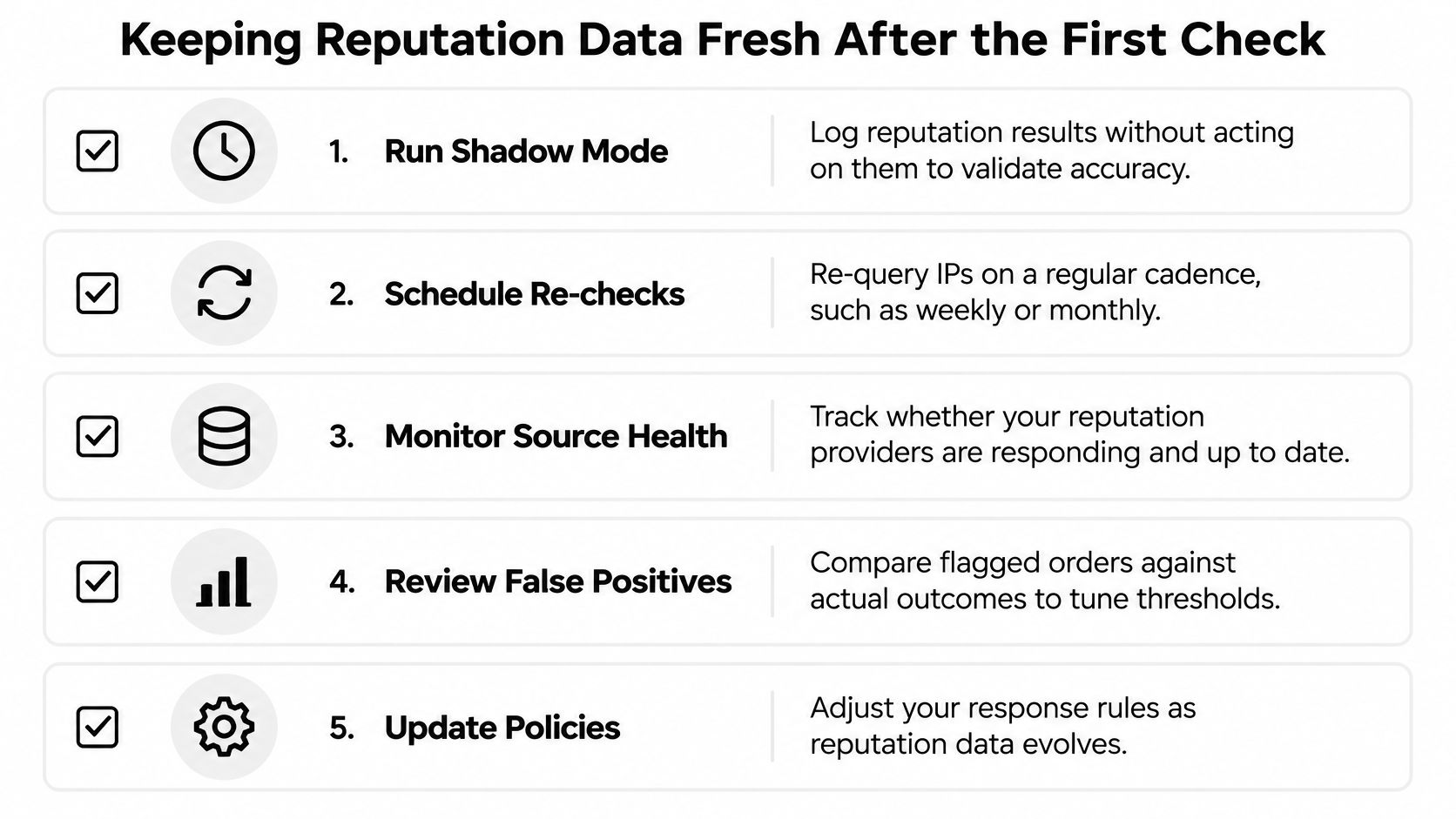
Start new rules in shadow mode. Log the action they would have taken, then compare those decisions with reviewed outcomes before allowing them to affect shoppers.
Track the evidence quality behind your labels, too. An order that hasn't yet produced a complaint isn't equivalent to a confirmed legitimate purchase.
Monitor the cost of mistakes
Keep operational measurements separate rather than reporting only how much traffic you blocked:
- Abuse prevention: Confirmed abusive sessions stopped and time to detection.
- Customer impact: Legitimate sessions challenged or lost, plus appeal and unblock outcomes.
- Source health: Failed queries, stale responses, delistings, and recurring listings.
- Uneven enforcement: Differences by geography, ASN, protocol, and acquisition source.
Recheck addresses after delisting and expire cached findings according to their relevance. Let clean observations lower risk gradually without instantly erasing repeated recent abuse.
Maintenance test: If nobody can explain when a blocked address will be reconsidered, the rule isn't finished.
Tie reassessment to traffic volume, source updates, appeals, and incident activity. A quiet store and a store handling a sudden surge shouldn't rely on the same review cadence just because both teams set a calendar reminder.
Wiring IP Reputation Into Shopify Order Reviews
Start in the order's fraud-analysis section, where Shopify makes the order IP available for inspection. Compare the address's general location with the customer's claimed location, then review the other indicators before deciding on fulfillment.
Shopify's fraud-prevention guidance specifically raises questions about hosting-company and proxy addresses. It also says an individual IP address or location description isn't, by itself, a fraud recommendation. Billing details, AVS, CVV, and unusual purchasing patterns belong in the same review.
Build a queue reviewers can resolve
For eligible online credit-card orders, Shopify provides a low, medium, or high recommendation for fraud-related chargeback risk. Shopify's order-protection documentation describes using Shopify Flow to hold high-risk orders for review, capture payment for lower-risk orders, or cancel orders matching defined criteria.
An external reputation check acts before or alongside Shopify's fraud analysis, not inside it. If you want Flow to use external findings, confirm that your implementation exposes those findings in a supported form. Don't assume a lookup result automatically becomes an available trigger or condition.
Give each queued order a clear reason and a resolution path:
- Evidence summary: Relevant IP finding, observation time, payment indicators, and conflicting details.
- Review question: What uncertainty must the reviewer resolve before fulfillment?
- Disposition: Release, continue holding, request verification, or cancel under the applicable policy.
- Audit record: Who acted, why they acted, and what evidence supported that action.
A practical Shopify fraud-analysis workflow should let the next reviewer understand the decision without repeating the entire investigation.
Keep the customer record coherent
Connect review notes to the correct order and customer record. Avoid scattering explanations across a support thread, an exported spreadsheet, and an unrecorded admin decision.
For the broader data-management problem, Yassine Malti's resource on how to unify customer data across Shopify offers related reading. Your operational requirement is straightforward: reviewers need consistent account, order, and session context without treating an IP as the customer identifier.
The storefront view complements that order-time record:
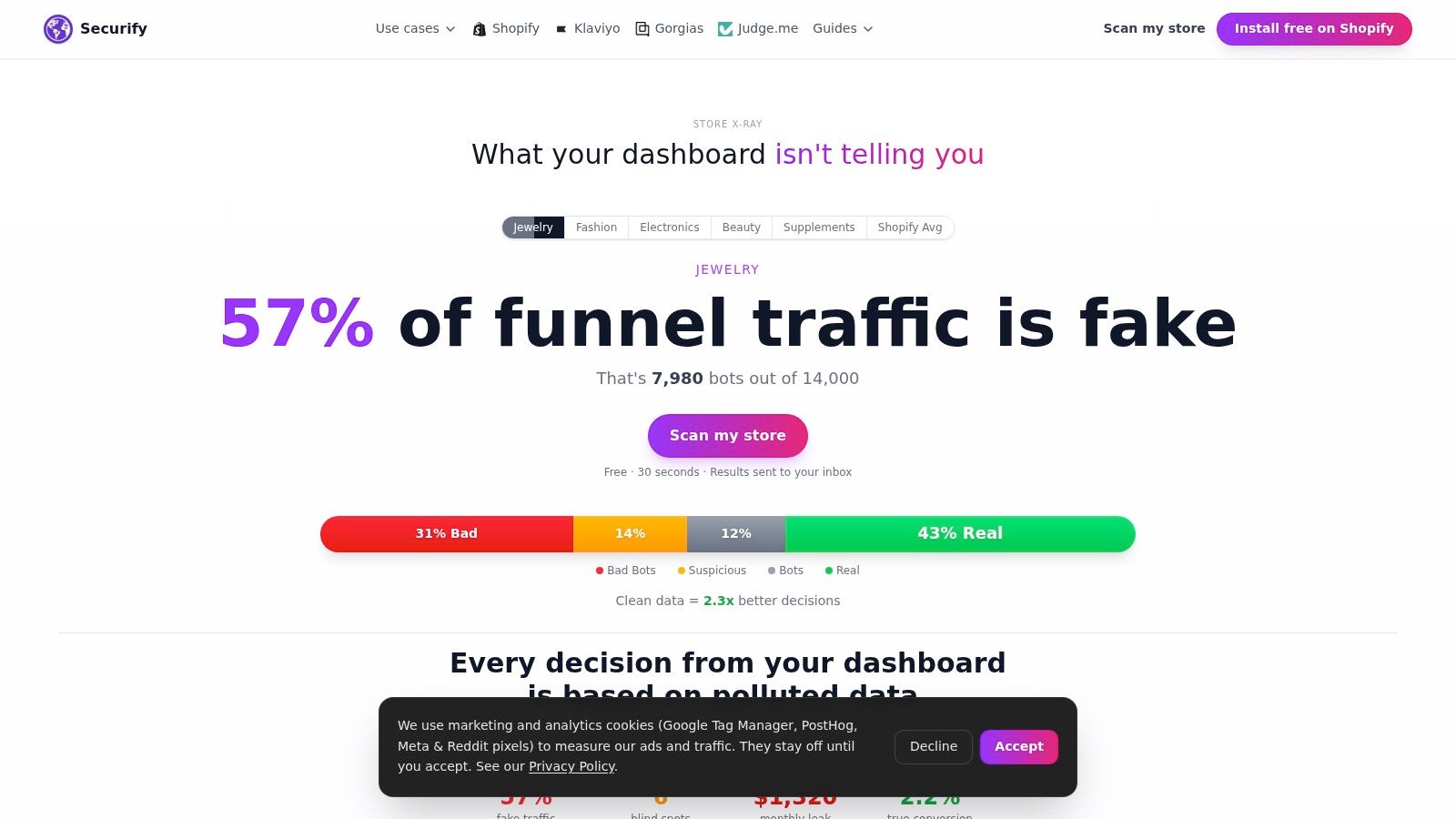
Keep customer communications neutral. Ask for the information needed to resolve the order rather than accusing someone because of their connection. Record the response and apply the same review policy consistently.
Where Securify fits
Securify is a Shopify-first security and traffic-quality app listed as Country Blocker Fraud Securify. It's a storefront-side option for identifying and mitigating bot traffic, VPN abuse, fake visitors, and abusive masked sessions before or alongside order-time review.
Its relevant capabilities include VPN and proxy detection, storefront-session traffic classification, specific-IP and range controls, and allowlist exceptions. Its no-signup Store X-Ray scan offers an initial traffic-quality assessment. Native integrations with Shopify, Klaviyo, Gorgias, and Judge.me support filtering non-genuine activity before it pollutes connected workflows.
Use that upstream layer to manage traffic behavior, while retaining your order-review process for payment and fulfillment decisions. It doesn't replace Shopify's fraud recommendation, establish that every masked visitor is fraudulent, or guarantee chargeback prevention.
Evaluate the available controls through Securify on the Shopify App Store, starting with a narrowly scoped policy and a documented exception process.
Frequently Asked Questions
Does a clean IP reputation check mean an order is safe?
No. Continue reviewing the payment indicators, account activity, and purchasing pattern. Don't release an otherwise concerning order solely because the lookup returned no listing.
How often should IP reputation checks run?
Check when a relevant session or order decision requires current evidence. Refresh cached results according to source updates, traffic volume, and the consequence of using an outdated finding.
What should I do when a legitimate customer has a flagged IP?
Review the order using independent evidence and release it if your policy supports that decision. Prefer a customer- or session-specific exception over broadly trusting a shared network.
Securify offers storefront traffic classification and VPN and proxy controls that complement order-time IP reputation checks. Visit Securify to assess your traffic quality, then use what you find to build targeted controls without turning a flagged address into an automatic rejection.