· geo blocking software · Shopify fraud · country blocking · VPN detection · shipping zones
Geo Blocking Software for Shopify Stores
Geo blocking software for Shopify stores: compare country rules, shipping zones, and fraud review, and see when a block helps or hurts real buyers.
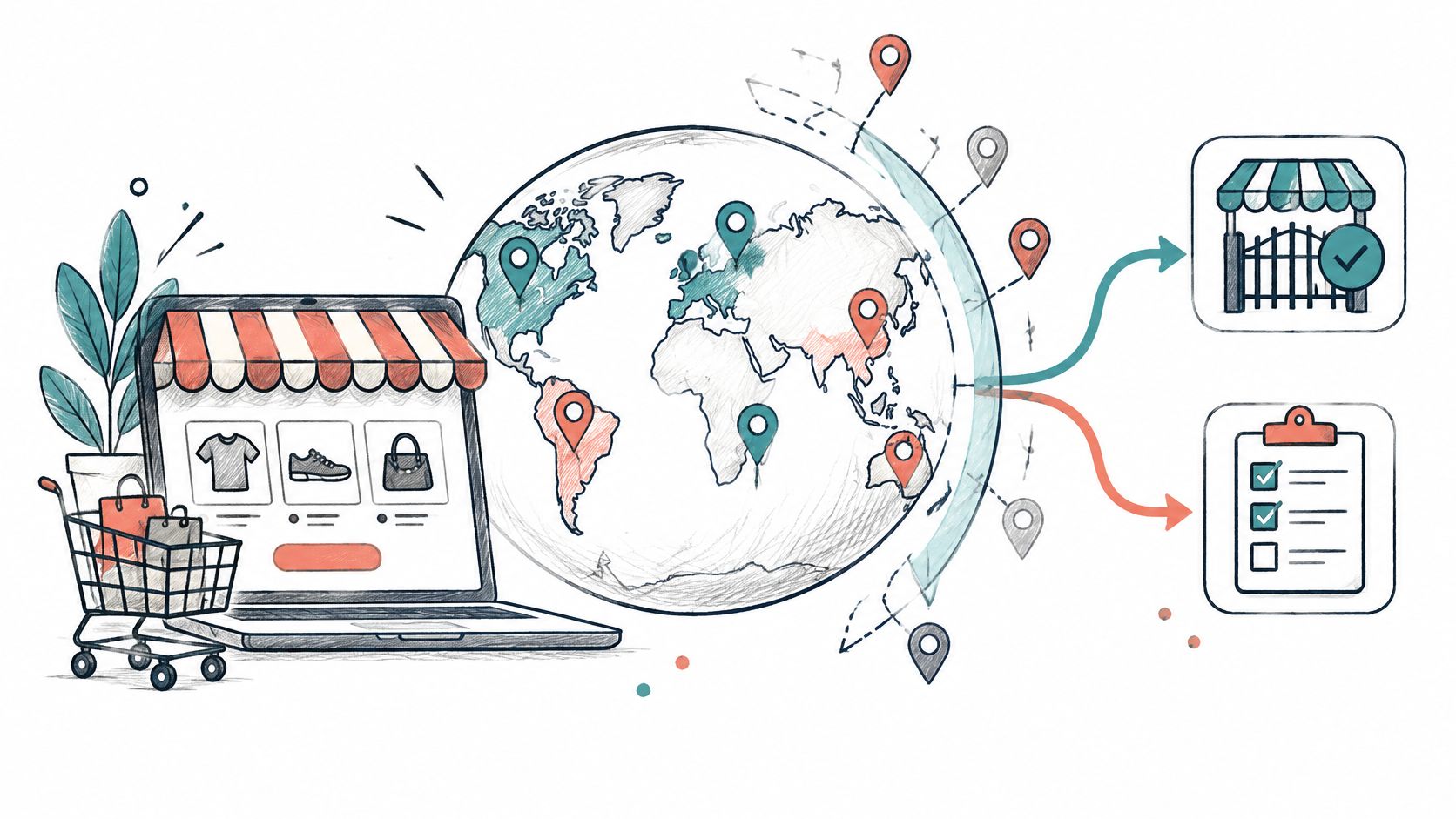
Blocking every country with suspicious orders is the wrong default. Geo blocking software controls storefront access, not buyer identity. Start with the problem you need to solve: unsupported delivery destinations, abusive sessions, repeated payment attempts, or risky orders awaiting fulfillment.
For a Shopify store, those problems belong at different control points. Shipping zones set delivery boundaries, traffic rules restrict sessions, and Shopify's fraud tools help assess payments and orders. A country deny list can be useful, but it shouldn't replace the controls that make a more specific decision.
Table of Contents
- Geo Blocking Software Options for Shopify Stores
- Country Rules Versus Shopify Order Review
- False Blocks from VPNs and Weak IP Data
- How to Roll Out Country Rules Safely
- Where Securify fits
- Questions Shopify Merchants Still Ask
Geo Blocking Software Options for Shopify Stores
Geo blocking controls Shopify stores use
| Control | Where it acts | Best job | Main limit |
|---|---|---|---|
| Shopify shipping zones | Checkout | Countries you will not deliver to | Does not stop browsing, bots, or checkout attempts from elsewhere |
| Shopify Payments Fraud Control lists | Payment and customer records | Known bad emails, IPs, or billing details | Not a country policy; needs Shopify Payments |
| Storefront country-blocking app | Session, before checkout | Markets you never ship to | IP country is probabilistic and can miss VPNs |
| CDN or firewall country rule | Edge, before the storefront | Sanctions lists and high-volume abuse | Technical to maintain and easy to over-block |
| Payment-risk rule on IP or card country | Payment authorization | Out-of-country cards and repeated charges from one IP | Does not stop the visit or the abandoned cart |
| Block one customer | Account | A repeat abuser you already know | One person at a time, not a market |
Choose the control by where the problem occurs. If you only need to prevent unsupported deliveries, changing storefront access is usually a broader intervention than necessary.
If the problem starts before an order exists, such as abusive sessions filling carts, an order-review process can't prevent the initial activity. Conversely, blocking visits won't tell your fulfillment team whether a remaining order has credible payment and address information.
Shipping and known-abuser controls
Shopify shipping zones determine where you offer delivery at checkout; visitors outside those destinations can still browse. Their failure mode is scope: they don't prevent bots, storefront activity, or someone starting checkout before discovering that delivery isn't available.
Keep the shipping configuration as your operational source of truth. A traffic rule should never permit a market your warehouse can't fulfill or exclude a market your checkout actively supports.
Shopify Payments Fraud Control lists target specified emails, IP addresses, or billing details rather than an entire country. Their limit is that they address known records and require Shopify Payments, so they aren't a substitute for a market-access policy.
Use a narrow record-level restriction when you can identify the abusive actor. Expanding that restriction to everyone sharing a country creates a much larger customer-service problem without establishing that those visitors are related.
Blocking one customer addresses a repeat abuser at the account level, not a geographic market. It won't establish that another account belongs to the same person, and account restrictions shouldn't be mistaken for broader payment or network controls.
Storefront and edge restrictions
A storefront country-blocking app acts on the session before checkout and can restrict traffic associated with markets you never fulfill. Its weakness is the location input: an IP-country result describes the visible connection, which might not represent the shopper's physical location.
Ask how the app enforces its rule before assuming every request is stopped. Test product pages, direct cart links, mobile browsing, and the customer experience when access is denied.
A CDN or firewall country rule acts at the edge when your architecture supports that placement, before a request reaches the protected storefront. It can enforce a documented compliance restriction or address concentrated abuse, but maintenance and broad exclusions can make it a poor first project for a nontechnical Shopify team.
Don't assume a managed Shopify storefront gives you the same edge configuration options as a separately hosted website. Confirm what you control, who can reverse a bad rule, and whether the restriction covers the intended traffic path.
Practical rule: Put the restriction as close as possible to the behavior you need to stop, not simply as early as possible.
Payment rules and the cost of choosing poorly
A payment-risk rule evaluates payment attributes, such as originating IP country, card country, and repeated activity from an address. It operates too late to prevent the visit or abandoned cart, and an available rule must be supported by your payment setup.
The Radar rules guide illustrates the distinction between geographic conditions and repeated authorization activity from the same IP. Treat these as different questions: whether a payment meets your market policy and whether its activity pattern resembles abuse.
Don't assume a rule documented for another payment environment can be pasted into Shopify. Check which conditions your payment tools expose and whether the action is review, rejection, or another form of verification.
Pricing should follow the control choice. Shipping zones and Fraud Control are Shopify-provided controls, with Fraud Control tied to Shopify Payments; app and edge-service prices vary by listing. Compare current eligibility, plan limits, request allowances, and App Store pricing rather than choosing from a headline monthly fee.
For an international launch, ServeApps' guide to expand your Shopify store overseas is useful planning context before you translate a shipping decision into an access rule. Opening a market also requires workable delivery, checkout, and customer-support arrangements.
Write down whether the unwanted activity is a session problem or an order problem before buying software. A working understanding of Shopify Fraud Analysis and a consistent process for Shopify high-risk orders will help keep those decisions separate.
Hard-block only where you have a documented reason and legal permission, generally markets you won't fulfill or territories you must exclude. Keep countries you still sell to on a review path rather than treating their customers as automatically ineligible.
Country Rules Versus Shopify Order Review
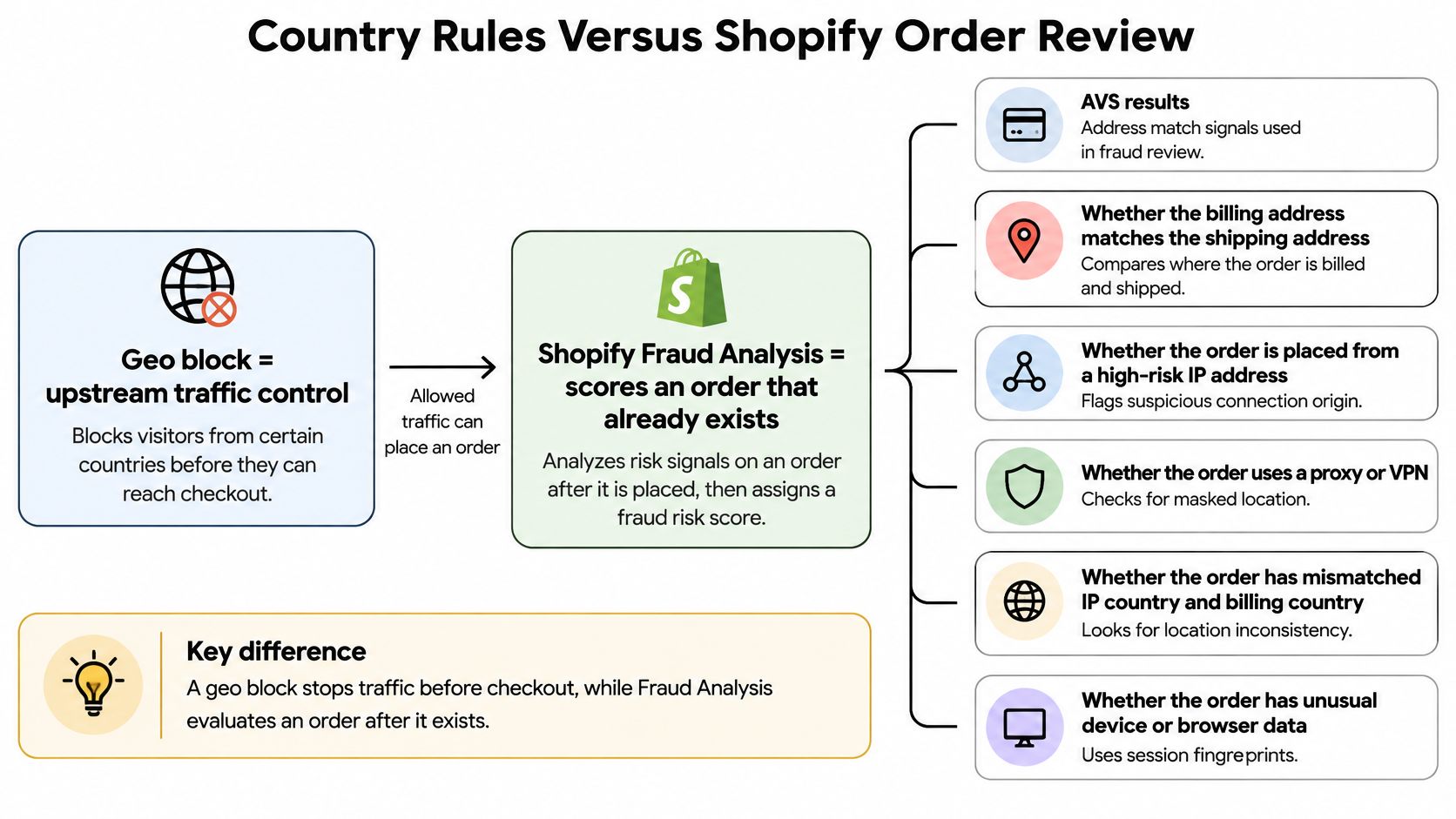
A geo block is an upstream traffic control. Shopify Fraud Analysis evaluates an order that already exists. The first decides whether a session can proceed; the second helps your team decide what to do before fulfillment.
According to Shopify's fraud-analysis documentation, review signals can include AVS results, whether the CVV was entered correctly, whether the customer's location matches the payment method, unusual purchase patterns, and the order's IP address. Shopify also cautions that an IP address or location description alone isn't a fraud recommendation.
Read the evidence before releasing inventory
Shopify presents the assessment in the order's Order risk section, including the risk level, recommendation, and individual indicators. Staff should inspect those indicators rather than treating the displayed country as a release or cancellation instruction.
A location mismatch is a reason to look closer. Say a customer places an order while traveling, uses their usual card, and ships to their established home address. The geographic inconsistency deserves attention, but it doesn't erase the other evidence supporting the purchase.
Compare that with an order showing conflicting payment information and unusual purchasing behavior. The operational decision is stronger when several independent indicators support it, rather than when staff repeatedly interpret the same location mismatch as separate evidence.
- Payment evidence: Review address verification and card-security results.
- Location consistency: Compare the connection with the payment and delivery context.
- Purchase behavior: Check whether the order pattern needs explanation.
- Fulfillment decision: Record why staff approved, held, or canceled the order.
Keep prevention and protection separate
Merchants using Shopify Payments can configure AVS and CVV filters and use Fraud Control for specified emails, IPs, or billing details. Those controls belong in the payment and order workflow, not in an assumption that every visitor from a country represents the same risk.
A broader Shopify fraud protection process also needs clear responsibilities: who reviews flagged orders, who contacts customers, and who authorizes fulfillment. Card networks and Shopify monitor chargeback rates, and merchants should keep their rate as low as possible.
Fulfillment check: A permitted session is not an approved order.
Use a fraud and bad-traffic guide to assign traffic restrictions and order decisions to the right owners. A geo rule can narrow the review queue, but it doesn't replace order review; proxy and hosting checks need a customer-verification procedure too.
False Blocks from VPNs and Weak IP Data
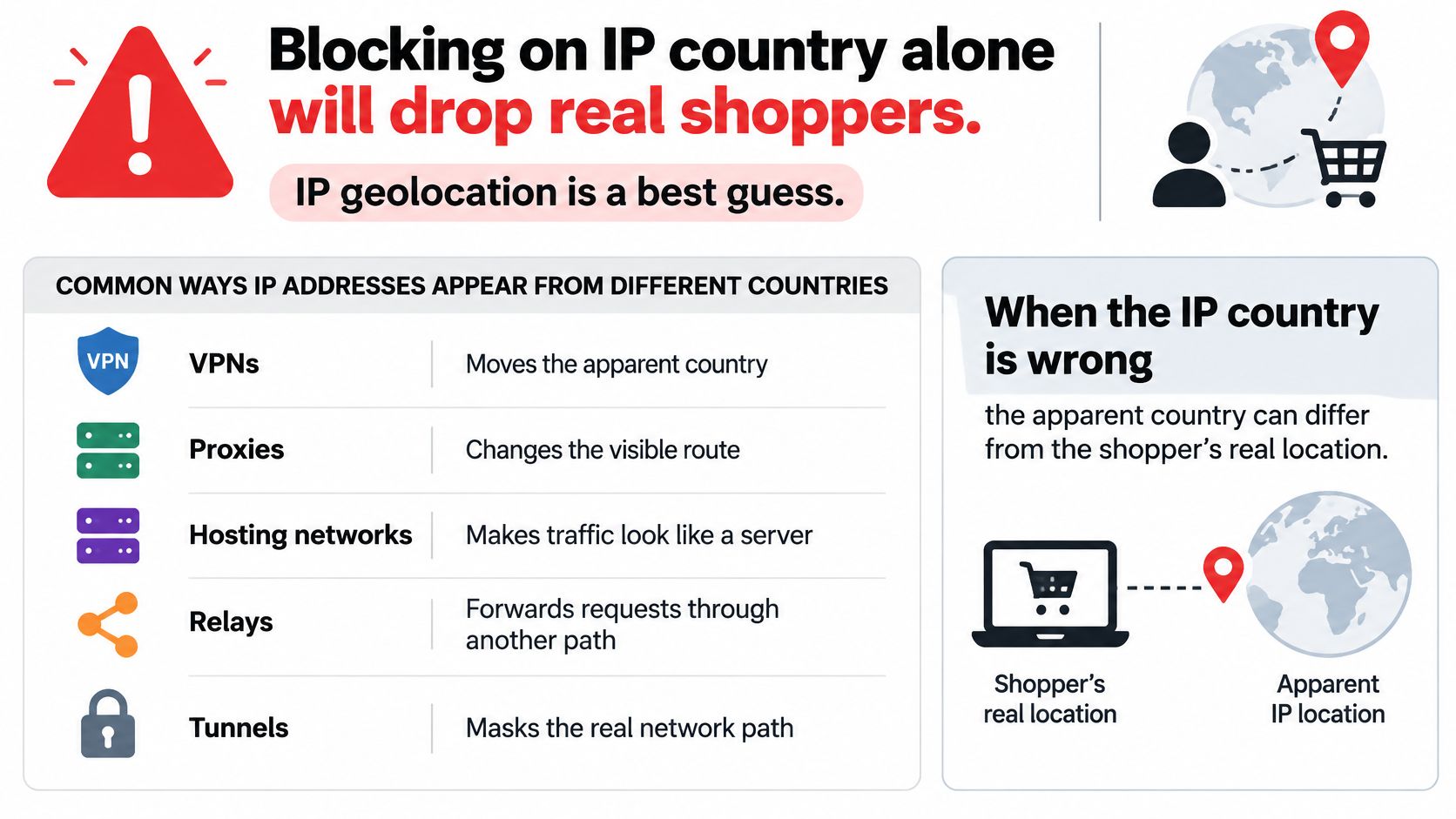
Blocking by IP country alone can reject real shoppers while leaving the underlying risk unresolved. An IP location estimates where a connection appears to originate; it does not confirm the shopper's location.
An independent IP-geolocation benchmark describes how VPNs, proxies, hosting networks, relays, and tunnels can distort location estimates. When providers disagree, particularly about a connection's location, treat that uncertainty as a reason to examine the route rather than block the visitor.
Separate location, masking, and automation
These signals answer different questions. Rolling them into one “bad visitor” label makes a false block harder to explain and correct.
- Country: Where does the visible IP appear to originate?
- Anonymizer: Does the connection resemble a VPN, proxy, or hosting network?
- Automation: Does the session behave like a bot or scripted checkout?
A VPN flag describes the connection, not the shopper's intent. A hosting-network flag calls for more context before treating an order as fraud.
Security.org's VPN consumer report reported that 42% of U.S. adults used a VPN for personal or work purposes in 2026, compared with 32% in 2025. A blanket VPN restriction can therefore block ordinary buyers on employer networks or privacy tools alongside abusive traffic.
Travelers, expatriates, and corporate users are useful cases for checking a rule. Ask whether it would reject someone browsing abroad who wants delivery to a destination the store supports.
A blanket country ban can reject legitimate buyers without resolving the underlying payment risk.
Use graduated responses
Allow known corporate VPN routes and carrier-grade NAT unless other evidence warrants intervention. For an ambiguous session, add verification where available. Reserve hard blocks for high-confidence commercial proxy or datacenter traffic supported by other abuse signals, or for a legally justified unsupported-market restriction. The guide to VPN and proxy detection explains why these connection signals need context.
Log the IP intelligence source, country result, VPN or proxy status, and action taken. Sample blocked sessions and customer complaints to see whether a rule catches legitimate traffic; don't judge it only by the volume blocked.
EU access rules require particular care. Stripe's EU geo-blocking compliance guidance explains that Regulation (EU) 2018/302 limits location-based access denial, automatic redirects without consent, and refusal of generally accepted payment methods solely because a customer is in another EU member state.
Shipping limitations differ from refusing storefront access or a generally accepted card. Use a documented policy for bot traffic and VPN abuse that preserves low-risk sessions, challenges uncertainty, and blocks when the evidence supports it.
How to Roll Out Country Rules Safely
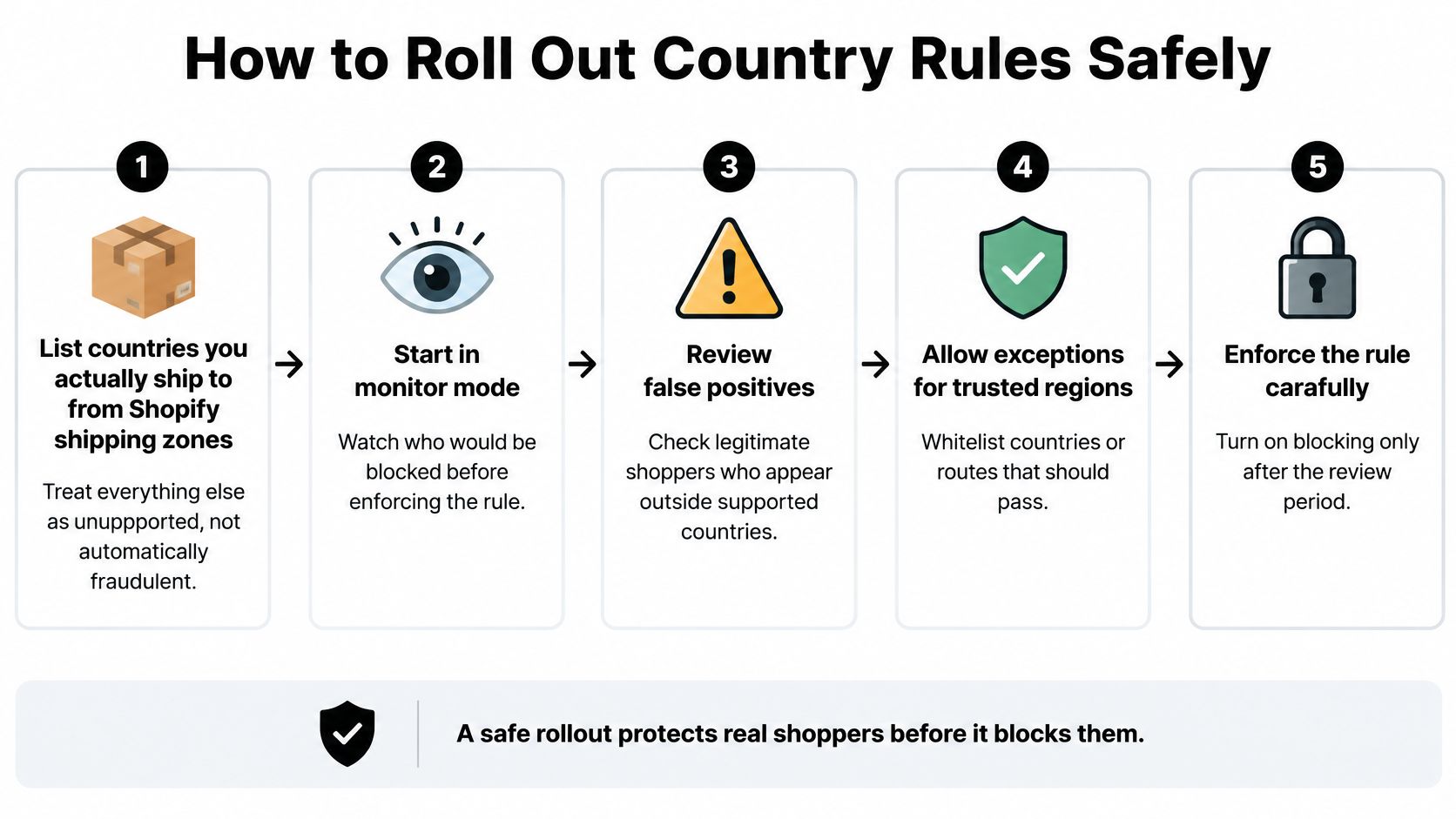
Set the shipping boundary first, then test the rule, assign an owner, and define how staff can reverse a mistaken block. A country deny list should not become a substitute for consistent order handling.
Follow a staged rollout
-
Confirm where the store can deliver. Reconcile Shopify shipping zones with fulfillment operations. Mark destinations the store cannot serve as unsupported, not automatically fraudulent.
-
Explain delivery limits before checkout. Add a clear notice to relevant product pages and the cart so shoppers can see the restriction before they begin payment.
-
Monitor traffic before enforcing a rule. If the tool supports previewing or monitoring decisions, use that period to assess how a proposed rule would affect visits. A traffic-quality review can help teams distinguish suspicious visits from normal shopping activity.
-
Keep supported destinations on an order-review path. Shopify's fraud-prevention guidance recommends examining location discrepancies, hosting-provider addresses, and proxy services, and contacting the customer when verification is needed. Consider those signals alongside the order's available payment indicators.
-
Handle payment velocity separately. Repeated authorizations from one IP within an hour call for supported payment-risk controls. Don't expand a country rule to address a payment pattern.
-
Use a narrow restriction for a known abuser. Follow a defined procedure for how to block a customer on Shopify rather than restricting everyone in the same market.
-
Audit decisions during the trial. Log the country, available risk flags, rule, and action for two weeks, then sample rejected sessions. Loosen rules that catch legitimate shoppers, and record the reason for each exception.
-
Assign a pre-peak review. Name an owner to test active rules, check exceptions, and reverse incorrect restrictions before traffic increases. A written manual fraud review procedure helps staff apply the same process under pressure.
Give staff a reversal procedure
For each rule, keep the business reason, affected traffic, exception criteria, owner, and last review together. Support staff should be able to explain a restriction and route a disputed case for review without reconstructing how the rule was set.
Test the exception path as carefully as the denial path. When a legitimate customer contacts support, give a useful explanation and a clear review process rather than asking them to retry the same blocked session.
Where Securify fits
A country deny list is a blunt control. Shipping limits, IP confidence, VPN signals, and order review address different risks, and aggressive restrictions can turn away legitimate travelers and cross-border shoppers.
Securify blocks traffic from countries merchants don't ship to and screens for bots, VPNs, and fraud signals, while allowing genuine shoppers through. Merchants can control traffic by country, IP, and fraud signal. Use those controls to restrict unsupported markets and clearly abusive activity, while leaving payment verification and fulfillment decisions to the relevant Shopify workflows.
Set rules around actual delivery coverage and documented risk decisions. Traffic controls can reduce exposure, but they do not replace staff review of the orders that remain or provide chargeback protection.
Questions Shopify Merchants Still Ask
Does geo blocking software stop chargebacks?
No, geo blocking software can cut some out-of-scope and abusive sessions before checkout, but it doesn't handle disputes or promise a chargeback result. Orders that pass a location rule still need appropriate payment and fulfillment checks, and both card networks and Shopify monitor chargeback rates, so keep yours as low as possible.
Can I block an entire country in Shopify?
Yes, a storefront country-blocking app or supported edge rule can restrict sessions, while Shopify shipping zones control delivery availability rather than browsing. Use a country-wide access restriction only when you won't fulfill that market or must exclude it, and confirm that applicable law permits the restriction.
Should I block every VPN?
No, a VPN can belong to a legitimate shopper using an employer network or a privacy tool. Reserve hard blocking for high-confidence proxy or datacenter traffic supported by other risk evidence, and allow or verify otherwise normal orders instead of rejecting every masked connection.
Is the IP country the shipping address?
No, the IP country describes the apparent origin of the connection, while the shipping address identifies the requested delivery destination. Card country, phone information, and IP location can disagree, so read them together in order review rather than treating any single field as proof of identity or fraud.
Securify offers country, IP, and fraud-signal controls for unsupported markets and abusive storefront traffic. Visit Securify to evaluate that traffic-control layer against your shipping policy, then keep Shopify order review in place for the purchases you intend to fulfill.