
· ecommerce fraud detection · Shopify fraud · chargeback prevention · false positives · order risk
Ecommerce Fraud Detection for Shopify Stores
Compare ecommerce fraud detection for Shopify: rules, behavior models, device and IP checks, and how to cut chargebacks without false declines.

Global payment-card fraud reached $33.83 billion in 2023, up from $33.45 billion in 2022, according to the Nilson Report. That figure is losses at card issuers, merchants, payment acquirers, and ATM acquirers, so it is wider than merchant-only ecommerce losses. Measured against worldwide card volume, fraud equaled 6.58 cents per $100 transacted, down from 6.81 cents per $100 in 2022. Losses got bigger while the rate per dollar got smaller. Ecommerce fraud detection has to be judged against both, or a growing store will look "worse" just because it sold more.
U.S.-issued cards were 25.29% of global card volume in 2023 and $14.32 billion of the losses, 42.32% of the worldwide total, up from $13.61 billion in 2022. A US DTC store sits in the market that takes a disproportionate share of card fraud. Run checks at the visit, at checkout, and again before you ship. Judge each layer by false declines and review load, not by how many orders it blocks.
Table of Contents
- What Ecommerce Fraud Detection Must Catch First
- Ecommerce Fraud Detection Approaches Side by Side
- Shopify Order Risk and Where Checks Run
- Lower Chargebacks Without False Declines
- Pick a Control for Your Store Situation
- Where Securify fits
- Ecommerce Fraud Detection Questions
What Ecommerce Fraud Detection Must Catch First
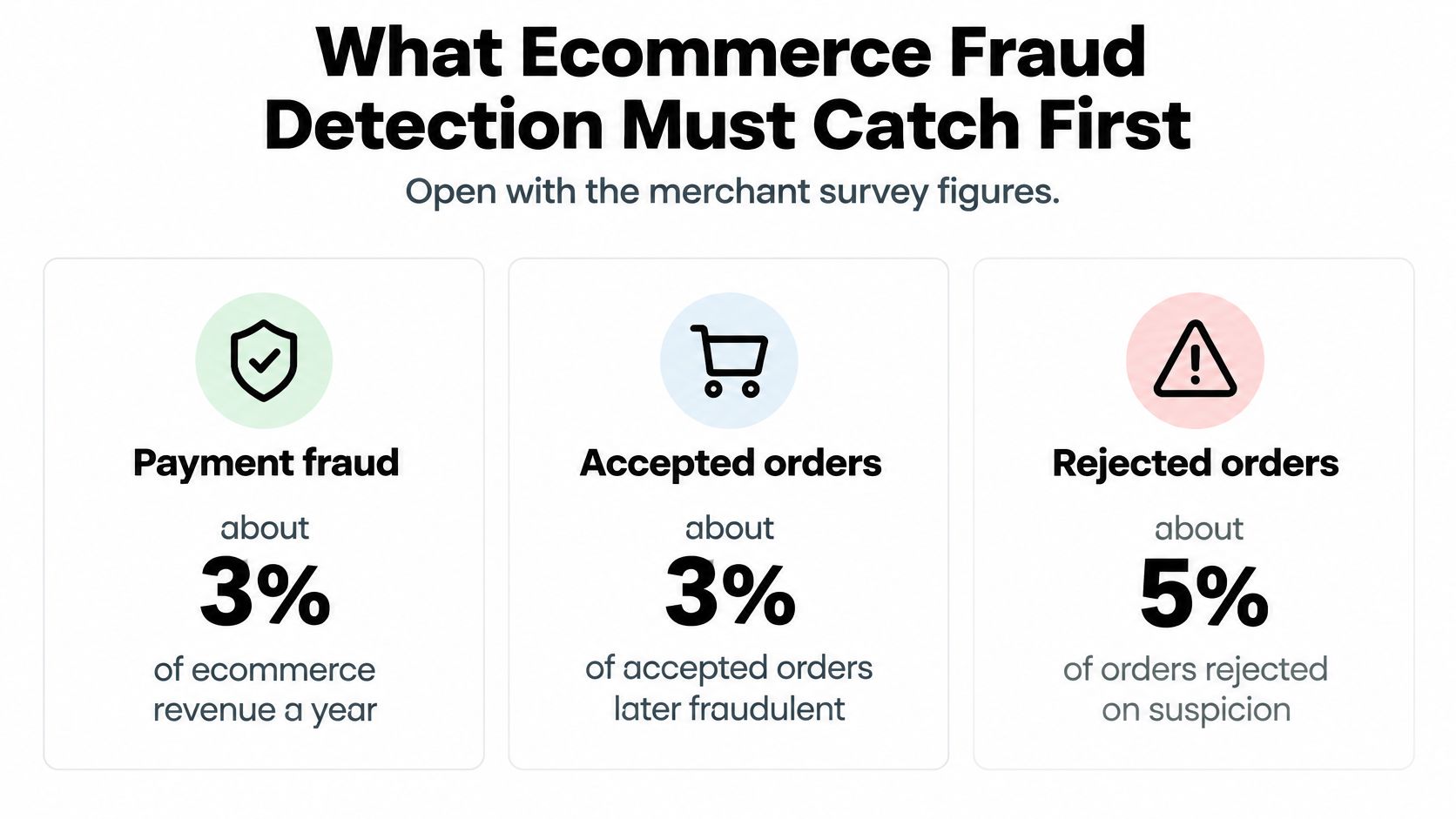
Merchants in the 2024 Global eCommerce Payments and Fraud Report estimated that payment fraud consumed about 3% of total ecommerce revenue a year, and that roughly 3% of accepted ecommerce orders later proved fraudulent. They also rejected about 5% of orders on suspected fraud. Those three numbers are the job. Stop the bad orders, and don't throw away a larger slice of good ones to do it.
Global merchant win rates for fraud-coded chargebacks sat below 20%. European merchants reported an approximate win rate of only 10%. Shipping first and arguing later is a weak plan. You already paid for the pick, the label, and the payment fee, and you usually don't get the money back.
Ecommerce fraud detection is the set of checks that separate a real buyer from card testing, account takeover, reseller abuse, and friendly fraud before the warehouse ships. Card testing is a burst of small or failed auths. Account takeover is a known customer whose device, ship-to, or password just changed. Reseller abuse is someone buying limited stock to flip. Friendly fraud is a real customer who later tells the bank the charge wasn't theirs.
Four approaches, none of them enough alone
A Shopify store usually needs more than one, because Shopify Fraud Analysis scores the order, not the whole visit.
- Rule-based checks fire on patterns you write, such as a country mismatch, a velocity cap, or a block list.
- Machine learning and behavioral scoring weigh session speed, account age, checkout timing, and payment retries.
- Device and IP reputation flags hosting addresses, proxies, and location mismatches as review prompts.
- Third-party services add device graphs, identity checks, or dispute tooling you don't build yourself.
Card networks and Shopify monitor your chargeback level. Keep that rate as low as possible. There isn't a comfortable band to sit in.
Practical rule: A smaller set of high-value bad orders can outweigh a larger count of cheap ones. The 3% revenue hit and the 3% bad-order rate lining up is a warning, not a comfort. Order count alone understates exposure.
Use the comparison below as the decision tool. Pick the layer by what it catches and who it wrongly stops, not by which one "blocks the most."
Ecommerce Fraud Detection Approaches Side by Side
| Approach | Catches well | Fails when | Shopify placement | False-decline risk |
|---|---|---|---|---|
| Rule-based | Known mismatches, velocity caps, block lists | New patterns, gifts, loyal buyers who look odd | Manual review rules and Shopify Flow | High if one mismatch auto-cancels |
| Machine learning and behavioral | Velocity, account age, checkout timing, payment retries | Thin order history and drifted fraud | Needs labeled orders; the score isn't native by itself | Set by the threshold you choose |
| Device and IP reputation | Proxy, hosting IP, geo mismatch, repeat devices | Shared networks, travel, corporate VPNs | Shopify IP and network indicators on the order | Medium if used as the only proof |
| Third-party services | Device graphs, identity, extra scoring, dispute tooling | Opaque scores and overlap with Shopify signals | App before checkout or beside order review | Rises as the vendor threshold gets stricter |
Rule-based checks
Rules cover known mismatches, velocity caps, and block lists. They're easy to paste into a dispute note because you can say exactly what fired. They're brittle the week the pattern changes, and they punish gifts. A billing address in Ohio and a ship-to at a parent's house in Texas is normal in December. If one mismatch auto-cancels, your false-decline rate climbs while fraud moves to a new email domain. Home for these is manual review rules and Shopify Flow, with a human on anything that isn't a hard repeat of confirmed abuse.
Machine learning and behavioral scoring
Models use session velocity, account age, checkout timing, and payment retries. Headline accuracy is a poor guide because fraud is rare. One ecommerce transaction study of 299,695 records found only 2.21% fraudulent transactions and 97.79% legitimate ones, and both tested models still hit about 99% accuracy, as reported in this ecommerce model comparison. TabNet produced higher precision at 92%. XGBoost reached higher recall at 72% and an F1-score of 80%. A model can look excellent and still miss a large share of fraud, or flood you with false alerts. The non-obvious failure is thin history. A first order on a new store has almost nothing to score, and fraud patterns drift, so a random split of last year's orders flatters the model. You need labeled orders, and the score isn't a native Shopify field by itself. If you want a closer read on weighing those signals, see customer risk assessment.
Device and IP reputation
Hosting IPs, proxies, geo mismatch, and repeat devices are useful. Treat them as review prompts, not proof. The failure mode is shared networks. A college dorm, a hotel, airport Wi-Fi, and a corporate VPN all look "masked." On Shopify, these notes live in the IP and network indicators on the order. Used as the only reason to cancel, the false-decline risk is medium and concentrated on travelers and gift buyers.
Third-party services
These add device graphs, identity checks, extra scoring, or dispute tooling the store doesn't build. You pay for coverage you can't staff. The failure mode is an opaque score that overlaps Shopify's own indicators, so two systems argue and your team reviews the same order twice. Place the service before checkout or beside order review. False declines rise as the vendor threshold gets stricter, so you own the cutoff, not the vendor's default.
Raise precision when review staff is thin. Raise recall when high-value chargebacks dominate. Report both, split by new versus returning customers, and don't trust one global accuracy number.
Shopify Order Risk and Where Checks Run
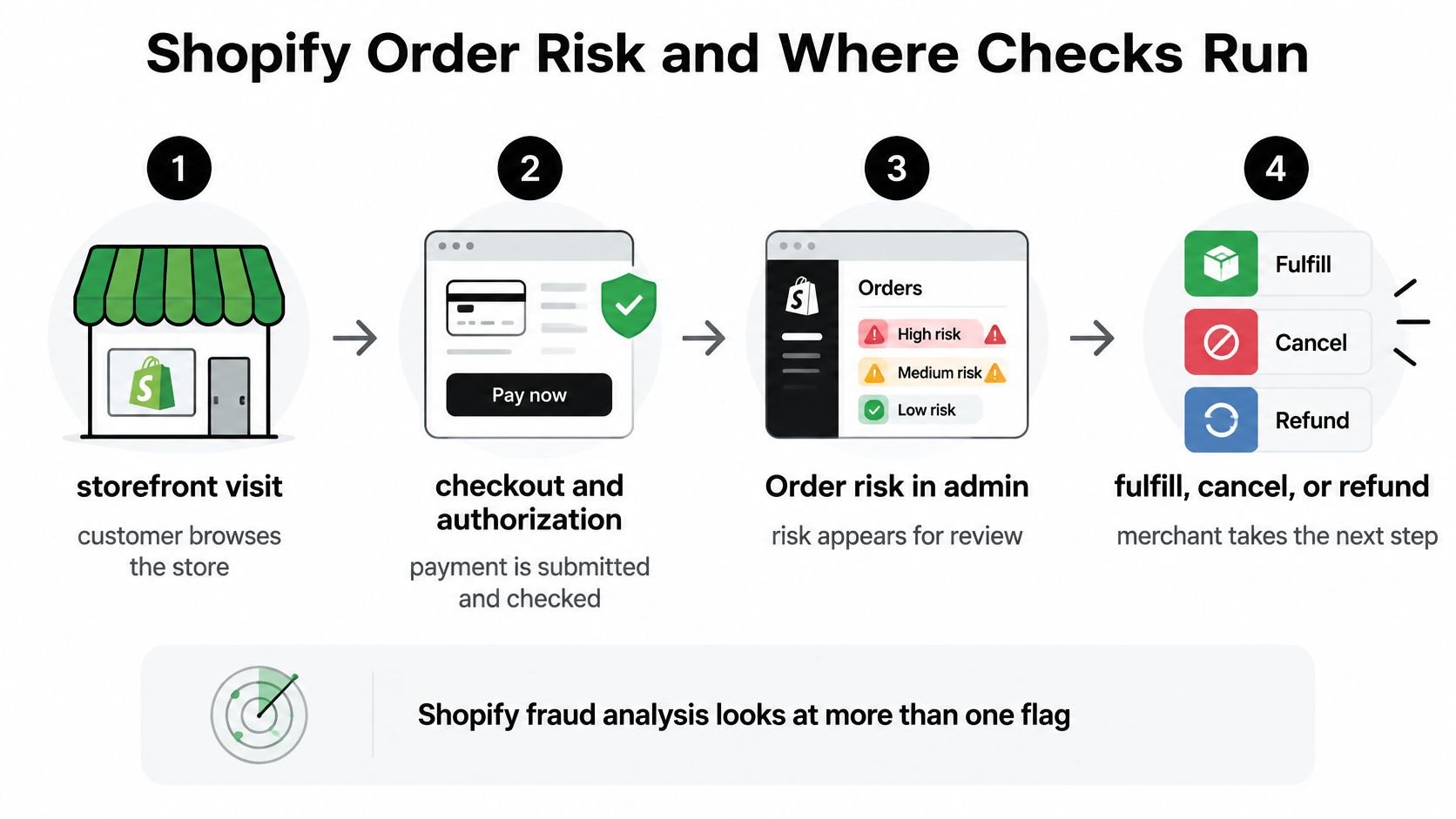
Checks run in time order. A shopper hits the storefront, then checkout and authorization, then Order risk in admin, and only then do you fulfill, cancel, or refund. Upstream traffic controls sit before this screen. They don't replace it.
What the order screen actually says
Shopify fraud analysis looks at more than one flag. On eligible online credit-card orders, indicators can cover Address Verification System results, whether the customer entered the correct Card Verification Value, whether location matches the payment method, unusual device or network activity, and attempts to use multiple credit cards. Shopify's fraud analysis guide is explicit that individual indicators, or the number of indicators, don't represent an order's overall risk. Don't add up red flags and call that a score.
The combined recommendation classifies the order as low, medium, or high risk of a fraud-related chargeback. For a high-risk order, the three actions are verify, cancel, or refund. A fuller walk-through of Shopify fraud analysis and of high-risk orders is worth keeping next to the admin screen so the team uses the same three actions.
Proxy, hosting, and gifts
An IP in a different general area from the claimed location, an address that belongs to a web-hosting company, or a proxy is a reason to contact the customer, not an automatic cancel. Shopify's fraud-prevention guidance says the same. Billing and shipping can differ on a gift. The sharper pattern is many names and billing addresses shipping to one place. Review those orders and call or email using the details supplied at checkout.
If you sell supplements or wellness products, paid traffic often arrives from offer pages you didn't build. Use AdLibrarySpy to find health ecommerce offers so you can see which creatives are feeding the sessions that later land as odd checkouts.
Admin path, before the box leaves
Open Orders, select the order, and read the Order risk section for the risk level, the recommended next step, and the indicators. Shopify's order-protection guide says fraud analysis reviews orders automatically and can surface AVS, CVV, IP-address details, and unusual purchasing patterns. The low, medium, or high recommendation is there so you decide whether to fulfill before shipment.
Fulfilling high-risk orders without review can produce chargebacks and may lead to removal from Shopify Payments.
Review belongs before the carrier scan. After the goods leave, verify, cancel, and refund stop being real options.
Lower Chargebacks Without False Declines
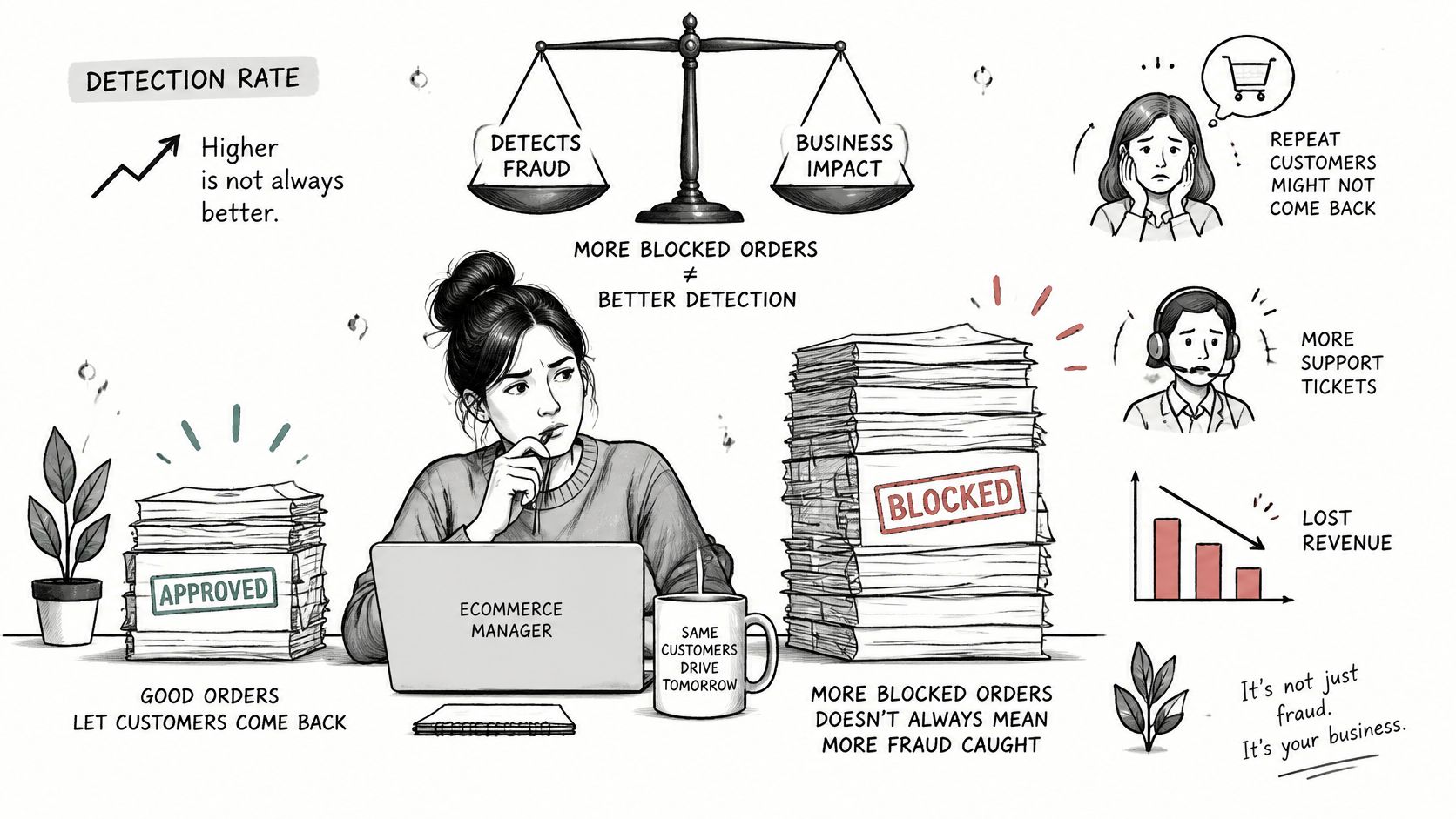
Detection rate is the wrong success metric. Blocking more orders isn't the same as detecting better. A false decline costs the sale, the next purchase, and support time.
Recent payment research, covered in this Visa Acceptance note on payment success rate, reports that false positives are rising even while overall fraud has declined for a second straight year. Payment success rate is now among merchants' top performance indicators. Separate merchant research in that same write-up found that more than 40% of organizations still rely on manual fraud-prevention processes, while fraud-prevention measures increase customer churn at 59% of U.S. merchants and 46% of Canadian merchants.
What a small DTC team should count
Say a returning customer in Texas gets declined because the IP looked like a VPN during a work trip. You lose that order, the ad spend that brought them back, and often a support ticket asking why the card "didn't work." That's the cost detection rate never shows.
Track four numbers. You don't need a data team.
- Orders canceled or held for risk each week. Count them, don't just feel the queue.
- Share later proved real. Of those holds, how many customers confirmed the order, reordered, or replied with a matching ID.
- Chargebacks by country and payment method. A spike in one country or one wallet is a threshold problem, not a storewide one.
- Manual-review minutes per day. If this climbs while chargebacks don't fall, the rules are creating work.
Compare them month over month. Move a threshold only when one of these numbers moves. Card networks and Shopify monitor the chargeback level, and the goal is to keep it as low as possible. A lower chargeback count that comes from declining good buyers isn't a win. For the dispute side, read chargeback fraud prevention, and for what a bad order costs once it ships, use chargeback costs and early traffic control. How you talk about the rate itself belongs with your Shopify chargeback rate notes, still without a target band.
Hold the threshold steady for a month, then change one rule. If held orders jump and proved-real orders jump with them, you tightened the wrong knob.
Pick a Control for Your Store Situation
| Situation | Start with | Do not |
|---|---|---|
| Ship to a short country list | Geo rules before checkout | Cancel every foreign IP after you already picked the order |
| Review queue is the bottleneck | Filter repeat high-risk visits; verify medium risk | Add more manual rules with no owner |
| Ads look busy but orders don't | Separate bots and proxies from buyers in analytics | Judge campaign ROI on raw sessions |
| Catalog or prices get scraped | Block scraping even with no checkout | Wait for a chargeback to act |
| Refunds and friendly fraud rising | Tighten policy and keep order evidence | Expect checkout scoring to stop policy abuse |
| High-value first orders | Human verify before fulfill | Auto-cancel on one AVS or IP mismatch |
You only ship inside the US. Block or challenge countries you don't ship to before those sessions reach checkout. Still review domestic high-risk cards in Order risk. Say a skincare brand ships to the lower 48 only. A cluster of checkout attempts from a country you don't serve shouldn't become a pile of canceled orders after you've already picked them.
The review queue is the bottleneck. Stop repeat high-risk visits earlier, and keep medium-risk orders on a verify step. Don't add more manual rules with no owner. A three-person team that already spends mornings in Orders will not get safer by writing a sixth Flow condition nobody watches.
Paid traffic looks busy and orders don't. Separate bot and proxy sessions from buyer sessions before you judge ads. A Facebook campaign that "converts" in the analytics and dies at checkout is often bad traffic, not a bad offer. Don't compute ROI on raw sessions.
Competitors scrape the catalog. Limit harvesting even when nobody checks out. Waiting for a chargeback means you've already given away price and inventory data for free.
Refunds and friendly fraud are climbing. In 2025, 62% of merchants said friendly fraud had risen year over year, according to the Verifi 2025 Fraud and Payments Report. The same year, 57% of surveyed ecommerce merchants reported increasing refund and policy abuse, in the Merchant Risk Council's global survey of 1,082 merchant professionals, as covered by The Paypers. Checkout scoring won't close a policy loophole. Tighten the return window, keep order evidence, and stop expecting a risk model to police "item not as described."
A block list is for confirmed abuse, not a single mismatch. Use how to block a customer on Shopify only after you've tied repeat orders to the same person.
High-value first orders. A $400 first purchase from a new email gets a human verify before fulfill. Don't auto-cancel on one AVS or IP mismatch. Call, or send a short confirmation, then ship.
AI-assisted shopping isn't the same as a bot
A global survey of more than 5,000 consumers, cited in that Verifi report, found 73% were already using AI during shopping. Don't treat all automation as fraud. A disputed order might be deliberate abuse, an account takeover, an assistant that misunderstood the cart, or a customer denying a purchase they let a tool make. Keep evidence of session behavior and verify odd high-value checkouts. Blanket-blocking every scripted visit will also block shoppers who are about to become customers.
Default stack for most US DTC stores: geography and bad-traffic filters first, Shopify's low, medium, and high recommendation before fulfill, and a third-party score only if order volume outgrows manual review.
Where Securify fits
Securify, listed on the Shopify App Store as Country Blocker Fraud Securify, screens storefront traffic by country, IP address, and fraud-pattern signals before a visitor becomes an order. It blocks bot, VPN, and proxy traffic, plus visits from countries the store doesn't ship to. Real shoppers pass straight through while bots and high-risk traffic are flagged before they touch your numbers or your orders. It works before checkout and doesn't replace checkout or payment fraud tools. It doesn't integrate with Shopify Fraud Analysis. It acts before or alongside that order-risk review, and it surfaces suspicious traffic before it becomes an order problem. See Securify on the Shopify App Store.
Ecommerce Fraud Detection Questions
What is ecommerce fraud detection?
Ecommerce fraud detection is the checks that tell a real order from stolen cards, account takeover, bots, and friendly fraud before you ship. It covers the visit, the payment, and the decision to fulfill, not a single score at checkout. If you only look after the label prints, you're doing recovery, not detection.
Does Shopify detect fraudulent orders on its own?
Yes, for eligible online card orders. Shopify shows indicators and a low, medium, or high risk of a fraud-related chargeback. Those indicators aren't a score you should add up. One mismatch can be a gift, and a quiet order can still be high risk if the combined recommendation says so.
How do I reduce chargebacks without blocking real customers?
Review before fulfillment, verify medium risk, and don't auto-cancel on a single address or IP mismatch. Card networks and Shopify monitor the chargeback level, and you should keep it as low as possible. Count the good orders you held, not only the bad ones you stopped, and loosen any rule that mostly catches real buyers.
What is the difference between rule-based and machine learning fraud detection?
Rules fire on patterns you write, and they're easy to explain in a dispute note or to a new hire. Models score behavior such as velocity, account age, and payment retries, and they need enough labeled orders plus a threshold you chose. A high accuracy number can still miss fraud or flag good buyers, because legitimate orders dwarf fraudulent ones.
Securify screens storefront visits by country, IP, and fraud-pattern signals so bots, VPNs, proxies, and countries you don't ship to are flagged before they become orders. That early filter sits in front of ecommerce fraud detection at checkout, which keeps the Order risk queue smaller while real shoppers still pass through. Visit Securify and see which sessions are noise before you change a checkout rule.