
· chargeback fees · chargeback costs · Shopify chargebacks · dispute fees · traffic quality
Chargeback Fees Explained: Costs, Rules and Prevention
Chargeback fees generally ran $20 to $100 per dispute in 2024. See what the fee covers, how it hits your Shopify payout, and how to cut it.

Would fighting a chargeback recover enough to justify the staff time? The processor fee is only one part of the cost: the dispute can also tie up the sale amount, while fulfillment costs are already spent.
For a Shopify store, decide whether to contest based on the amount you could recover and the time needed to prepare a response. A win may recover the disputed payment, but it does not return the goods or reimburse labor.
Table of Contents
- Chargeback Fees and What Each Dispute Costs
- How a Chargeback Moves Through Your Payout and Deadlines
- Whether to Fight Each Chargeback or Accept It
- How Traffic Controls and Checkout Checks Reduce Chargeback Exposure
- Where Securify fits
- Chargeback Fee Questions Merchants Ask
Chargeback Fees and What Each Dispute Costs
What does a chargeback cost after the processor fee? The fee is the easiest expense to spot, but fulfillment and staff time can make it the smallest line in the dispute.
Entrepreneur's coverage of the 2024 Chargeback Field Report puts the general chargeback-fee range at $20 to $100 per disputed transaction in 2024. That is not a Shopify-specific price. Your payment provider's terms determine the fee you pay.
What a chargeback costs you, layer by layer
| Cost layer | Typical size | When it hits | Back if you win? |
|---|---|---|---|
| Processor chargeback fee | $20 to $100 per disputed transaction in 2024 | When the dispute is filed | Yes on Shopify Payments |
| Disputed sale amount | Full disputed order value | Withdrawn when the dispute is filed | Yes on Shopify Payments |
| Merchandise and outbound shipping | Product cost plus shipping paid | Already spent when the order ships | Not reimbursed separately; a dispute decision doesn't return goods |
| Staff time for evidence and responses | Hours spent reviewing, preparing, and responding | Over the life of the dispute | No, labor isn't returned |
The cost layers affect cash and profitability differently. The disputed payment is cash removed from your account; product and shipping costs are expenses already incurred. For profitability, don't count the full sale as lost profit and then subtract those same fulfillment expenses again.
For bookkeeping context, Loopfour explains why chargebacks reduce revenue. Track these costs per case, then compare them with your store's chargeback rate using this guide to Shopify chargeback rates.
Check the fee-return policy
Shopify Payments returns the disputed amount and chargeback fee when you win. Other processing arrangements may treat administrative fees differently. PXP's chargeback-fee guidance notes that those fees can be nonrefundable, so check your agreement rather than assuming a win returns every charge.
Practical rule: Budget from payout records and fulfillment costs, not from the processor fee alone.
Record the fee, product cost, outbound shipping, and estimated staff hours for each dispute. That gives you a more useful cost per case, including whether a low-value order is worth the time required to contest it.
How a Chargeback Moves Through Your Payout and Deadlines
A chargeback creates a cash-flow problem before anyone decides whether the customer's claim is valid. You need enough visibility to manage both the deduction and the evidence deadline.
Shopify's chargeback-process guide says the disputed amount and processing fee are withdrawn, the deduction comes from the next available payout, and the merchant's response deadline is typically 7 to 21 days after filing.
The process from filing to outcome
-
The cardholder disputes the charge. The customer contacts their card issuer rather than requesting a resolution directly from your store. Check the dispute reason before choosing evidence, because a delivery complaint needs a different response from an unauthorized-payment claim.
-
The bank withdraws funds. The disputed transaction amount and chargeback-processing fee are withdrawn. Check the full deduction, not just the order amount, so your cash forecast reflects what's unavailable.
-
Shopify deducts from your payout and notifies you. Open the notification and record the specific response deadline shown for that case. Assign an owner immediately, especially if customer support, fulfillment, and finance each hold part of the evidence.
-
You submit evidence through representment. Representment is your response challenging the dispute. Gather order details, fulfillment records, delivery confirmation, and relevant customer communications, then check that the submission directly addresses the claim.
-
The card company makes the final decision. Shopify doesn't decide whether your evidence wins the case. Check that your submission is complete before its deadline rather than treating a support conversation as a substitute for submitting evidence.
-
The financial outcome is applied. If you win on Shopify Payments, the disputed amount and fee return; if the customer wins, neither returns. Reconcile the final adjustment against the original deduction so a closed case doesn't remain incorrectly recorded as an outstanding recovery.
The sequence below shows where the cash deduction and evidence work occur.
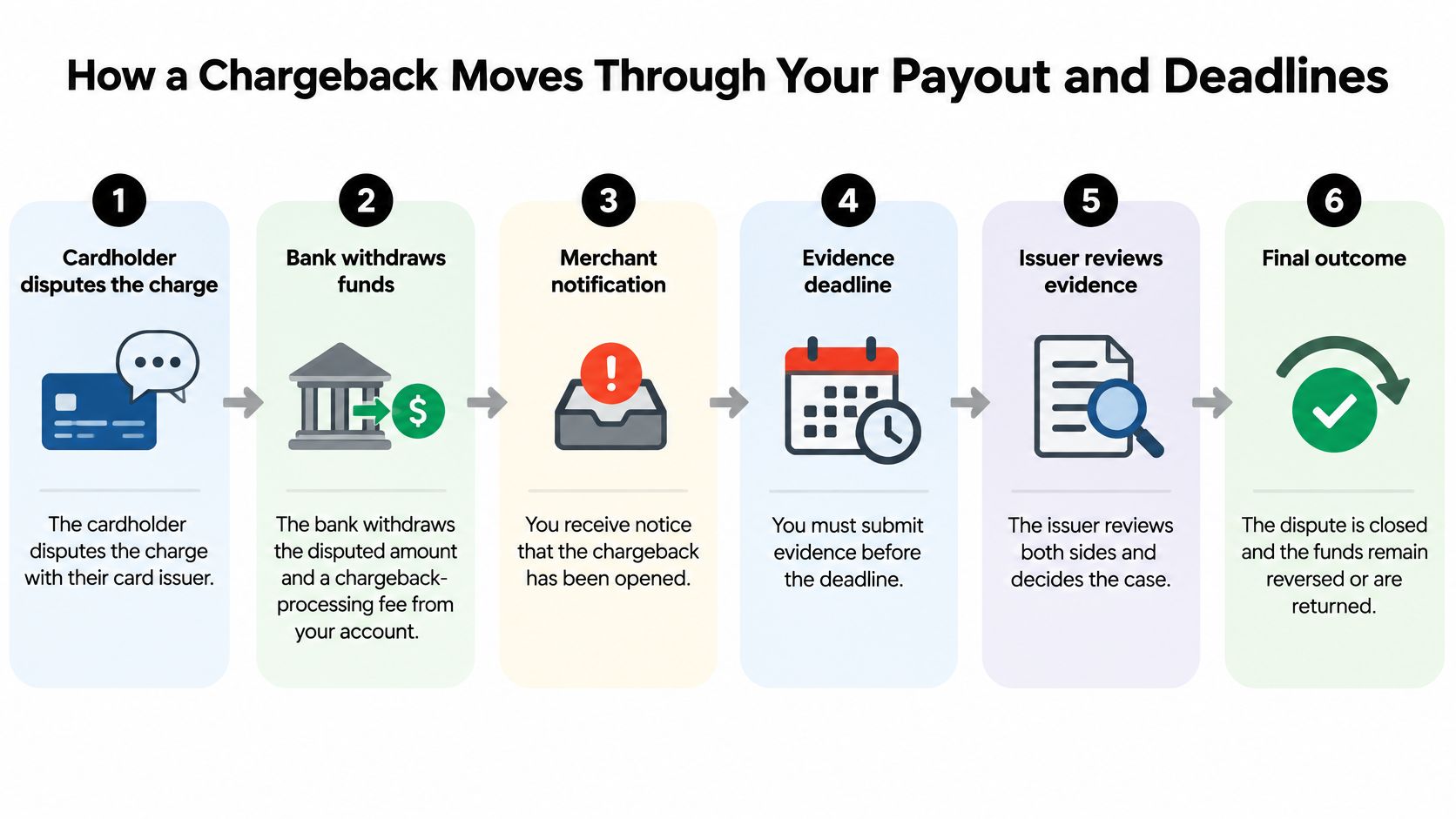
Even a case you eventually win can leave you short of operating cash while it's open. Don't commit expected recoveries to supplier payments or shipping bills before the money appears in your payout records.
For the accounting workflow, Jumpstart Partners' guide to reconciling credit card transactions provides context for matching payment activity with settlement records. Keep the original sale, dispute deduction, fee, and any recovery connected to the same order.
The customer's clock isn't your response clock
A delivered order doesn't mean the dispute window has closed. Under the US Fair Credit Billing Act, the Federal Trade Commission's billing-error guidance gives cardholders 60 days from the first statement showing the error to dispute in writing, with issuer acknowledgment generally due within 30 days and resolution within two billing cycles, no later than 90 days after receipt of the letter.
The written dispute goes to the issuer's billing-inquiries address, not its payment address. These consumer billing-error rules are separate from the deadline your store receives for submitting chargeback evidence.
Dispute deadlines by party
| Party or step | Deadline | Source |
|---|---|---|
| Cardholder written dispute, US credit-card billing error | 60 days from the first statement showing the error | Federal Trade Commission |
| Card issuer acknowledgment | Generally within 30 days unless already resolved | Federal Trade Commission |
| Card issuer resolution | Two billing cycles, and no later than 90 days after receipt of the letter | Federal Trade Commission |
| Shopify merchant response to a chargeback | Typically 7 to 21 days after filing | Shopify Help |
A customer's legal dispute window doesn't extend your merchant evidence deadline.
Set a reminder when the Shopify notification arrives, with an internal preparation deadline before the actual submission cutoff. Keep order, tracking, and delivery records accessible through the case's resolution, including the applicable consumer-law resolution period, rather than deleting them after delivery.
Whether to Fight Each Chargeback or Accept It
Would contesting this chargeback recover more than it costs your team to pursue? The processor fee is often the smallest part of the decision. Staff time and submission costs can outweigh the disputed amount, especially on low-value orders.
Mastercard's chargeback-cost analysis reports that US merchants average $46 in third-party costs and $82 in internal costs per chargeback. Those figures are not a store's automatic cost, but they show why the work of preparing evidence belongs in the calculation.
Base each fight on incremental recovery
Start with this calculation:
Expected recovery = disputed amount × estimated probability of winning − additional labor and submission costs.
If your processor returns the fee when you win, include that potential recovery. Track merchandise, shipping, and nonrefundable fees separately: they show the total loss, but more work on a dispute will not necessarily recover them.
Use your own cost-per-case records to estimate the work required. A guide to merchant chargeback protection can help frame the costs and decisions involved. The manual fraud review burden also matters when the same staff must hold legitimate orders for review.
Before contesting, assess:
- Order value against effort. Estimate the remaining work, not just the time already spent opening the case.
- Evidence quality. Check whether delivery records and customer messages address the actual dispute reason.
- Customer history. Compare the order with prior purchases and communications, without treating familiarity as proof of authorization.
- Repeated identifiers. Look for shared devices, IP addresses, shipping addresses, or emails across disputed orders.
Separate the case decision from the pattern investigation
Consider a hypothetical $40 order with a $25 fee and about 45 minutes of staff work. The fee plus labor can exceed the order's value. If the fee is already nonrefundable, base the decision on expected recovery versus additional effort rather than trying to reverse a sunk cost.
For a hypothetical $400 order with the same $25 fee, strong evidence may justify more preparation. The larger recoverable amount can support the extra work, while weak evidence can still make a contest uneconomic.
Decision rule: Set a store-specific dollar threshold below which you accept weak-evidence disputes and log them for pattern analysis.
Allow exceptions when evidence is strong and inexpensive to submit. Investigate repeat sources even when each individual dispute is small. Fighting every case consumes labor; accepting every case can hide recurring first-party misuse or automated abuse.
How Traffic Controls and Checkout Checks Reduce Chargeback Exposure
Which control can act before the disputed order exists? The answer depends on where the suspicious behavior appears.
According to FF News' coverage of the 2024 Chargeback Field Report, 72% of surveyed merchants reported increased chargebacks over the previous three years. Among merchants reporting increased frequency, the average increase was 18%. Sift's 2025 data puts the increase in retail e-commerce chargeback rates at 233%.
These figures describe broad trends, not what an individual store should expect. Use your own dispute reasons and traffic patterns to choose where controls can help.
Prevention controls and where they act
| Control | Where it acts | Exposure it reduces | Trade-off |
|---|---|---|---|
| Address and CVV checks | Checkout | Mismatched card and billing details | Strict decline rules can reject legitimate buyers with typos |
| 3-D Secure authentication | Checkout | Card-not-present fraud | Can add an authentication step for the buyer |
| Order risk screening | Order review before shipping | Suspicious orders that reach fulfillment | Review time and false flags |
| Country and shipping-area rules | Storefront | Visits and attempted orders from regions you don't serve | Broad rules can block real buyers |
| VPN and proxy detection | Storefront sessions | Masked access associated with card testing | Legitimate shoppers also use VPNs |
| Bot blocking | Storefront sessions | Automated card testing and fake sessions | Requires tuning to avoid blocking useful crawlers |
Timing determines what each control can catch. Storefront controls can restrict suspicious visits before an order exists. Checkout checks assess payment activity, while order review gives your team a chance to act before shipping.
Use layered controls where they address different risks. A normal-looking browsing session can still end in a stolen-card payment, and a customer can later dispute an authorized purchase.
Match the control to the failure
Use Shopify Fraud Analysis as one input to order review. Read its available signals together, consider the customer's explanation where appropriate, and document why you shipped or canceled.
For a broader operating checklist, consult chargeback fraud prevention, MANDATE's practical e-commerce fraud detection techniques, and this guide to e-commerce fraud detection. Set rules around observable behavior that warrants intervention, and tune them to avoid restricting legitimate shoppers unnecessarily.
Match the fix to the failure. A confusing billing descriptor calls for clearer payment identification; a delivery complaint calls for fulfillment and communication fixes.
Review your last five disputes and assign each to the control that could plausibly have spotted the problem first. Record cases where no traffic or checkout control would have helped. That record helps keep traffic restrictions focused on risks they can address.
Where Securify fits
Where do chargeback fees fit in the wider cost of a dispute? They are usually the smallest line. Staff time, lost merchandise, refunds, and the payment amount can matter more, so traffic controls are useful when they address a pattern that starts before checkout.
Securify is a security and traffic quality platform for Shopify merchants. It helps merchants whose chargebacks have been creeping up identify fraud patterns at the visit, before they become disputed orders weeks later. Its controls cover the storefront traffic layer; they do not replace checkout or payment fraud tools.
Consider targeted controls when disputes are associated with suspicious visits, such as repeated masked sessions or traffic from countries the store does not serve. A suspicious signal is not proof that every visitor is fraudulent, so restrictions can also block legitimate shoppers. The practical test is whether the traffic pattern plausibly connects to disputes and whether the staff time spent adjusting rules is justified by the exposure they could reduce.
Check dispute patterns alongside traffic quality, then choose controls you can justify. The aim is to catch relevant activity early without treating every disputed order as a traffic problem.
Chargeback Fee Questions Merchants Ask
Do I get the chargeback fee back if I win?
Yes, on Shopify Payments, the disputed amount and chargeback fee are returned when you win. If the customer wins, neither is returned, and other processors can apply different fee-return policies, so check the agreement for the payment method involved.
Is a refund better than fighting a chargeback?
A refund can be the better resolution before a dispute, but it isn't automatically the right action once a chargeback is open. Confirm with your processor or Shopify Support how the refund would affect the disputed payment and fee, and how the existing case must be closed. Don't assume issuing a refund alone ends the dispute.
Does one chargeback hurt my account?
One chargeback is a reason to review the order, not proof that your account is in trouble. Card networks and Shopify monitor chargeback rates, and you should keep yours as low as possible. Watch for a rising pattern and repeated sources rather than dismissing each case as an isolated expense.
Securify offers storefront bot blocking, VPN and proxy controls, and country rules for merchants whose dispute patterns start with suspicious visits. Visit Securify to assess that earlier traffic layer, then compare the available controls with the patterns in your dispute log.