
First-Party Fraud Explained: What It Is and How to Stop It
First-party fraud is when the customer is the fraudster: friendly fraud, refund and promo abuse, serial returns. What Shopify shows you and what stops it.
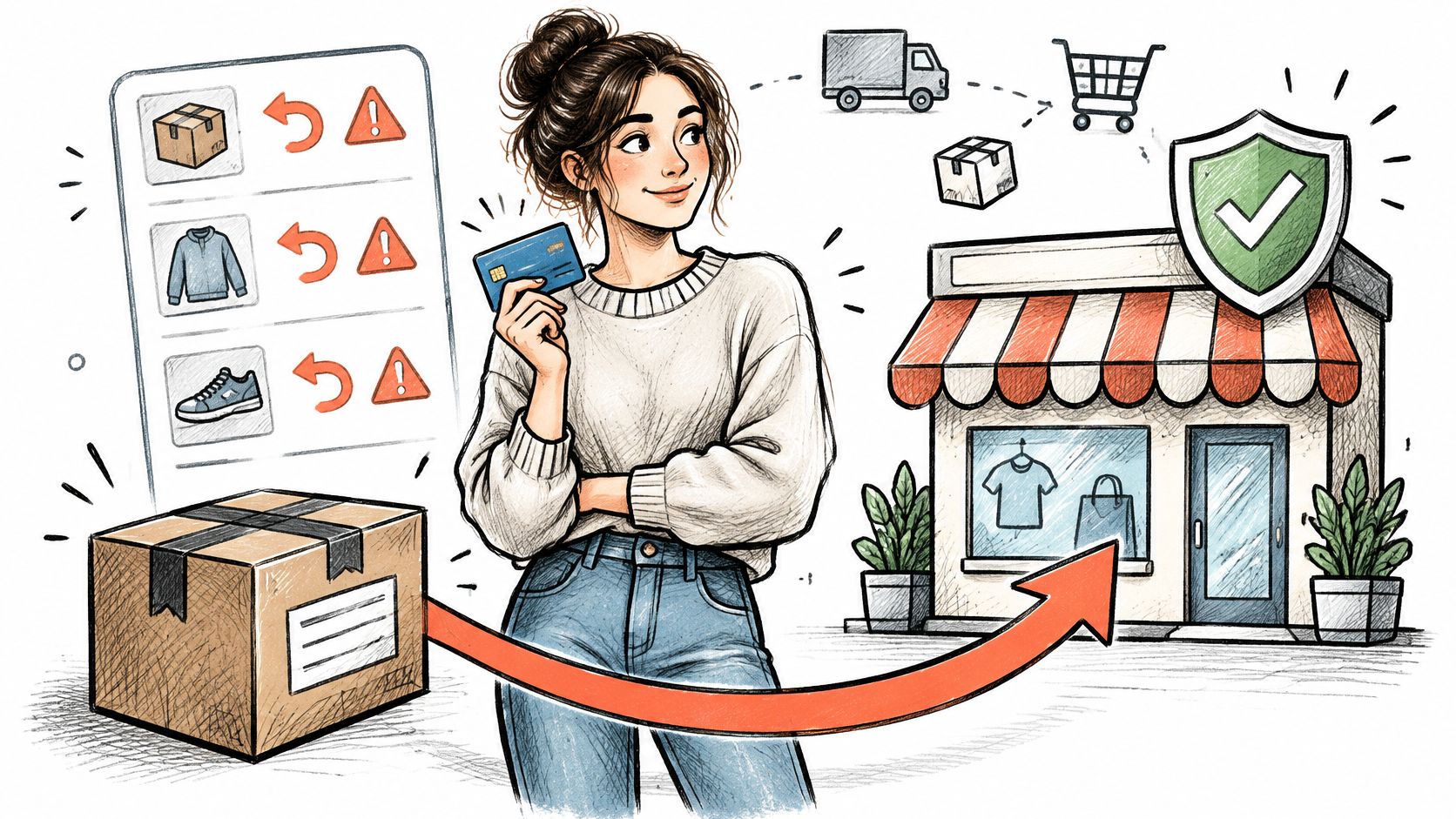
First-party fraud is when a customer uses their own identity, card and account to get goods, refunds, discounts or credits they aren't entitled to. The payment can be genuine while the customer's later claim is false.
For a Shopify merchant, that's a frustrating distinction. You checked the order, shipped to the buyer's address and kept the tracking number. Nothing looked stolen. Then a dispute arrived, or the return box contained something you never sold. Stopping this pattern takes more than a checkout risk score. It takes clear rules, useful evidence and a customer record your team can act on.
Table of Contents
- Why First-Party Fraud Hits Ecommerce Stores Differently
- What Is First-Party Fraud in Ecommerce
- First-Party Fraud Examples in Your Online Store
- First-Party vs Third-Party Fraud Side by Side
- Why Shopify Fraud Analysis Misses First-Party Fraud
- How to Prevent First-Party Fraud Without Blocking Good Customers
- Where Securify fits
- First-Party Fraud Questions Answered
Why First-Party Fraud Hits Ecommerce Stores Differently
Say a buyer disputes an order weeks after you delivered it to their own address. They used their own card, and your checks passed. The loss looks like a payment problem, but no payment credentials were stolen.
Most banking definitions don't help you decide whether to ship the next order. In ecommerce, the practical issue is simpler: the customer may be the person abusing the transaction.
The delay matters. You need to recognize the pattern across disputes, returns and promotions, then preserve evidence before fulfillment. Otherwise, each new order looks unrelated to the last loss.
What Is First-Party Fraud in Ecommerce
A buyer returns a box that arrives empty, then demands a full refund for the item they kept. Card networks label the dispute version of this behavior first-party misuse. Mastercard's security rules describe the underlying issue: a legitimate cardholder challenges a genuine transaction, potentially after receiving the goods or services.
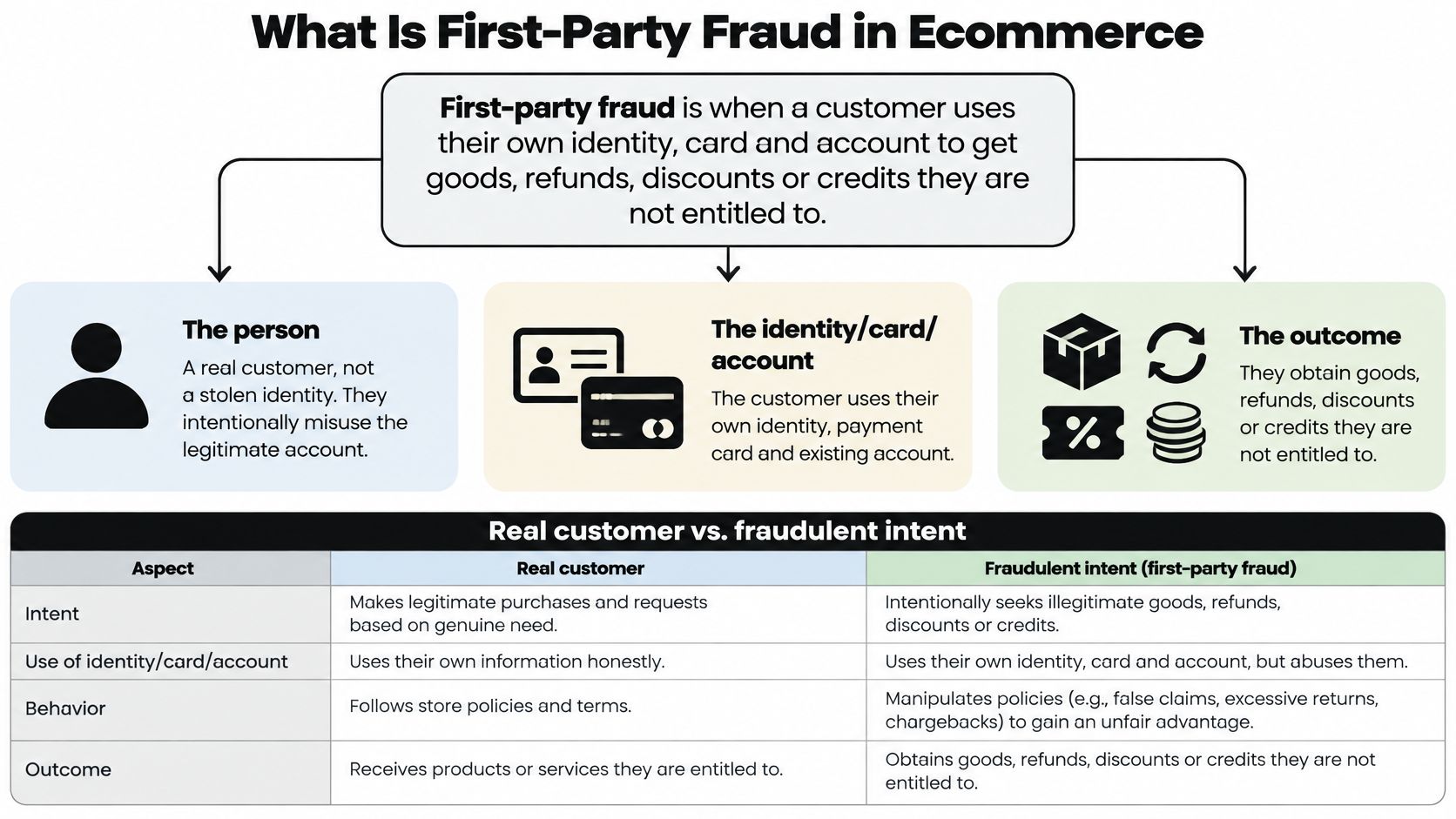
The distinction from third-party fraud matters in your admin. Third-party fraud means someone uses another person's card or account without authorization, so stolen-card screening catches it. First-party cases come from the account holder themselves, which is why those checks stay silent. In lending, the same term covers lying on an application; a store owner needs a broader operational view spanning orders, refunds, returns and promotional benefits.
Not every inaccurate dispute is deliberate. A forgotten purchase or unfamiliar billing name can produce a similar complaint. Intent changes your response: help a confused buyer recognize the purchase, but investigate contradictory claims before granting another refund.
First-Party Fraud Examples in Your Online Store
Treat these as investigation categories, not automatic findings of fraud. A return, shared address or delivery complaint alone doesn't establish dishonesty.
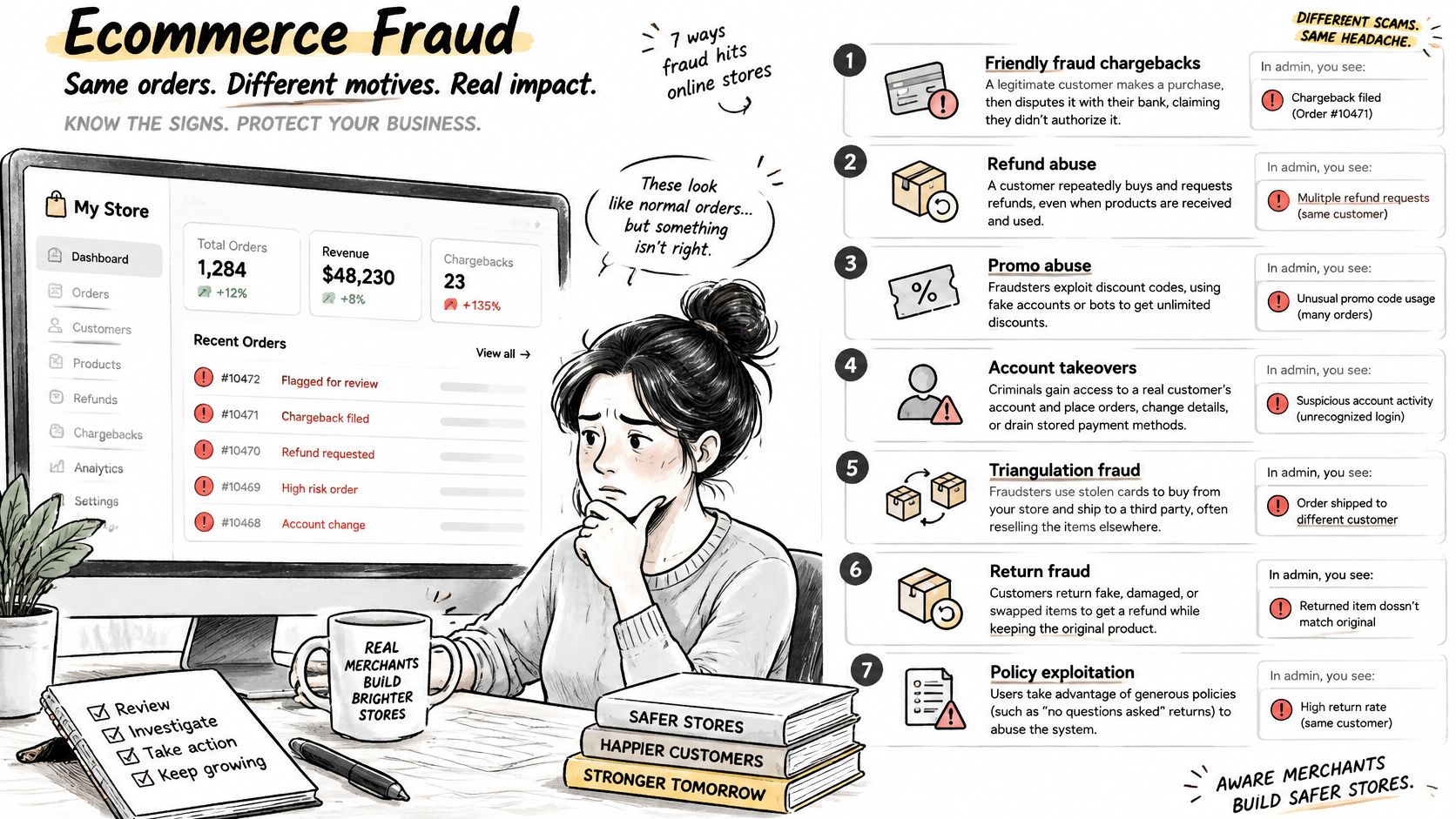
Seven patterns worth reviewing
-
Friendly fraud chargebacks. A real buyer disputes an authorized order as unrecognized, not received or not as described. The dispute might reflect confusion or deliberate misuse, so compare the claim with the order's history. In admin, friendly fraud can appear as a dispute against a fulfilled, delivered order.
-
Item-not-received refund requests. Tracking shows delivery, but the buyer asks support for a replacement or refund. Misdelivery remains possible, so check the carrier's evidence rather than treating a delivery scan as conclusive. In admin, you see delivered fulfillment alongside the refund request your team records.
-
Refund and return abuse. A buyer sends back worn merchandise, a different item or an empty box. Inspect the package before approving the refund and attach warehouse evidence. In admin, return fraud appears through return reasons and inspection notes or photos your team adds.
-
Promo and discount abuse. A buyer creates several emails to reuse a welcome offer, or exploits combinations your promotion wasn't meant to allow. A leaked code isn't proof the buyer acted fraudulently. In admin, you see repeated discount usage across orders and customer records.
-
Account and referral abuse. Several accounts collect referral credits, points or welcome gifts for the same person. Compare addresses and redemption histories; device information requires supporting records and isn't automatically available across customer profiles. In admin, repeated shipping details can connect apparently separate customers.
-
Serial returners. A customer returns most purchases while staying within your published policy. That can destroy margin without constituting fraud, so separate unprofitable behavior from false claims. In admin, review the customer's orders and associated returns rather than assuming a built-in return-risk score exists.
-
Chargeback after a refund. A refund and dispute land on the same order. Timing or processing confusion can explain the overlap, so match the refund confirmation to the disputed payment. In admin, both events appear in the order's payment history.
Customer-record checks
- Repeat claims: Review disputes and refunds across the customer's orders.
- Return frequency: Compare completed orders with their associated returns.
- Shared addresses: Compare shipping details across customer records.
- Repeated offers: Review discount usage and the orders receiving it.
For payment-specific investigation, use the Shopify chargeback fraud guide. The pattern matters more than a single suspicious event.
First-Party vs Third-Party Fraud Side by Side
First-party vs third-party fraud compared
| Dimension | First-party fraud | Third-party fraud |
|---|---|---|
| Who | The customer using their own card and identity | An unauthorized person, sometimes using automated attempts |
| Signal at checkout | Card and address checks can pass | Failed checks, inconsistent details or repeated attempts may appear |
| What Shopify shows you | Order history, dispute records, return reasons, and your tags and notes; no dedicated first-party-fraud verdict | Fraud Analysis recommendations where available; blocked attempts only where relevant controls provide them |
| When you find out | Often after fulfillment through a dispute, return, refund request or promotion review | Potentially before fulfillment if checks identify the attempt |
| What stops it | Enforceable policies, delivery evidence, selective verification and customer-level restrictions | Payment-risk review, configured cancellation rules and upstream traffic controls |
Two edge cases decide the column. Account takeover remains third-party even when the attacker signs into an established account and uses the saved address; the customer still did not authorize that order. A household purchase is less tidy: authorized use of a partner's card sits on the first-party side, while a relative using stored credentials without permission needs investigation before you label it.
Neither column guarantees a clean checkout result. Stolen-card purchases can pass checks, and genuine buyers can trigger warnings. Treat the label as routing: authorized-buyer abuse points to enforceable policy, delivery evidence, selective verification and memory on the customer record; unauthorized use points to payment-risk review, configured cancellation rules and upstream traffic controls.
Practical rule: Classify who authorized the purchase before deciding which control failed.
Use Shopify risk management to place that decision within your wider review process.
Why Shopify Fraud Analysis Misses First-Party Fraud
Shopify Fraud Analysis focuses on the risk of a chargeback due to fraud, rather than predicting every future customer disagreement. A buyer using their own payment method, address and familiar device may give transaction checks little reason to object.
That's the boundary, not a claim that the tool never catches relevant behavior. A repeat abuser can still place an order with suspicious characteristics. But a low-risk recommendation doesn't establish that the buyer will follow your return policy or tell the truth afterward.
For a closer explanation, see how Shopify Fraud Analysis rates an order.
Your operational record supplies a different kind of evidence:
- Order history: Earlier purchases, refunds and disputes.
- Return records: Stated reasons compared with inspected merchandise.
- Customer notes and tags: Documented decisions your next reviewer can understand.
- Support records: Messages acknowledging receipt, use or an agreed resolution.
Keep observations separate from conclusions. “Returned a different SKU, inspection photo attached” is useful. “Scammer” gives the next employee nothing they can verify.
How to Prevent First-Party Fraud Without Blocking Good Customers
Start by separating confusion from abuse. A clearer billing descriptor and recognizable confirmation email can resolve a forgotten purchase without adding checkout friction.
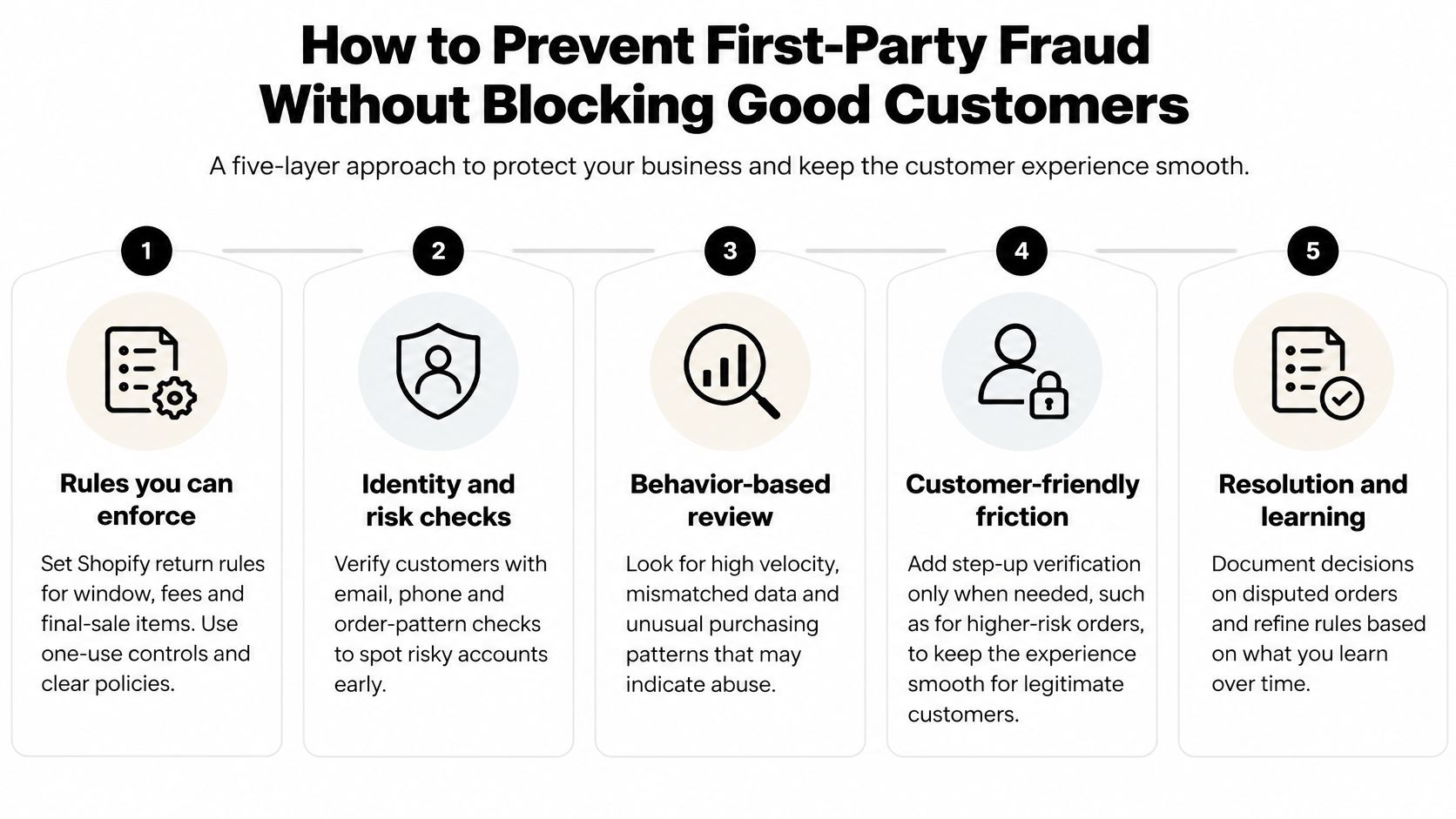
Rules you can enforce
Set explicit return windows, applicable fees and final-sale exclusions. Configure discount eligibility, usage limits and minimum purchases instead of relying on promotional wording alone.
Show the relevant terms before purchase and repeat them in confirmation messages. Make support easy to reach so customers have a practical route to resolve mistakes without going directly to their bank.
Proof on every order
Retain carrier tracking, delivery confirmation, the purchased listing and customer messages. Consider signatures or delivery photos for expensive shipments, recognizing that they establish delivery rather than proving every part of a buyer's claim.
Shopify's chargeback process guide gives a response window of usually 7 to 21 days, and your response is submitted on the due date even if you haven't added evidence.
Where lawfully collected, retain relevant IP and device records: Visa's Compelling Evidence 3.0 framework uses matching historical transaction information, including IP address or device identification, for eligible disputes. Limit access and retention; Trackingplan's first-party data privacy considerations offer useful context for handling these records responsibly.
Verify risky orders before shipping
Review first orders with unusually high value or explanations that don't match the order details. Send a specific question by email or call before releasing fulfillment.
For selected cases, OTP+ offers phone confirmation of risky orders. A confirmed phone establishes access to that phone, not honest intent, so don't treat verification as a guarantee against a later dispute.
Remember customers
Tag documented disputers and return-abuse cases, but distinguish unresolved allegations from established patterns. Use customer risk assessment to give reviewers a repeatable decision process.
Apply available checkout restrictions carefully, testing which identifiers your configuration supports. Shared IPs and household addresses can affect innocent buyers; Shopify doesn't provide a universal customer-profile block button that solves every repeat-order route.
Respond consistently
Learn how to fight a friendly fraud chargeback with evidence matched to the actual claim. Refund promptly when your store made the mistake, and decline future purchases when documented abuse justifies that decision.
Card networks and Shopify monitor chargeback rates, so keep yours as low as possible. Don't improve a fraud dashboard by refusing legitimate resolutions.
Where Securify fits
First-party fraud is a customer-history problem as much as a transaction problem. Your team needs a way to apply what it already knows before another order creates more work.
Securify on the Shopify App Store blocks fake and risky emails and customers, checking a blocked email at checkout so an order using it is never created. That's useful for restricting a known repeat abuser, not proving that an unfamiliar buyer intends to commit fraud.
The Free plan includes this, along with unlimited IP, IP-range and country blocking, unlimited high-risk order alerts and unlimited visitor logs.
Securify works before or alongside Shopify Fraud Analysis, not instead of it. It doesn't detect friendly fraud at checkout, score disputes, handle chargebacks or manage returns. Keep policy decisions and supporting evidence in your store's review process.
First-Party Fraud Questions Answered
What should I do when a chargeback notification arrives?
Start with the deadline, because everything else has to fit inside it. Pull the order's delivery confirmation, the policy acceptance captured at checkout, and any support thread tied to that customer. Submit the relevant evidence through the dispute channel before the cutoff, then record the outcome on the customer profile either way.
What evidence should I keep after a refund or dispute?
Keep what you would need to show the same claim happening twice: delivery and tracking confirmation, the terms the buyer accepted at checkout, support messages, return photos if you collected them, and the order's full history. Store it on the customer record so it survives archived support threads. A second dispute months later is only recognizable if the first one left a trail.
Should I refund a suspicious claim or contest it?
For a first claim with no prior pattern, a refund often costs less than the staff time a dispute consumes. A documented repeat pattern changes that calculation: refusing with your stated policy protects the margin and builds the record you need later. The right call depends on what the customer history shows, so keep it current.
How do I restrict a repeat abuser without blocking a household?
Restrict at the account or email level before reaching for IP controls. An IP block can cover an entire network, including relatives, roommates or unrelated shoppers on the same connection. Check whether the address, device or payment details are shared with legitimate customers first, then apply the narrowest control that stops the pattern.
Can I tell a fraudster from a genuinely unhappy customer?
A mistaken complaint and a fraudulent one look identical in isolation. Intent shows up in the pattern: repeated disputes, returns that fall just outside policy, benefit claims spread across accounts. Investigate before you assign blame, and treat one-off incidents as service cases unless the record says otherwise.