
· shopify chargeback fraud · chargeback prevention · friendly fraud · fraud protection · shopify fraud
Shopify Chargeback Fraud: Prevention and Protection
Learn how Shopify chargeback fraud works, detect friendly fraud and stolen cards, and protect your store with practical prevention steps.
You're looking at an order that seems ordinary until the details start to separate. The customer's billing location doesn't fit the shipping destination. The session came through a masked connection. Several orders arrived within minutes, each using a different name but similar checkout behavior. By the time the first chargeback appears, the failure may have started days earlier in the traffic reaching your store.
Shopify chargeback fraud isn't only a dispute-management problem. It can begin with low-quality traffic, stolen payment credentials, account misuse, or a buyer who knowingly disputes a legitimate purchase. The practical response is to reduce suspicious activity before fulfillment, preserve evidence while the order is fresh, and keep your chargeback rate as low as possible because payment networks and Shopify monitor it.
Table of Contents
- What Shopify Chargeback Fraud Actually Looks Like
- Common Shopify Chargeback Fraud Attack Patterns
- How Chargebacks Hurt More Than Sales
- How to Spot Suspicious Orders Before Chargebacks
- Prevention Steps and Dispute Workflow
- Where Securify fits
- Frequently Asked Questions
What Shopify Chargeback Fraud Actually Looks Like
A merchant sees a chargeback as a transaction problem. The bank sees a disputed payment. Your operations team sees a lost order, a fee, an evidence deadline, and another investigation added to the queue. Those descriptions are all accurate, but they miss the upstream pattern.
Suppose a store receives a burst of new customers from an unfamiliar geography. Most sessions are short, several visitors use masked connections, and a small group creates accounts with different names but similar device and checkout behavior. A few orders pass payment checks, ship successfully, and then become “fraudulent” disputes. The chargebacks look separate in Shopify, yet the traffic pattern may connect them.

Shopify says a chargeback removes the disputed amount from the merchant right away. If the merchant wins, the disputed amount is returned. Merchants can review open chargebacks and inquiries in the admin, while high-risk orders flagged by fraud analysis can be reviewed before fulfillment, as described in Shopify's chargeback guidance.
The dispute is the visible symptom
The direct loss is obvious, but the operational cost starts earlier. Someone reviews the order, checks the customer record, contacts fulfillment, searches for delivery proof, and decides whether to cancel or ship. If the store treats every unusual order as dangerous, legitimate buyers can face friction or unnecessary cancellations.
The better question is not just, “Can we win this dispute?” It's, “What brought this order into the funnel, and did similar sessions behave the same way?” That shift helps you find bad traffic before it turns into inventory loss and dispute work.
Practical rule: Treat a chargeback as an investigation into the order and its source traffic, not as an isolated event.
Shopify separates fraudulent chargebacks from the overall chargeback rate in its reporting. That distinction matters because a store can have customer-service disputes, fulfillment complaints, and suspected payment fraud mixed together in one broad number. The chargeback fraud prevention guide offers a useful framework for separating those causes and assigning the right response.
Common Shopify Chargeback Fraud Attack Patterns
Fraud rarely arrives with a single unmistakable signal. It usually appears as a combination of weak signals that become meaningful when you compare orders, sessions, and fulfillment records.
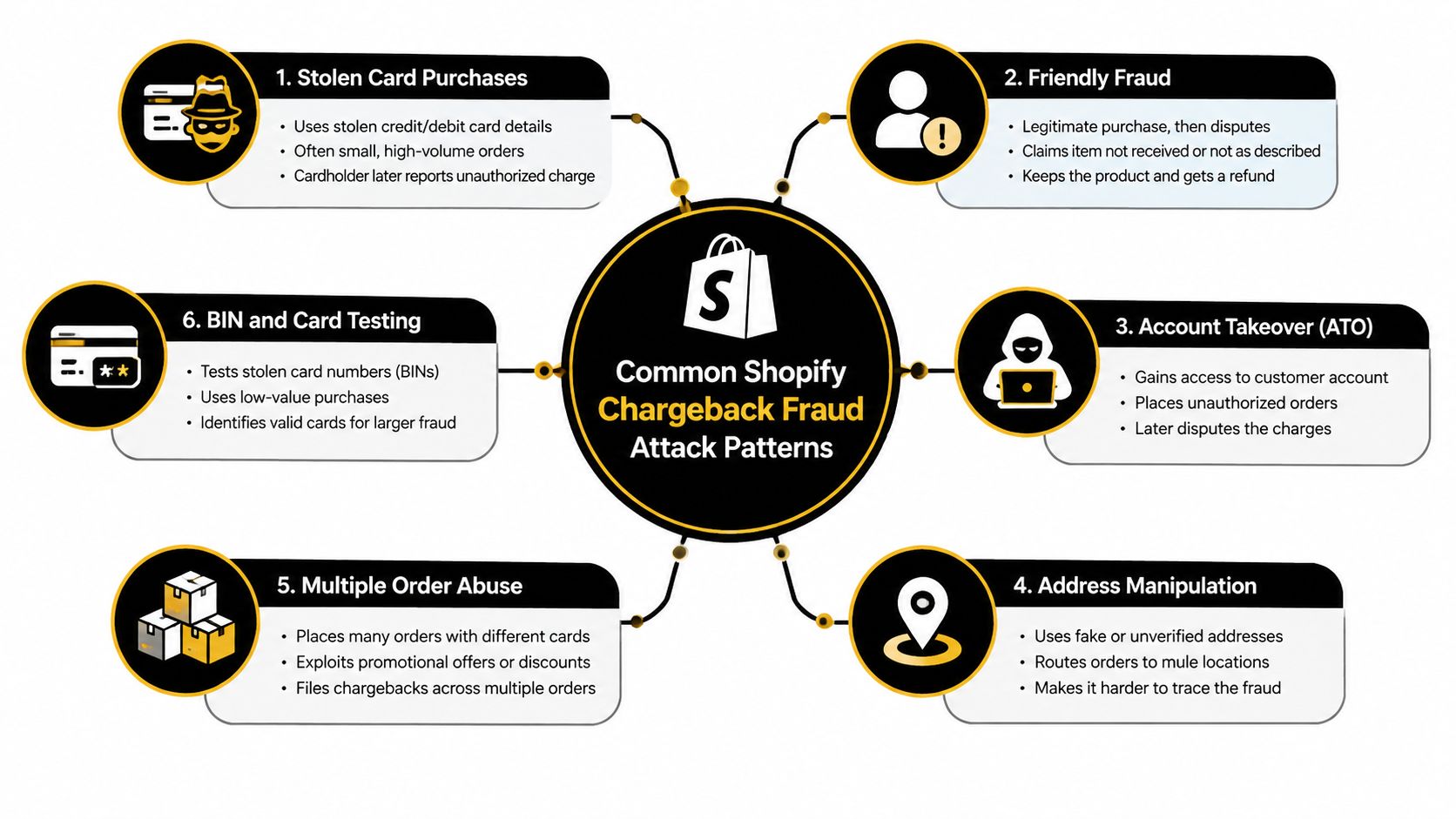
Friendly fraud and stolen payment methods
Friendly fraud occurs when a cardholder knowingly disputes a purchase, or claims not to recognize it despite having made or received the order. It can look like a normal customer complaint, especially when the billing descriptor is unfamiliar or a household member placed the order.
Stolen payment methods create a different pattern. The buyer may use a new account, rush delivery, choose high-resale products, or provide a shipping address that has no relationship to the billing details. A single mismatch doesn't prove fraud. Several mismatches combined with unusual checkout behavior deserve review before fulfillment.
Bot-driven and masked traffic
Automated traffic can create fake accounts, test payment credentials, scrape product information, or inflate acquisition reports. VPN and proxy use isn't automatically malicious, but repeated masked sessions from locations that don't match your market can make attribution harder.
Watch for:
- Velocity: Multiple orders arrive close together, with similar carts or checkout paths.
- Identity variation: Names and email addresses change, but device or session characteristics repeat.
- Routing anomalies: Orders originate from masked or unexpected locations while shipping destinations cluster elsewhere.
- Account reuse: New accounts show behavior associated with older disputed orders.
- Checkout pressure: Buyers request urgent shipping, unusual address changes, or repeated payment attempts.
Mastercard says a strong rebuttal package includes the IP address, exact purchase timestamp, AVS and CVV match results, delivery confirmation, and the customer's purchase or usage history. Those details connect the transaction to a device, location, and fulfillment trail, as explained in Mastercard's chargeback evidence guidance.
The goal isn't to block every order with an imperfect profile. It's to identify repeated combinations that correlate with disputes, then apply proportionate controls. A customer with one unusual signal may need no intervention. A cluster of similar sessions and prior disputes should receive a different treatment.
How Chargebacks Hurt More Than Sales
The disputed order value is only the first line in the loss. A merchant may also lose the product, pay operational costs, absorb payment fees, spend staff time on evidence, and lose the opportunity to sell that inventory to a legitimate customer.
Fraud also damages decision-making. Fake visitors can inflate sessions, distort conversion rates, contaminate audience reports, and make a campaign appear weaker or stronger than it really is. If suspicious traffic lands on product pages but rarely completes legitimate purchases, marketing teams may change targeting or creative when the real problem is traffic quality.
The cost appears before the dispute
A manual-review queue has a capacity limit. When staff investigate too many ambiguous orders, they either slow fulfillment or approve risky orders under pressure. Excessive caution creates false positives, which can reduce conversion and frustrate genuine customers.
That creates a difficult trade-off:
- Approve everything: Fulfillment moves quickly, but fraud and dispute exposure rise.
- Review everything: Risk may fall, but labor costs and customer friction increase.
- Filter upstream: The store removes more suspicious sessions before they create orders, leaving staff to review the cases that still need judgment.
The third approach is not automatic protection. It requires good rules, monitoring, and periodic adjustment. But it addresses the source of the workload instead of asking the dispute team to absorb every downstream consequence.
Recent industry data cited by Shopify says the total cost of fraud for US retailers reached $4.61 for every $1 of fraud in 2025, up 32% since 2022. The same source reports that businesses win only about 50% of representments on average, or 54% in the US, as described in Shopify's ecommerce fraud management analysis.
Those figures change how a merchant should evaluate prevention. A control that reduces suspicious traffic may protect analytics and review capacity even when it doesn't eliminate every chargeback. For a deeper look at this upstream economics problem, see the guide to Shopify chargeback costs and early traffic control.
Bad traffic weakens the measurement loop
A store that counts fake sessions as demand can make poor budget decisions. It may retarget visitors who were never genuine prospects, interpret low conversion as a product problem, or overestimate the quality of a marketing channel.
Clean measurement doesn't replace fraud review. It gives the review team better context. When suspicious sessions are visible as a distinct class, merchants can compare their behavior with legitimate visitors and decide whether to block, challenge, monitor, or allow them.
How to Spot Suspicious Orders Before Chargebacks
Start with the order, then inspect the session and customer history around it. Shopify's fraud analysis tool is designed to identify orders that may be fraudulent before fulfillment. For high-risk orders, Shopify says merchants can verify, cancel, or refund the order, so the review needs to happen before inventory leaves the warehouse.
Use a repeatable review sequence
Check the following in the same order every time:
- Confirm the payment and identity signals. Review AVS and CVV results, billing and shipping details, email quality, phone information, and whether the customer has prior undisputed purchases.
- Inspect the traffic context. Look for masked connections, unexpected geography, repeated session behavior, unusual referral sources, and rapid activity across several accounts.
- Compare fulfillment risk. Consider the product's resale value, shipping speed requested, address changes, and whether delivery confirmation will be available.
- Choose a documented outcome. Verify the order, pause it for human review, cancel it, or refund it. Record the reason so later analysts can compare decisions with outcomes.
For card-not-present disputes, network rules emphasize compelling evidence that links the cardholder to the transaction or demonstrates prior undisputed use. Collecting device-level, identity, and fulfillment telemetry at checkout improves the evidence available for a fraud dispute, according to American Express compelling evidence guidance.
Chargeback risk signals to watch
| Signal | What it suggests | Recommended action |
|---|---|---|
| Billing and shipping details don't align | Possible stolen payment method or reshipping activity | Hold fulfillment and verify the customer |
| Masked connection from an unexpected location | Identity and geographic attribution are less reliable | Compare with account, device, and order history |
| Several accounts show similar checkout behavior | Automation, testing, or coordinated abuse | Group the orders and inspect the shared signals |
| Urgent shipping for a high-resale item | The buyer may prioritize speed over normal purchasing behavior | Require additional review before fulfillment |
| Prior disputes linked to similar identity signals | Repeat abuse or an unresolved customer issue | Review past orders and set a consistent policy |
| Traffic spikes without corresponding legitimate sales | Bot activity or low-quality acquisition | Segment the traffic and adjust upstream controls |
Don't rely on a single flag. A customer traveling abroad may use a VPN for privacy. A legitimate gift order may ship to a different address. The decision becomes stronger when several independent signals point in the same direction.
The Shopify fraud orders guide can help your team turn these checks into a consistent operating process rather than an improvised judgment call.
Prevention Steps and Dispute Workflow
Prevention starts before fulfillment. Shopify's fraud analysis can surface high-risk orders, but a score or warning doesn't make the decision for you. Review the order, confirm details when the value justifies the effort, and cancel or refund when the risk is not acceptable.
Build the workflow around evidence
Capture useful evidence while the order is active, not after a dispute arrives. Retain the exact purchase time, IP information, AVS and CVV outcomes, customer communications, account history, fulfillment records, tracking, and delivery confirmation where available.
Keep customer communication organized as well. A shared record between operations, support, and fulfillment prevents one team from promising a refund while another submits contradictory evidence. Teams that need a broader system for organizing conversations can also review retail communication software as part of their support process.
When a chargeback opens, Shopify says the customer first disputes the charge with their bank. The bank then initiates the chargeback, withdraws the disputed amount plus a fee, and Shopify notifies the merchant with a response deadline. Evidence windows are usually 7 to 21 days, and issuer review can take up to 75 days after evidence submission, according to Shopify's chargeback process.
Match evidence to the claim
Don't upload a generic order summary and expect it to answer every dispute. A fraud claim needs identity and transaction evidence. A delivery claim needs fulfillment and delivery proof. A product complaint needs the listing, customer messages, and records showing what was supplied.
Use a simple case checklist:
- Reason code: Identify what the customer claimed.
- Timeline: Connect order placement, payment, communication, shipment, delivery, and usage.
- Identity: Show consistent customer, device, address, and payment signals.
- Fulfillment: Include tracking and delivery confirmation.
- Communication: Provide messages that demonstrate purchase knowledge or resolution attempts.
- Submission quality: Make the evidence legible, direct, and relevant to the claim.
A successful representment can return the disputed amount, but it doesn't remove the need to fix the traffic or order pattern that created the case. Prevention, review, and evidence collection should operate as one workflow.
Where Securify fits
Securify sits upstream of Shopify's order-level review. The Shopify app can filter bot traffic, detect VPN and proxy abuse, apply geo-blocking rules, and classify suspicious sessions before poor-quality activity turns into checkout noise. That can help merchants protect analytics and reduce the number of questionable sessions reaching the order queue, but it isn't a chargeback guarantee or a replacement for evidence collection.
The practical role is early visibility. A merchant can inspect traffic quality, identify repeated patterns, and apply controls before or alongside Shopify's built-in fraud tools. Stores that need a Shopify-focused traffic control option can review Securify on the Shopify App Store.
For merchants evaluating broader order protection workflows, Shopify Protect provides related background on how prevention and downstream payment controls fit together.
Frequently Asked Questions
What counts as Shopify chargeback fraud?
It includes disputes involving an unauthorized payment, stolen card details, account misuse, or a cardholder who knowingly disputes a legitimate transaction. Not every chargeback is fraud. Product, delivery, billing, and customer-service problems need different investigations.
Look for connections across orders rather than judging one transaction in isolation. Repeated device signals, masked traffic, similar shipping destinations, and prior disputes can reveal a pattern that a single order doesn't show.
How can you distinguish friendly fraud from genuine payment theft?
Friendly fraud often leaves a stronger customer trail. The buyer may have logged in, used the product, communicated with support, or placed earlier undisputed orders. Genuine payment theft may show weaker identity continuity, unusual geography, rushed fulfillment, and no credible relationship between the customer and the account.
No signal proves intent by itself. Compare purchase history, device and session evidence, communication, and fulfillment records before labeling the case.
Should a store block every VPN user or unfamiliar country?
No. A VPN can belong to a legitimate customer, and blocking broad regions can remove real demand. Use geography and masked access as risk inputs, then combine them with product, identity, velocity, and order-history signals.
If your business doesn't serve a country, geo-blocking may be reasonable. If you do serve it, a review or challenge may be less damaging than an automatic block.
How can merchants reduce fake orders?
Start with traffic quality, checkout signals, and pre-fulfillment review. Segment suspicious sessions, remove obvious automation, inspect repeated identity patterns, and create a clear rule for holding or canceling high-risk orders.
The guide to stopping fake orders on Shopify is useful when the problem includes repeated checkout abuse rather than isolated disputes.
What improves the odds of winning a fraud dispute?
Submit evidence that directly addresses the customer's claim. Include transaction timing, identity and device signals, AVS and CVV results, customer history, communications, fulfillment records, and delivery confirmation when relevant.
Don't wait until the deadline to discover that your team can't reconstruct the order. Evidence retention is a prevention practice, not only a dispute task.
What should a merchant review first?
Review the source traffic, the order's risk signals, and the customer's history before looking only at the chargeback outcome. Then compare the case with recent disputes to find shared patterns.
That sequence helps you decide whether the next action is better fulfillment documentation, tighter review, cleaner acquisition data, or upstream traffic control.
Securify helps Shopify merchants identify bot traffic, VPN and proxy abuse, suspicious sessions, and geo-risky visits before they create more checkout and analytics noise. Visit Securify to assess whether upstream traffic controls fit your chargeback prevention workflow.