
· merchant protection from chargeback · shopify fraud prevention · chargeback dispute evidence · ecommerce risk management · block vpn shopify
Merchant Protection from Chargeback Tactics
Learn practical merchant protection from chargeback tactics for Shopify. Filter risky traffic, build defensible evidence, and handle disputes effectively.

The fastest way to lose money on chargebacks is to treat them like a payment-team problem. By the time a dispute reaches the card network, you've usually already paid for the goods, the shipping, the support time, and the disruption to cash flow, so the main win is stopping suspicious traffic before it becomes an order at all. Merchant protection from chargeback works better when it starts at the storefront, not at representment.
Table of Contents
- The Real Cost of Ecommerce Chargebacks
- Filtering Risky Traffic Before Checkout
- Building Defensible Order and Fulfillment Evidence
- Responding to Disputes Within the Shopify Window
- Where Securify fits
- Frequently Asked Questions About Chargeback Prevention
The Real Cost of Ecommerce Chargebacks
Chargebacks are often described as a cost of doing business, but that framing hides the operational drag. In the U.S. study from the Federal Reserve Bank of Kansas City, merchants received chargebacks equal to about 1.6 basis points of transaction count and 6.5 basis points of sales value for Visa and Mastercard, and merchants ultimately bore about 70% to 80% of chargeback losses. That means the loss is rarely just the disputed sale, it also hits working capital, fulfillment, and team time. The same research found that fraud was the largest category, about 50% of total chargebacks, which is why a prevention-first setup matters so much. Federal Reserve Bank of Kansas City research archive
Why the network view matters
Card networks don't just look at isolated cases, they watch patterns. Visa's merchant screening criteria show how repeated fraud and dispute activity can become an account-level problem when volume and sales ratios cross certain thresholds. That's why a merchant can't think only in terms of “did we win this one dispute,” because the broader pattern affects processing stability and review burden too. Visa Merchant Screening Service documentation
Practical rule: every chargeback should be treated as a signal about traffic quality, checkout quality, or fulfillment evidence. If you only answer after the dispute opens, you're already paying the most expensive version of the problem.
The bigger mistake is waiting to see the damage before making changes. Card-not-present transactions produced a merchant fraud-loss rate of 14.17 basis points versus 1.02 basis points for card-present transactions in the Kansas City Fed study, which is exactly why remote checkout needs upstream controls, tighter evidence, and cleaner session quality. A store that keeps bad traffic out of checkout is protecting both approval quality and the later ability to defend disputes.
For a deeper framework on the economics of early filtering, see shopify chargeback costs and early traffic control.
Filtering Risky Traffic Before Checkout
Most merchants start with payment rules and only later notice the traffic problem. That's backwards. If a session is clearly automated, masked, or coming from a place you don't serve, it shouldn't reach the cart in the first place.
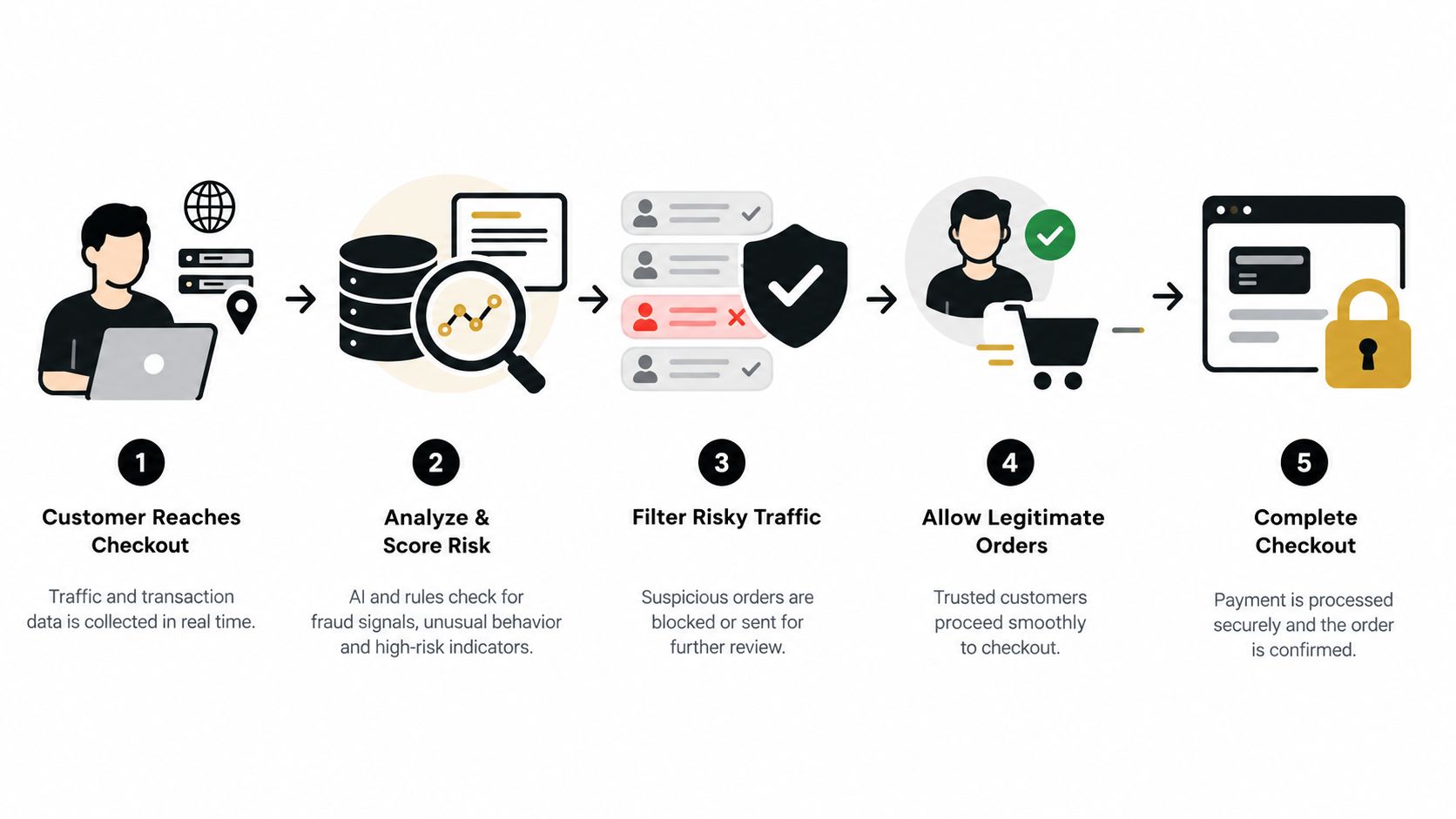
What to filter first
Start with the signals that usually show up before a bad order is placed. Repeated identities, proxy or VPN masking, impossible geography, velocity spikes, and mismatches between billing, shipping, account, and device data are the common patterns that deserve attention. A clean store doesn't need to block every odd visit, but it does need a reliable way to slow suspicious sessions down before they create noise in analytics and support queues.
Here's a practical sequence that works on most Shopify stores:
- Score the session early. Look at geography, device changes, velocity, and repeated checkout attempts before the customer gets far.
- Hold borderline visits. Don't auto-decline every anomaly, route uncertain cases to review or a stronger verification step.
- Preserve the trail. Keep immutable logs tying the session to the order attempt, so later dispute evidence isn't assembled from memory.
- Watch for abuse patterns. If the same masked behavior keeps showing up, use traffic controls at the storefront, not just at checkout.
- Protect legitimate shoppers. Travelers and privacy-conscious buyers can look unusual without being fraudulent, so keep a human review path for edge cases.
How to avoid false declines
The trade-off is real. Tight rules can block fraud, but they can also cut into legitimate conversion if you treat every VPN or geography mismatch as a threat. A better rule is to separate automated abuse from customers who just look unusual, then verify only the borderline cases. If you want a practical example of how merchants use phone verification to add friction only where it's justified, CartBoss on phone verification is a useful reference point.
For merchant-side traffic controls, bots and proxies is the right place to go deeper on storefront filtering logic.
Building Defensible Order and Fulfillment Evidence
A strong dispute file starts before the dispute exists. The best evidence chain connects the first storefront visit to the final delivery, so you can show the card issuer how the same customer moved through the journey. If you only keep one kind of proof, you'll end up with gaps. A clean authorization doesn't prove delivery, and a tracking number doesn't prove the cardholder authorized the purchase.
Map the evidence to the claim
Visa's chargeback guidance is clear that merchants should map specific documents, such as AVS outcomes, device signals, and delivery confirmations, directly to the issuer's stated claim rather than sending a generic bundle. That matters because each dispute reason asks a different question. Fraud disputes need different proof than authorization issues, and consumer disputes need different proof again. Visa chargeback guidance
| Evidence Mapping by Dispute Category | Primary Evidence Required | Supporting Context |
|---|---|---|
| Fraud | Authorization result, AVS or CVV outcome, device and IP signals | Session logs, account creation details, repeat attempt history |
| Authorization | Processor response, card verification outcome, timestamped order record | Billing and shipping match, checkout metadata |
| Processing Error | Order logs, payment capture records, refund history | Descriptor clarity, duplicate-charge review |
| Consumer Dispute | Delivery confirmation, customer-service correspondence, policy acceptance | Cancellation history, refund request trail |
Keep the chain unbroken
The operational goal is simple, preserve the same customer trail across the storefront, checkout, fulfillment, and support layers. If a shopper opens a ticket, that record should sit next to the order. If the order is delivered, the proof should sit next to the tracking event. That kind of continuity is what makes later representment possible instead of frantic.
An evidence file wins when the issuer can follow the story without guessing.
For a useful analogy outside ecommerce, work orders for repair shops show the same principle. The record has to connect intake, approval, work completed, and handoff, or the case gets messy fast.
For a Shopify-specific operational playbook, see Shopify chargeback protection.
Responding to Disputes Within the Shopify Window
Once the chargeback lands, speed matters more than perfection. Shopify gives merchants a limited response window, typically 7 to 21 days after the chargeback is filed, and the exact due date appears in the admin in the store's time zone. If that deadline passes, Shopify won't accept more evidence, and the outcome is final. Shopify chargebacks in admin
What to do on day one
The first job is to classify the dispute correctly. Fraud, authorization, processing error, and consumer dispute each call for different evidence, so don't dump everything into one folder and hope the issuer sorts it out. Pull the order record, delivery proof, support messages, refund history, and any authentication details, then match each item to the reason code.
Shopify also automatically submits available order information on the due date even if the merchant adds no evidence, but that baseline response rarely provides the context needed to win complex disputes. Shopify chargeback process That automatic submission is a floor, not a strategy.
Why waiting hurts
A lot of merchants wait until the last day because they assume more time means better evidence. In practice, waiting usually means lost context. Support threads get buried, staff forgets what happened, and delivery records become harder to match to the original session. The right move is to collect the case as soon as the dispute appears and submit before the deadline, not on it.
A Shopify chargeback also hits cash flow immediately because the disputed amount is deducted from the next available payout. Shopify chargebacks That makes response speed a working-capital issue, not just a back-office task.
Operational rule: if the dispute file isn't ready the same day the chargeback lands, the store is already behind.
For a related overview of payment-fraud handling inside Shopify, shopify fraud protection is a practical next read.
Where Securify fits
Securify fits upstream of the payment event, where the cheapest decisions get made. It evaluates storefront sessions for bot behavior, VPN abuse, proxy masking, suspicious geography, and other bad-traffic signals before a customer reaches the cart, which helps keep junk traffic out of the order stream. That kind of filtering can reduce manual review volume and improve the quality of the data you use later in chargeback defense. If you want to see the product itself, visit Securify on the Shopify App Store.
Frequently Asked Questions About Chargeback Prevention
What is friendly fraud in a Shopify store
Friendly fraud usually means the cardholder recognizes the purchase but still disputes it. The reason can be confusion, household purchases, subscription mistakes, dissatisfaction, or an intentional attempt to get both the product and the refund. The practical answer is better evidence, clearer messaging, and faster support records, not just stricter card blocking.
Can VPN users be legitimate shoppers
Yes. A VPN is a signal, not proof. Some buyers use privacy tools or travel often, and those customers can look unusual without doing anything wrong. The better approach is to flag masked sessions for review, then combine that signal with order history, geography, device consistency, and checkout behavior before deciding.
Should a merchant block every high-risk order
No. Blocking everything that looks strange creates false declines and can hurt conversion more than it helps. A better policy is to hold borderline orders, verify them when needed, and only block when the pattern clearly points to abuse. That gives you room to protect revenue without treating every outlier like fraud.
Why do some disputes win and others lose
Win rates depend on the reason code, the evidence, and whether the merchant represented the case. Merchants can't rely on a single headline percentage because the denominator changes the picture. The stronger move is to track response rate, represented cases, won cases, accepted cases, and expired cases separately so the team knows what's working.
What evidence matters most for a chargeback fight
The best evidence is the evidence that answers the issuer's actual claim. For fraud disputes, that often means authentication outcomes, device and IP data, and the order trail. For delivery disputes, fulfillment and delivery confirmation matter more. For consumer complaints, customer-service logs and policy acceptance become more useful.
If you want cleaner traffic before it becomes a payment problem, visit Securify and see how storefront filtering can support your chargeback workflow. It's built for merchants who want to cut bad sessions early, reduce review noise, and keep better records for the disputes that still get through.