
· bot detection · Shopify bot protection · bot traffic · fraud prevention · ecommerce analytics
Bot Detection on Shopify: Signals, Metrics and Fixes
Learn how bot detection works on Shopify: behavioral, fingerprint and IP signals, how bots skew sales metrics, and fixes you can apply this week.
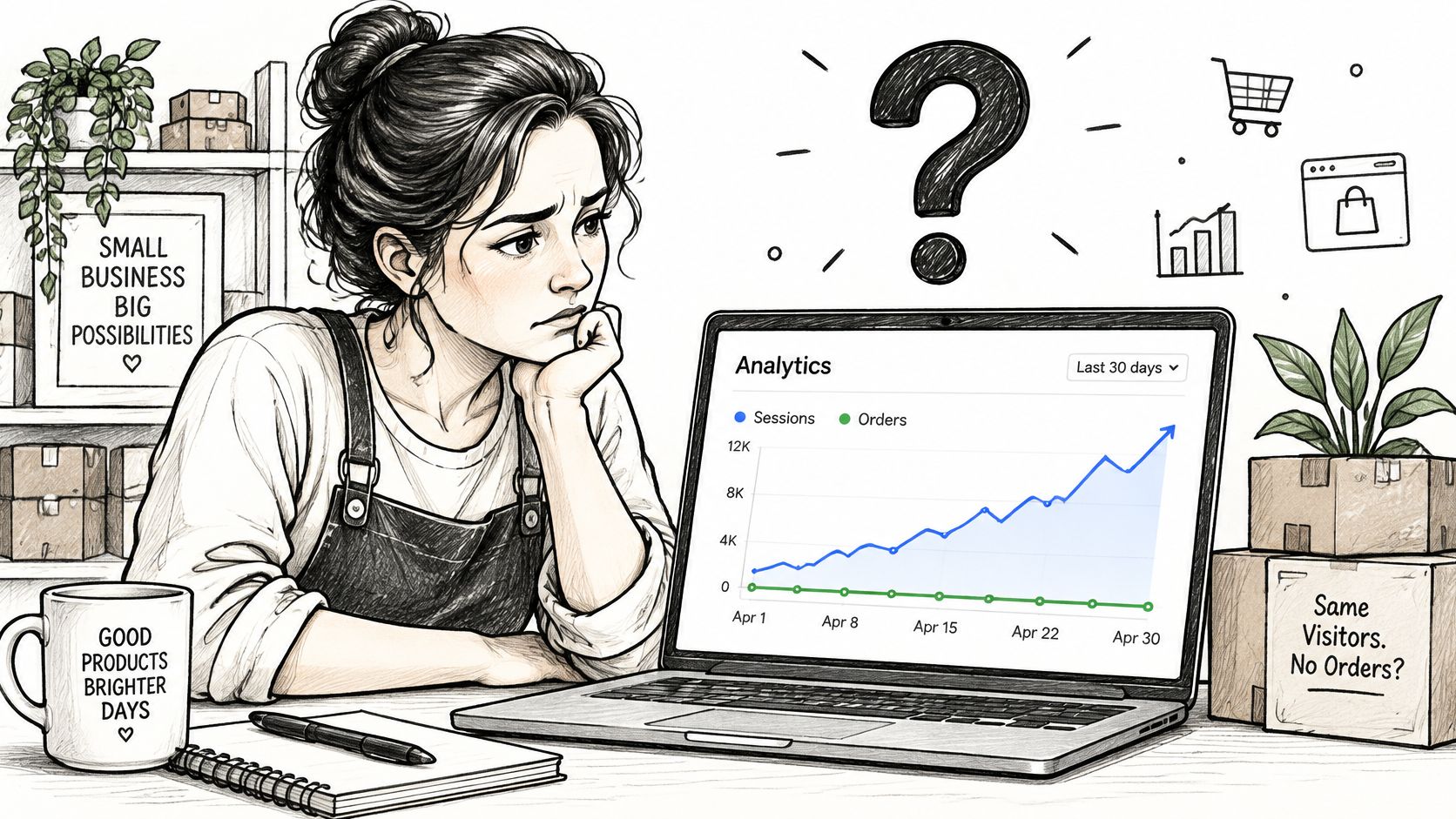
Your Shopify sessions are climbing, but orders aren't moving. Paid traffic looks cheaper, checkout abandonment looks worse, and your team is debating whether to change pricing or rebuild the product pages. Before changing the store, check whether the extra visitors are really shopping.
Table of Contents
- What Bot Detection Is and Why Shopify Stores Need It
- Bot Detection Techniques Compared
- Behavioral Signals That Expose Bots
- Fingerprints and IP Signals Working Together
- How Bots Skew Shopify Sales and Marketing Metrics
- How to Detect and Mitigate Bots on Shopify, Step by Step
- Where Securify fits
- Bot Detection Questions Merchants Ask
What Bot Detection Is and Why Shopify Stores Need It
Bot detection is the work of telling automated visitors apart from people and deciding what to do with each one. For merchants, that decision affects both access to the store and confidence in its reporting.
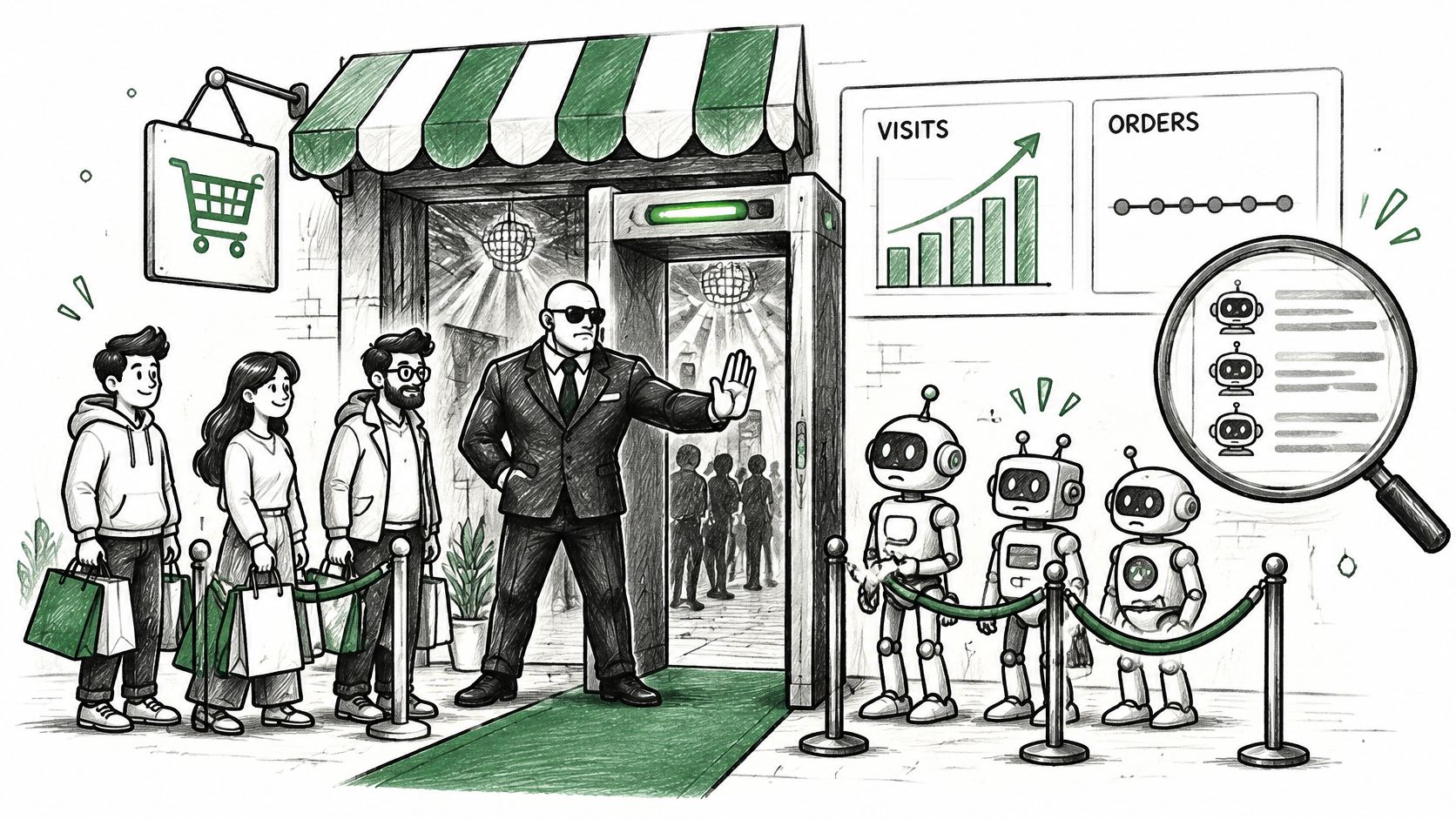
Think of a nightclub door. The bouncer doesn't just count the line. They check behavior, examine identification, and decide who should enter. A storefront needs the same distinction between a visitor's claimed identity and what that visitor really does.
In 2023, bots generated 49.6% of global internet traffic, malicious bots accounted for 32%, and bad-bot traffic represented 35.4% of US internet traffic, according to Imperva's analysis of automated traffic. Those are internet-wide measurements, not estimates of your store's traffic.
The total includes useful automation, such as search crawlers and monitoring tools. Sorting automation is the job, not banning every bot.
Why classification belongs before business decisions
Automated sessions can inflate visits, extract catalogs, test checkout flows, and create work in support or review queues. A traffic spike can therefore look like customer demand without representing more potential buyers.
- Marketing decisions: Separate shopping activity from automated page requests before judging campaign quality.
- Operational decisions: Investigate repeated requests before treating every form submission or checkout start as customer intent.
- Access decisions: Preserve useful crawling while restricting activity that creates cost without commercial value.
The bot traffic and VPN abuse guide provides additional context for investigating masked and automated visits.
Every visit raises two separate questions: Is this automated, and should it reach my store's numbers and orders?
Bot Detection Techniques Compared
No single signal is enough. Working systems combine inexpensive request checks with network context, session behavior, and selective verification.
Simple bad bots increased from 33.4% of bad-bot traffic in 2022 to 39.6% in 2023, while evasive bad bots still represented 60.5% in 2023, according to Imperva's report takeaways. Static browser-name lists and basic rate limits aren't a complete defense against that mix. Those figures don't, however, establish the miss rate of any particular control.
Bot detection techniques, what they check and where they fail
Treat the following as operational strengths and limitations, not guaranteed detection outcomes.
| Technique | What it examines | Catches well | Misses or false positives | Shopify use |
|---|---|---|---|---|
| User-agent and header checks | Declared browser, header order, missing headers | Default scripts that identify themselves | Browser claims can be copied | Cheap initial filter |
| IP reputation and network ownership | Source address, network owner, hosting and proxy indicators | Known abusive addresses and hosting-based scrapers | Shared networks and residential proxies complicate classification | Network rules and crawler verification |
| Behavioral analysis | Request timing, navigation, session depth | Repetitive catalog access and scripted checkout attempts | Slow automation can resemble browsing | Endpoint-specific responses |
| Browser and device fingerprinting | Browser attributes, rendering, JavaScript consistency | Some headless clients and contradictory configurations | Privacy settings can look unusual | Corroborates network signals |
| CAPTCHA or JavaScript challenges | Ability to complete a browser or interaction test | Automation unable to complete the selected test | Adds friction and doesn't prove purchase intent | Selective verification on risky endpoints |
| Order-level risk scoring | AVS, CVV, IP address, purchase patterns | Suspicious orders with checkout data | Doesn't undo earlier analytics events | Order review and workflow routing |
Match the control to the problem
A browser-name check can identify an obvious script. It can't establish that a convincing browser is a person. Likewise, an order score can support a fulfillment decision without explaining whether earlier catalog traffic was useful.
Before choosing a response, identify the action you're protecting. Reading a public collection page, repeatedly extracting prices, and submitting payment details don't carry the same risk.
Practical rule: Run cheap checks broadly. Reserve costly challenges for suspicious activity on sensitive paths, including catalog extraction and checkout attempts.
On Shopify, confirm where a particular control can operate before designing the workflow. A storefront app shouldn't be assumed to control every checkout request or underlying platform endpoint.
Behavioral Signals That Expose Bots
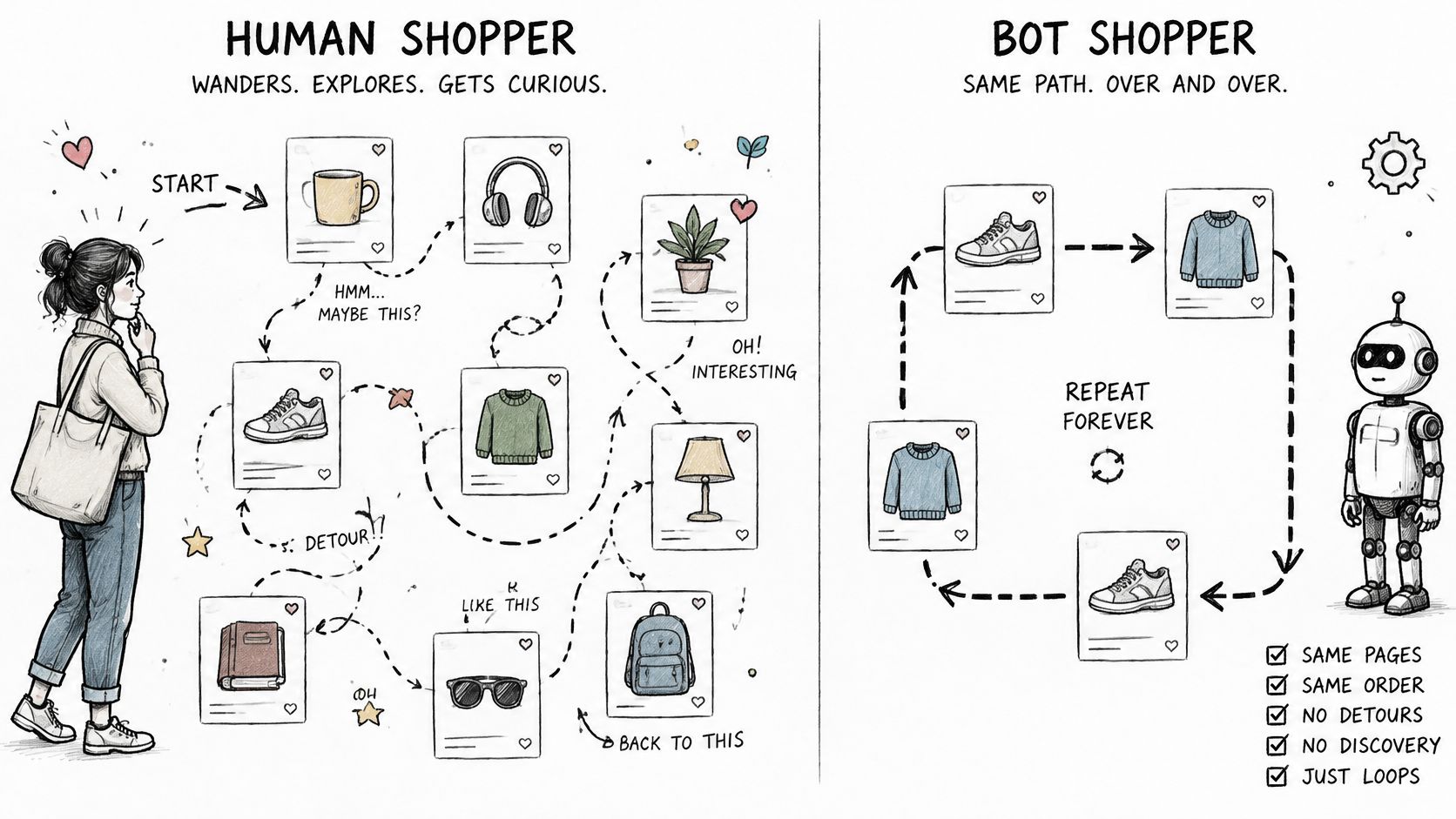
People often browse unevenly. Scripts often repeat. That contrast is useful, but it's a starting hypothesis rather than proof: a determined scraper can slow down, and a returning customer can move quickly.
Research using academic digital-library traffic found that combined request and semantic features achieved balanced accuracy above 90% in that environment, as described in the empirical bot-classification study. That result supports combining signals. It isn't a promised accuracy level for Shopify.
Read the sequence, not just the speed
Useful behavioral features include:
- Request rate and burstiness: Compare sustained repetition with isolated bursts that could reflect ordinary page loading.
- Product-path sequences: Look for systematic catalog traversal rather than movement between related collections and products.
- HTTP-method distribution: Check whether the mix of page requests and submissions fits the action being attempted.
- Status-code patterns: Repeated failures deserve investigation, especially when the client keeps requesting similar paths.
- Session depth: Distinguish extensive catalog extraction from a plausible discovery journey.
- Referrer consistency: Check whether the apparent arrival source fits subsequent navigation.
Consider a hypothetical session that walks through a long sequence of product URLs, skips supporting assets and cart pages, and never changes direction. That pattern is consistent with scraping.
Contrast it with a visitor who opens a collection, filters the results, compares products, adds an item to the cart, and leaves. The second journey resembles shopping, even though it produces no order. Neither example should become an automatic verdict without corroboration.
Validate both sides of the decision
Balanced accuracy gives equal weight to correct bot classification and correct human classification. That's useful when the classes are uneven, because a model can otherwise look successful while performing poorly on the smaller group.
The business errors differ. Blocking a shopper can cost a sale. Allowing a scraper can contaminate reporting and consume resources.
A detection count measures how often a rule fired. It doesn't establish how often the rule was right.
Review labeled sessions by hand before tightening thresholds. Keep false positives separate from total detections, and retain uncertain sessions as uncertain rather than forcing a convenient label.
Fingerprints and IP Signals Working Together
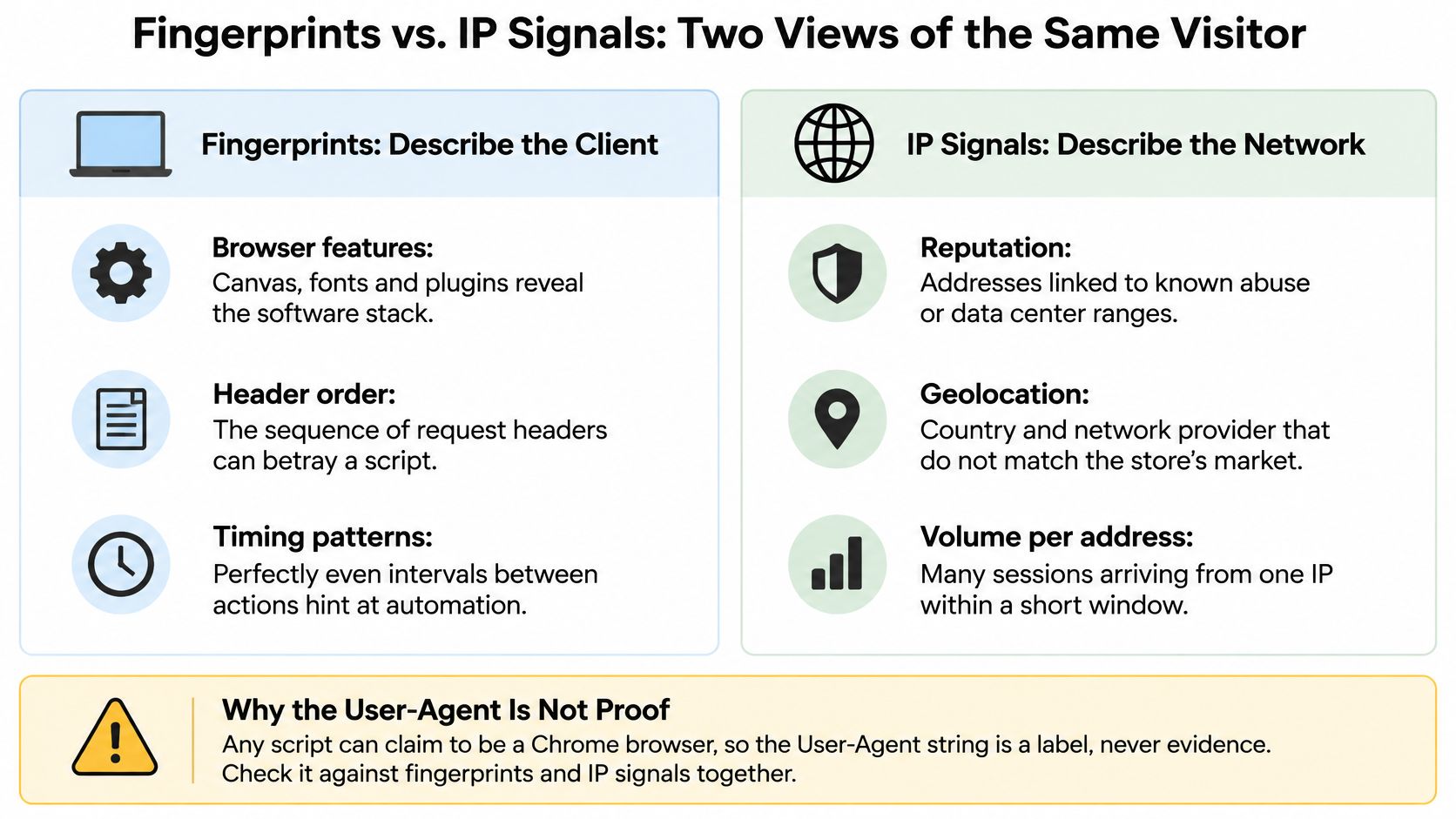
Fingerprints describe the client. IP signals describe the network it arrives from. The strongest warning often comes from disagreement between them, rather than an unusual value in either category.
A User-Agent string is a declaration, not proof. A script can claim to be a search crawler or an ordinary browser without being either.
Verify claimed crawler identities
Google's crawler-verification guidance describes checking a source IP through reverse DNS, confirming an approved domain, and then checking that the hostname resolves forward to the original address. Published crawler IP ranges provide another verification method.
The essential distinction is claimed identity versus independently checked identity. A request presenting itself as a search crawler but arriving from an unrelated hosting network, anonymous VPN, or residential provider shouldn't receive an automatic crawler exemption.
Verify it before granting high-volume catalog access. Otherwise, a copied identity can become a route around scraping controls.
Look for contradictions across signal groups
Client-side and request-level checks can include:
- Header and TLS consistency: Does the connection resemble the browser the client claims to use?
- Browser attributes: Do reported characteristics contradict each other?
- Automation traces: Does browser execution suggest a headless or scripted client?
- Timing: Does the client repeat actions with an implausibly rigid rhythm?
Network checks add a different view:
- Reputation: Has the source been associated with abusive activity?
- Network ownership: Is the address associated with hosting, residential access, or another network category?
- Proxy indicators: Is the connection masked through a VPN or proxy?
- Endpoint behavior: Does the source repeatedly target sensitive store actions?
An IP reputation check is most useful as supporting context, not a standalone customer verdict.
Privacy-conscious customers, travelers, and people on shared corporate or mobile networks can look unusual. A VPN flag doesn't establish malicious intent, and a residential address doesn't establish a human visitor.
A sensible response to an isolated mismatch is lower confidence and further observation. Stronger intervention needs stronger evidence, particularly when the visitor is approaching a purchase.
How Bots Skew Shopify Sales and Marketing Metrics
A higher conversion rate can be a filtering artifact, not a sales improvement. Remove sessions from the denominator and the rate can rise without another completed order. Aggressive blocking can also remove legitimate visitors, so a cleaner-looking dashboard isn't sufficient evidence of success.
For operators, the larger risk is making a real business change in response to activity that never represented customer demand. Use these patterns as investigation prompts, not automatic diagnoses.
How bot traffic distorts each Shopify metric
| Metric | How bots distort it | Sign to check |
|---|---|---|
| Sessions and bounce rate | Automated visits change the volume and apparent engagement mix | Session spikes without matching orders |
| Conversion rate | Non-buying automated sessions enlarge the denominator | A rate decline while revenue remains steady |
| Add-to-cart and checkout starts | Scripted actions resemble purchase intent | Starts increase without completed orders |
| Paid campaign cost per acquisition | Abusive clicks can consume spend; fake visits can confuse traffic-quality interpretation | Compare spend and orders, not visits alone |
| Klaviyo signups | Form automation adds non-genuine subscribers | Signup bursts followed by bounces or little engagement |
| Gorgias ticket volume | Spam submissions add support work | Tickets without corresponding customers or orders |
| Judge.me reviews | Automated activity can manipulate review workflows | Unusual bursts associated with new identities or a shared network |
| Server load and inventory holds | Repeated requests consume resources; abusive reservation behavior can affect availability where holds apply | Load or unavailable stock without corresponding purchases |
| Chargebacks | Payment abuse can later become disputed orders | Card networks and Shopify monitor the rate; keep it as low as possible |
OWASP's automated-threat guidance identifies scraping, inventory abuse, card testing, fake reviews, click fraud, and analytics distortion as distinct threats. Don't assume every abnormal metric has the same cause.
Separate a traffic problem from a buying problem
Consider a hypothetical scraper cluster repeatedly loading product pages without using the cart. Sessions rise and the reported conversion rate falls. Cutting prices in response would address an apparent buying objection that the scraper never had.
In another hypothetical pattern, scripts start checkouts but never pay. The team sees abandonment and starts rewriting shipping messages. That work may be useful for real shoppers, but it won't resolve automated checkout testing.
Judge a traffic-control change by preserved buying activity and reduced confirmed abuse, not by a prettier conversion rate.
The bot noise in store analytics guide and this explanation of traffic quality support the same operational distinction: activity volume isn't equivalent to commercial intent.
Keep raw and filtered views where possible. Without the original denominator and intervention logs, you can't tell whether a change improved decisions or merely changed the report.
How to Detect and Mitigate Bots on Shopify, Step by Step
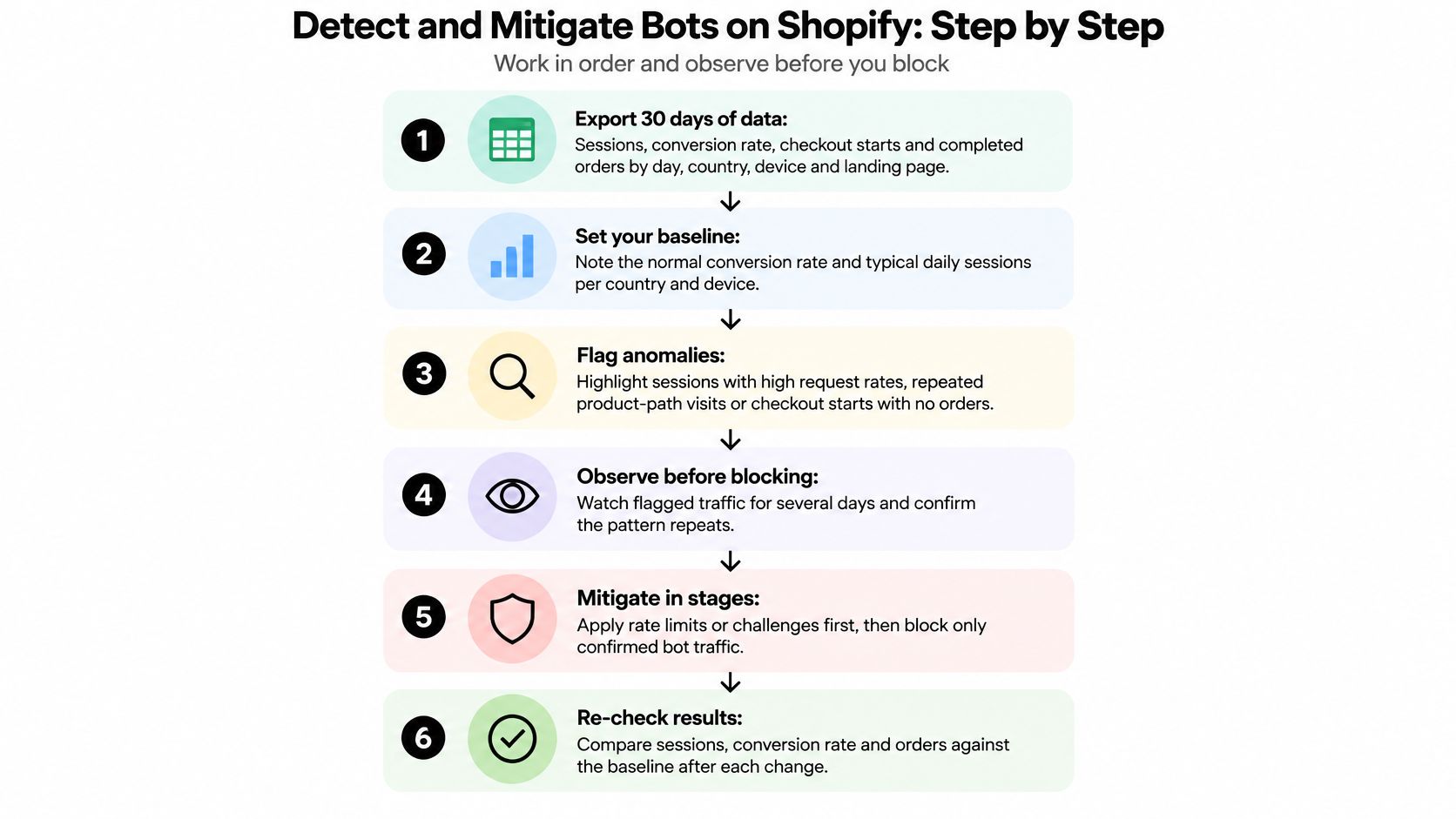
Observe before you block. Establish what changed, identify the suspicious segment, and choose a response you can reverse.
Build evidence before enforcement
-
Export a baseline. Use a recent period that covers your normal trading pattern, comparing sessions, conversion rate, checkout starts, and completed orders by day, country, device, and landing page, because aggregate totals hide concentrated anomalies.
-
Review the order indicators available in Shopify's fraud-prevention guidance: AVS results, CVV checks, customer IP address, unusual purchase patterns, and low-, medium-, or high-risk classifications, because these provide order context rather than relying on traffic suspicion alone.
-
Find clusters, not merely unfamiliar visitors. Group suspicious activity by network, landing path, timing, and repeated actions, because coordinated patterns are more informative than an unfamiliar country or device.
-
Verify traffic claiming a crawler identity using the earlier identity checks, because an unverified name shouldn't earn a bypass.
Apply controls with a rollback path
-
Observe, rate-limit, challenge, then block. Where your available controls support it, set responses by endpoint risk and begin with suspicious catalog or checkout activity, because a storewide rule can punish unrelated browsing.
-
Consider country restrictions against your actual shipping coverage, because blocking destinations you serve can exclude legitimate buyers. Keep exceptions and rollback criteria explicit rather than treating an entire region as one risk category.
-
Route risky orders for review. Use Shopify Flow workflows appropriate to your payment setup, because Shopify warns that fulfilling high-risk orders without review can lead to chargebacks and payment-processing problems.
-
Re-run the baseline after an observation period and compare against a comparable unfiltered cohort where safe, because a before-and-after comparison alone can confuse traffic filtering with campaign, inventory, or seasonal changes.
Prove what the block removed
Log the rule, response, geography, device, and network category for each intervention. Reconcile those records with checkout starts and completed orders, then examine support complaints and challenge outcomes.
Look specifically for blocked or challenged visits later associated with legitimate purchases. Where identification is incomplete, record that uncertainty instead of claiming there were no false positives.
Compare downstream signups, tickets, reviews, and server load as well. A reduction in abusive requests is useful, but it shouldn't conceal a loss of genuine customer activity. Keep confirmed attacks out of any comparison cohort rather than exposing sensitive workflows merely to preserve an experiment.
When evaluating a Shopify security app, match its intervention point to the problem you're measuring. Shopify's order-level analysis evaluates orders after the visit has already occurred. It doesn't clean historical session data.
Where Securify fits
Securify sits at the storefront traffic layer, screening Shopify visitors in real time for bot, VPN/proxy, and fraud-pattern signals while genuine shoppers pass through. Its value shows up in measurement first: fewer non-shopping visits in funnel counts, cleaner paid-campaign denominators, less scraping and repeat suspicious traffic creating work before any fake order exists.
When earlier screening is useful
The fit is strongest when analytics sessions, campaign clicks, and review queues disagree with what buyers really did. It is weaker when a baseline already looks clean, because earlier filtering cannot improve numbers that were not distorted.
The scope is narrow by design. It covers the visit before checkout or payment tools see it, so order review, dispute handling, and reimbursement stay outside the lane. Judge it like a measurement change: did bot-classified sessions fall, did checkout starts and completed orders hold, and did preventable review work drop without pushing real buyers out?
Bot Detection Questions Merchants Ask
Is bot detection the same as fraud detection?
No. Bot detection classifies visitors and sessions, while fraud detection evaluates suspicious orders and payment activity. They overlap around checkout, but neither classification proves the other: a human can commit fraud, and useful automation can visit legitimately.
Can bot detection block real customers by mistake?
Yes. False positives can affect VPN users, privacy-browser users, and customers on shared networks. Reduce that risk through staged responses, reversible rules, and checks for blocked or challenged sessions later associated with legitimate orders.
Does robots.txt stop bots from scraping a Shopify store?
No. It's a voluntary instruction file, not an enforced access control. Academic research on crawler compliance supports treating crawler identity and behavior separately from stated directives, so robots.txt can't replace enforcement such as rate limits or selective challenges.
Are all bots bad for an online store?
No. Search crawlers and monitoring tools can provide useful discovery and operational checks. Decide whether to allow automation based on verified identity, purpose, behavior, and business impact, rather than treating every automated visit as abuse.
Securify offers real-time storefront screening for bot, VPN/proxy, and fraud-pattern signals before they become downstream reporting noise. Visit Securify to assess whether earlier traffic screening fits the anomalies in your store, then compare the results against your baseline and completed orders.