
· farming social media · shopify merchants · bot traffic · social media growth · audience engagement
Farming Social Media for DTC Growth
Farming Social Media. Learn to farm social media ethically for your Shopify store. Build genuine audience growth and prevent bot traffic with practical guide.

Social media can bring in 86 representative panels' worth of manipulated engagement activity and still leave you with bad traffic, bad attribution, and operational noise, so the smart move is to farm social media for human community, not fake signals. The merchant who sees viral traffic, then watches fulfillment, support, and refund pressure climb, is usually looking at manufactured attention, not buyers.
Table of Contents
- Why Social Engagement No Longer Equals Real Customers
- Ethical Audience Building Versus Risky Farming Tactics
- How to Validate Social Referrals Before Trusting Attribution
- Bot Traffic Risks That Artificial Engagement Creates for Shopify Stores
- Building a Sustainable Social Media and Commerce Workflow
- Where Securify Fits
- Frequently Asked Questions
Why Social Engagement No Longer Equals Real Customers
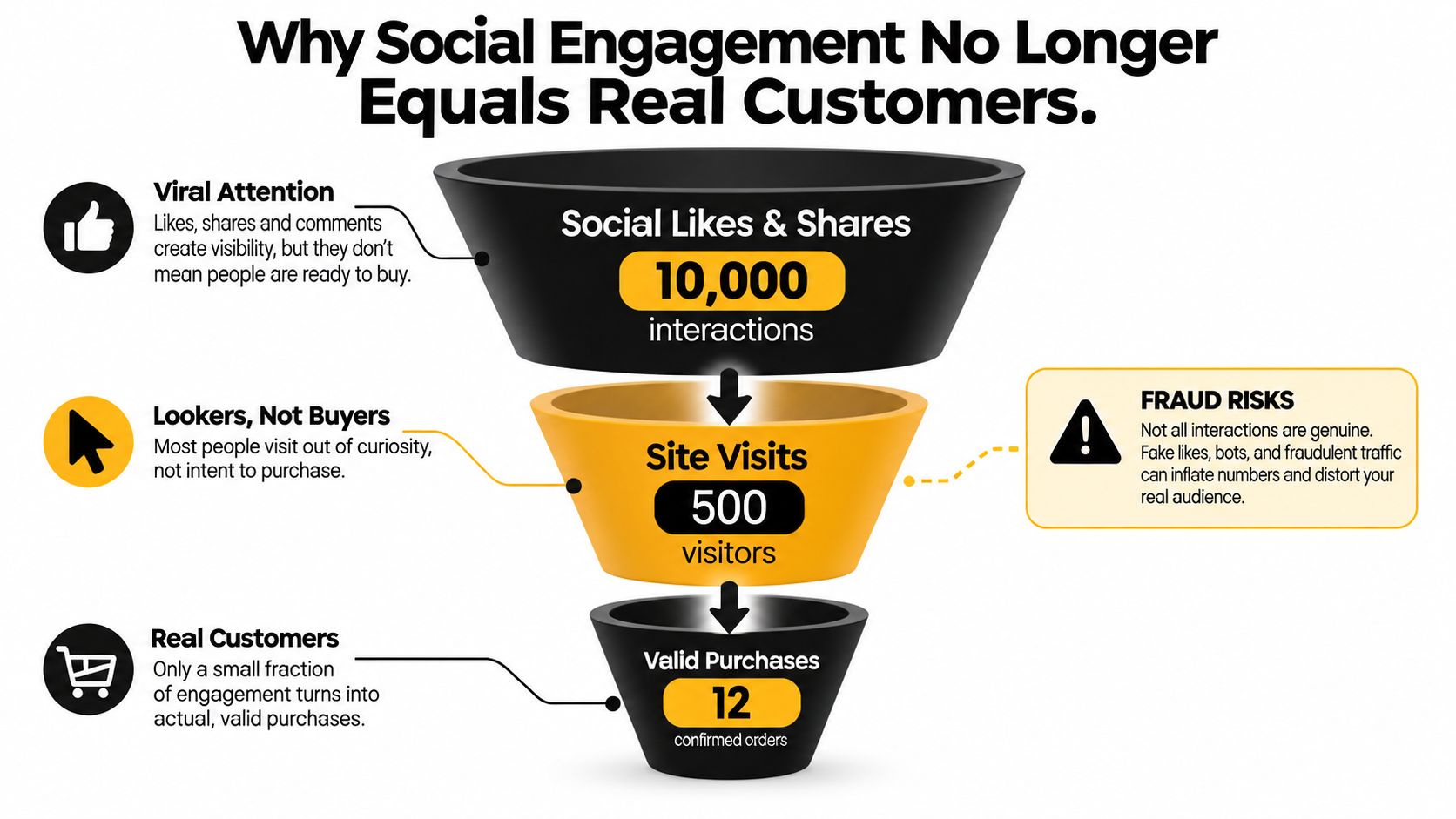
A store can look busy and still be underperforming. The dashboard fills with likes, comments, and follows, but the order queue barely moves, support gets noisier, and the traffic source keeps producing sessions that never act like shoppers.
That is the trap with farming social media in a manipulative sense. Engagement panels sell likes, follows, and other signals at scale, and the traffic they generate rarely converts. Research on social-media marketing infrastructure shows a real commercial market built around artificial engagement, with services, marketplace listings, and repeatable delivery systems. That is a clear warning that popularity signals can be manufactured. IMDEA Networks research on social-media farming infrastructure
What the numbers are really telling you
The test is simple. Do the people behind the engagement behave like buyers?
A NATO experiment found purchased engagement across political and government pages on Facebook, Instagram, Twitter, and YouTube. That matters for merchants because the same tactics that make a post look active can also make store traffic look healthier than it is. When manipulation reaches public-facing content like that, it is a reminder that visible activity alone is not proof of intent.
Practical rule: if engagement rises faster than product-page sessions, add-to-cart activity, and checkout starts, treat the spike as suspicious until it proves otherwise.
For a Shopify operator, the fallout shows up downstream. Artificial engagement can inflate reach, distort campaign attribution, and make traffic or conversion performance look stronger than the underlying human response. If you do not separate those effects, you can end up scaling the wrong creator, the wrong post, or the wrong audience segment.
Early warning signs merchants should watch
A farming-style campaign often leaves obvious marks. Comments repeat the same praise, engagement arrives in synchronized bursts, and the traffic source looks busy without producing meaningful storefront behavior. If those synchronized bursts line up with source patterns that resemble bots and proxies, pause before you trust the attribution. That is not proof on its own, but it is enough to look deeper.
Raw engagement is a weak proxy for intent. Conversion behavior is the stronger signal.
Start with the landing page, not the feed. Real customers move from interest to product views to cart activity. Manufactured attention usually stalls before any of that happens.
Ethical Audience Building Versus Risky Farming Tactics
The phrase farming social media gets used for two completely different behaviors. One builds an audience with trust. The other tries to buy the appearance of trust. For a Shopify store, those aren't similar tactics with different styles, they create different data, different risks, and different outcomes.
Here's the clean comparison.
| Criteria | Ethical audience building | Risky farming tactics |
|---|---|---|
| Customer quality | Real people who can become repeat buyers | Low-intent accounts, bots, or paid engagement with weak buying intent |
| Attribution reliability | Cleaner source data and clearer campaign readouts | Polluted analytics and misleading attribution |
| Chargeback exposure | Lower risk when the traffic source matches actual buyers | Higher review burden when traffic doesn't match order behavior |
| Content sustainability | Posts teach, help, or entertain over time | Content exists to game visibility and often burns out fast |
| Platform compliance | Fits platform rules and community expectations | Risks removals, suppression, or account limits |
| Long-term brand health | Builds trust, email quality, and better reviews | Inflates vanity metrics while weakening trust |
A useful outside reference for automation-heavy community work is the guide to Reddit automation. Even there, the lesson is the same. Automation can help distribute content, but it can't replace credibility, and it shouldn't be used to simulate authentic demand.
What healthy growth looks like
Ethical audience building usually looks less dramatic in the short term. A useful post gets saved, shared, discussed, or revisited. A risky tactic looks louder at first, then collapses when support tickets, order issues, or analytics drift expose the mismatch.
A merchant who values clean data should ask a simple question before trusting any campaign: would I still want this audience if it never clicked the ad? If the answer is no, the campaign may be producing vanity, not value.
A practical decision lens
Use six checks before you celebrate a post or partnership. Are the people responding likely to buy, do the sessions match the claimed audience, does the content still make sense in a week, and do the downstream outcomes support the spike? If those answers are fuzzy, the campaign belongs in review, not in your attribution model.
How to Validate Social Referrals Before Trusting Attribution
A social referral should earn its place in your reports. Treat it like a candidate, not a fact. The fastest way to protect attribution is to inspect the traffic before it shapes budget, creative, or inventory decisions.

Start with behavior, not follower counts
Pull the campaign-account metadata first. Look at posting frequency, repost ratio, follower-to-following ratio, account age, repeated text, and synchronized timestamps. Those signals matter because they show whether the account behaves like a normal community participant or a manufactured amplifier.
Then move to the storefront side. Compare landing-page sessions, add-to-cart rate, and purchase rate against a control campaign with similar audience, creative, geography, and spend. The goal is not perfection. It is to see whether the new traffic behaves more like verified humans or like noise. When evaluating creator partnerships, Social Cloud on influencer KPIs offers a useful benchmark set. For a practical traffic-noise framework, this guide to Shopify bot traffic and analytics noise is a useful companion.
Use quarantine and holdout logic
If referrals look suspicious, hold them out of attribution first. Do not let one shaky source contaminate the rest of your reporting. Then run a simple comparison. Did those sessions produce real product-page engagement and checkout progression, or did they bounce after the first click?
Operational rule: block only when the pattern is strong enough to justify it, investigate when the pattern is unclear, and restore traffic only after it proves itself in downstream commerce behavior.
That approach fits the reality that high activity can still miss a lot of abuse, even when it catches some of it. It also avoids the common mistake of treating platform removals as a prevalence estimate. A platform can remove obvious bad actors and still leave plenty of polluted traffic in your funnel.
Don't confuse suspicion with proof
A geo mismatch or proxy signal is a review cue, not an automatic verdict. The same is true for international traffic, especially if your brand ships broadly or has a real customer base outside the US. The right move is to combine behavioral, network, and order-level evidence before making a blocking decision.
One clear test is downstream commerce behavior. Real buyers leave a trail through checkout starts, product interaction, and orders. A referral source that stays under 1% add-to-cart rate while your control campaign runs at 3% should be quarantined before it affects budget decisions.
Bot Traffic Risks That Artificial Engagement Creates for Shopify Stores
Artificial engagement does not stay on the post. It spills into the store, and once low-quality traffic starts arriving, your analytics, customer data, and review queues can all take damage at the same time.
What bad traffic does to the store
Bot-heavy or farmed traffic can inflate session counts, pollute email lists, and create review noise. It can also increase manual fraud-review work because the traffic patterns do not line up cleanly with payment behavior. For a merchant, that means more time checking orders and less time improving the store.
Shopify's own fraud guidance makes the order-level point clear. Look at address verification, CVV, location match, unusual device or network activity, and multiple-card attempts together, not in isolation. Shopify also says that IP address or location description alone is not a fraud recommendation. Shopify fraud analysis guidance
Proxy and VPN signals need context
Geo inconsistency is useful as an early warning layer, but it is not proof. A customer using a privacy tool, a proxy service, or a hosting-company network may be legitimate. Shopify's prevention guidance treats proxy use and geographic inconsistency as review considerations, then recommends contacting the customer when those conditions appear. Shopify fraud-prevention guidance
That matters because bad traffic and real shoppers can look similar at the edge. The difference shows up when you combine the signal with payment method behavior, ordering patterns, and device consistency.
Think in layers, not labels
The fastest merchants classify traffic upstream, then verify orders downstream. That keeps polluted sessions out of your reports without assuming every abnormal visit is malicious. It also reduces the risk of blocking legitimate travelers or privacy-conscious buyers.
For storefront operators, wasted ad spend is only part of the cost. Dirty numbers warp pricing, creative, and inventory decisions for a customer base that never really existed.
If you need a stricter filter for bot-heavy or farmed traffic, apply it before attribution starts shaping budget calls.
Merchant takeaway: if the traffic looks loud but the orders do not move, the problem is probably closer to the source than the checkout.
Building a Sustainable Social Media and Commerce Workflow
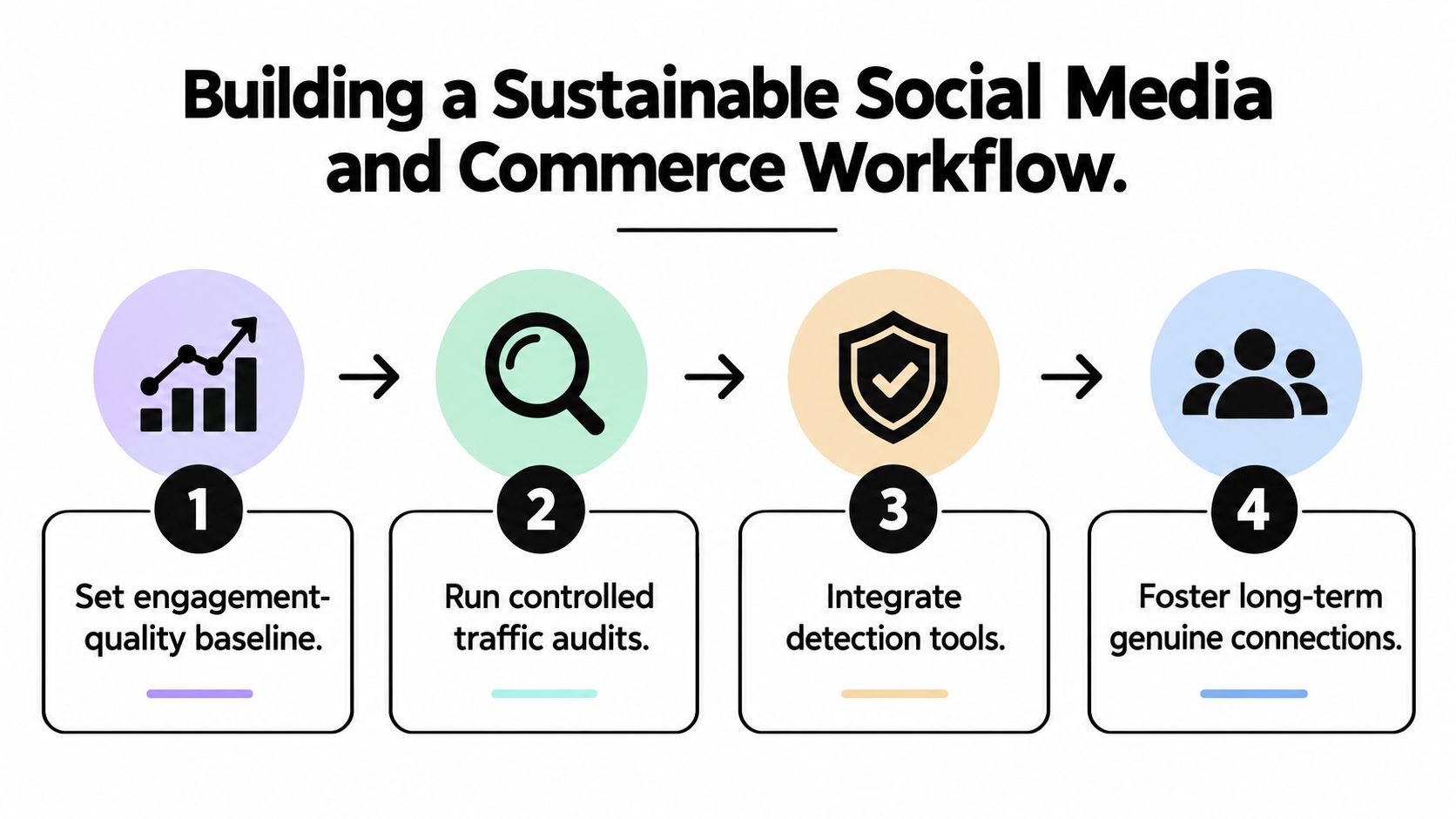
A durable workflow starts with a baseline. Before you trust any social channel, measure engagement quality, not just volume. That means watching unique engaged accounts, comments per impression, saves or shares per impression, click-through rate, landing-page sessions, add-to-cart rate, and purchase rate, then comparing those numbers against a similar control campaign.
Keep the workflow tied to revenue
The cleanest goal is incremental revenue per verified-human session. That keeps your team focused on real commerce instead of vanity reach. If a post drives attention but not product interest, it hasn't earned more budget.
A practical routine looks like this.
- Set the baseline: record how normal traffic behaves before you scale a creator, post, or paid social push.
- Run a holdout: keep suspicious or uncertain traffic out of attribution until it proves it can convert.
- Review the signals: compare referral quality, checkout behavior, and support patterns against your normal cohort.
- Recalibrate often: adjust by platform, campaign type, and audience, because one rule won't fit every source.
Build for community, not just distribution
Durable social growth comes from content that people want to keep following. That usually means clear proof, transparent language, and a consistent rhythm. It also means accepting that some campaigns will underperform because they attract the wrong kind of attention.
For merchants who want a traffic-quality layer to sit alongside existing operations, a small-screen test can help identify abuse before it spreads. The point is to keep polluted sessions out of email, support, and reviews so your social strategy reflects real customer behavior, not fake momentum.
Where Securify Fits
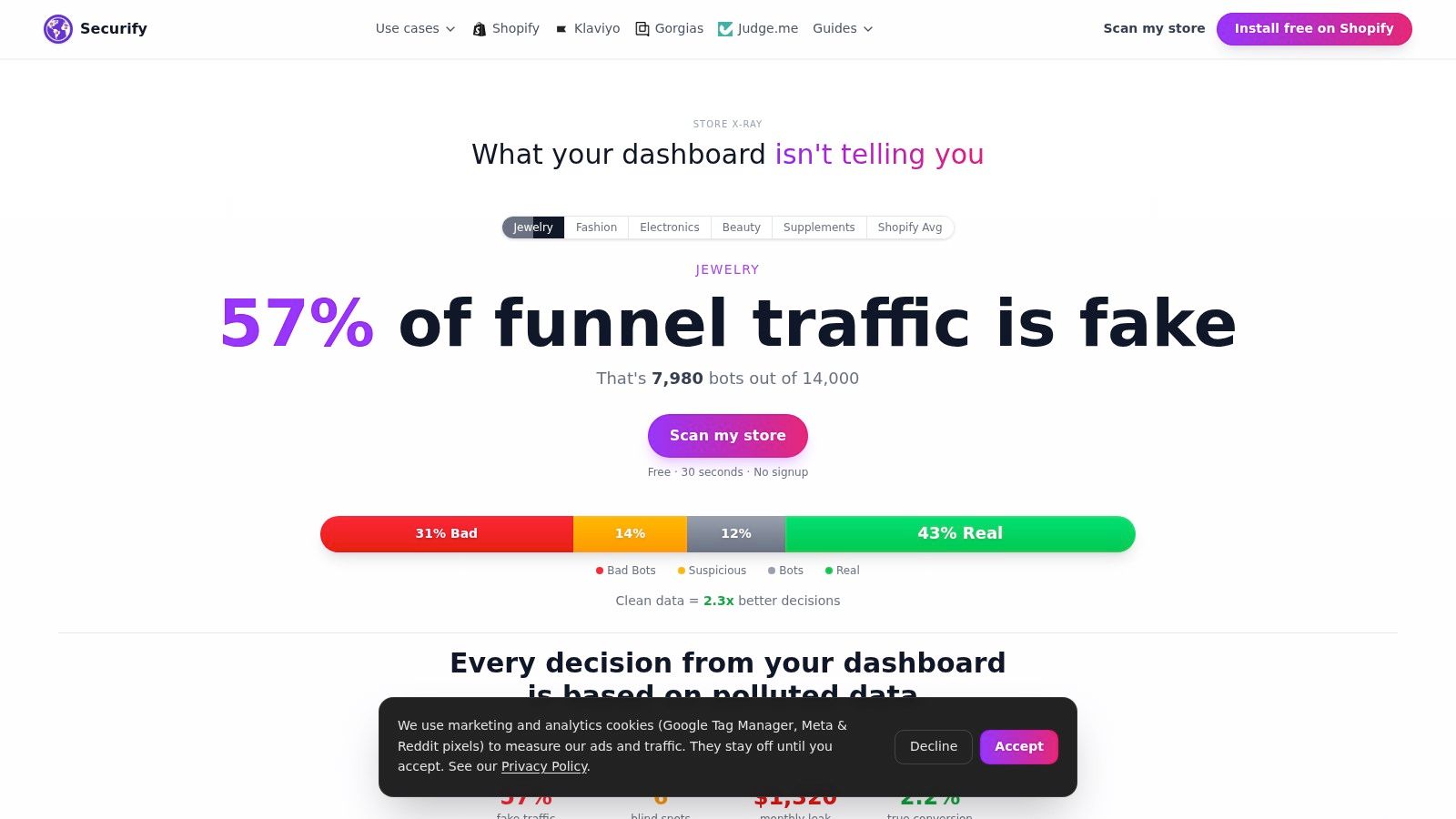
Securify is built for merchants who need to separate real shopper interest from bot traffic, VPN abuse, fake visitors, and other forms of non-genuine activity. It adds a traffic-quality layer before bad sessions can pollute storefront analytics, email lists, support queues, or product reviews. The app also includes controls for bot blocking, VPN and proxy detection, geo-blocking, price protection, and a fast Store X-Ray scan. Review the app here, Securify on the Shopify App Store.
For stores dealing with shaky social referrals, that kind of filtering helps you judge campaigns on verified-human behavior instead of inflated engagement. It can also make downstream reporting more stable when you're trying to decide whether a creator, audience, or channel deserves more budget.
Frequently Asked Questions
How do I know if social traffic is real buyers or just noise?
Check what the visitors do after they land. Real buyers usually move beyond the first page, while noise often stops at the entry point. Compare those sessions against a normal campaign before you trust the source.
What's the clearest sign of bot pollution?
A mismatch between engagement and commerce behavior is the biggest clue. If the campaign looks busy but doesn't produce product views, add-to-cart activity, or orders, treat it as suspect and review the source quality.
Should I block international visitors if the traffic looks risky?
Not by geography alone. Some international shoppers are legitimate, and some domestic sessions are just as suspicious. Use location as one signal among several, not as proof.
How should I evaluate influencer partnerships?
Look past follower count and focus on audience behavior, comment quality, and downstream store performance. A partnership is only useful if it brings you real shoppers, not just a spike in surface metrics.
What's the safest way to protect attribution?
Quarantine questionable traffic first, then compare it against a control. That keeps bad data out of your core reports while you decide whether the source deserves more trust.
If you're dealing with social traffic that looks strong on the surface but keeps creating fraud, support, or analytics headaches, Securify can help you filter non-genuine sessions before they distort your numbers. It's a practical layer for Shopify merchants who want cleaner attribution and less noise in the store.