
· credit card fraud · ecommerce fraud prevention · shopify security · chargeback prevention · bot traffic blocking
How to Prevent Fraud on Credit Card Orders
Learn how to prevent fraud on credit card orders with actionable steps for Shopify merchants. Block bots, verify traffic, and reduce chargebacks effectively.
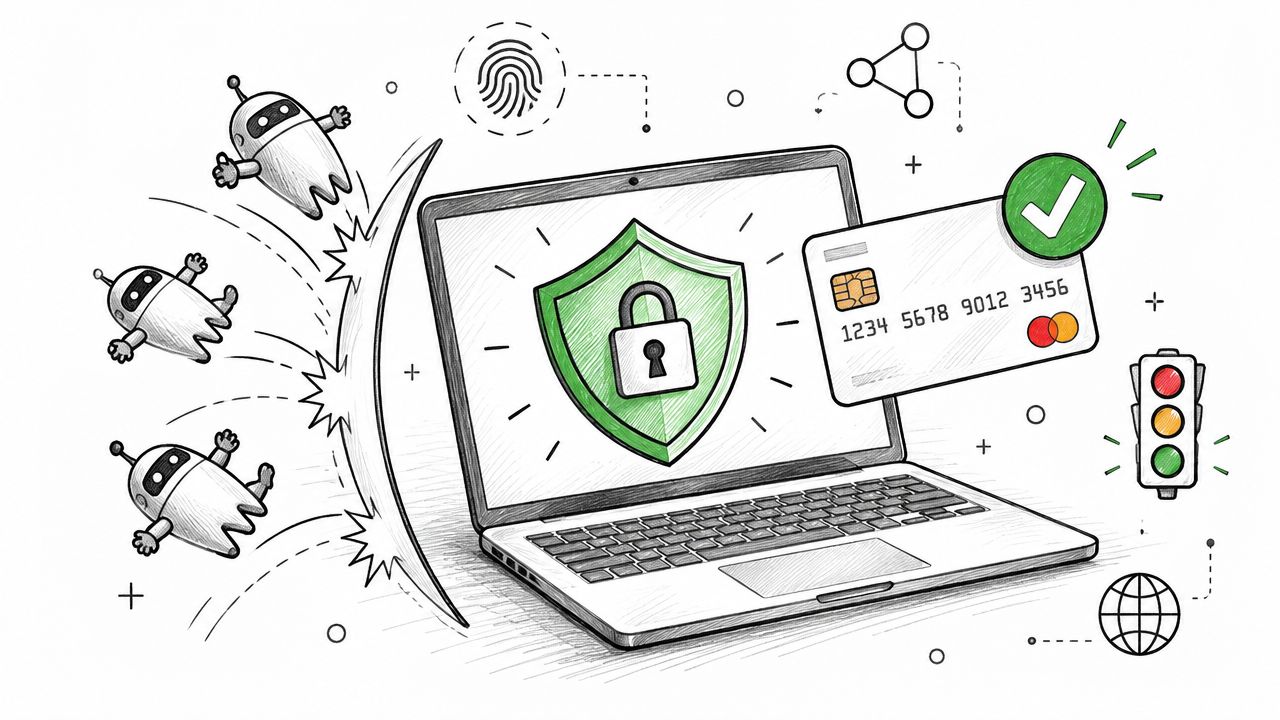
Only 5% of fraudulent credit-card charges involved a physically stolen card, according to a recent U.S. survey. The same report estimated that 61.3 million Americans experienced fraudulent charges in the past year, with about $6.1 billion in unauthorized purchases, and 51% of victims experienced fraud multiple times. The practical lesson for ecommerce operators is clear: learning how to prevent fraud on credit card orders starts long before a payment gateway approves or declines a transaction. Security.org's credit card fraud report shows why remote attacks, stolen credentials, and account takeover deserve more attention than the familiar image of a stolen wallet.
A payment gateway still matters, but it sees only the final stage of a longer journey. If bots, proxy users, credential stuffers, and automated checkout attempts reach your storefront unchecked, they can pollute analytics, strain support teams, contaminate email lists, and create unnecessary payment risk. Strong fraud prevention combines upstream traffic quality, selective authentication, transaction monitoring, and a disciplined response process.
Table of Contents
- The Modern Reality of Remote Payment Fraud
- Implementing Step-Up Authentication at Checkout
- Filtering Bad Traffic and Bot Signals Upstream
- Reducing Manual Reviews and Friendly Fraud
- Building a Post-Transaction Response Workflow
- Auditing Your Storefront for True Conversion
The Modern Reality of Remote Payment Fraud
The traditional fraud story is simple: someone steals a physical card, uses it in a shop, and the merchant absorbs the loss. Ecommerce fraud is less visible and more persistent. Attackers can use breached credentials, stolen identity information, automated tools, and compromised accounts without ever possessing the original plastic card.
The shift became especially visible in the United States on October 1, 2015, when the EMV liability shift moved responsibility for certain card-present counterfeit fraud from issuers to merchants that hadn't upgraded to chip-capable terminals. A merchant could become liable when a chip card was processed as a magnetic-stripe transaction. The rule applied to specific in-person counterfeit scenarios, not every chargeback or fraud type, but it accelerated the move toward layered payment security and correct chip acceptance. The EMV liability-shift summary provides the historical context.
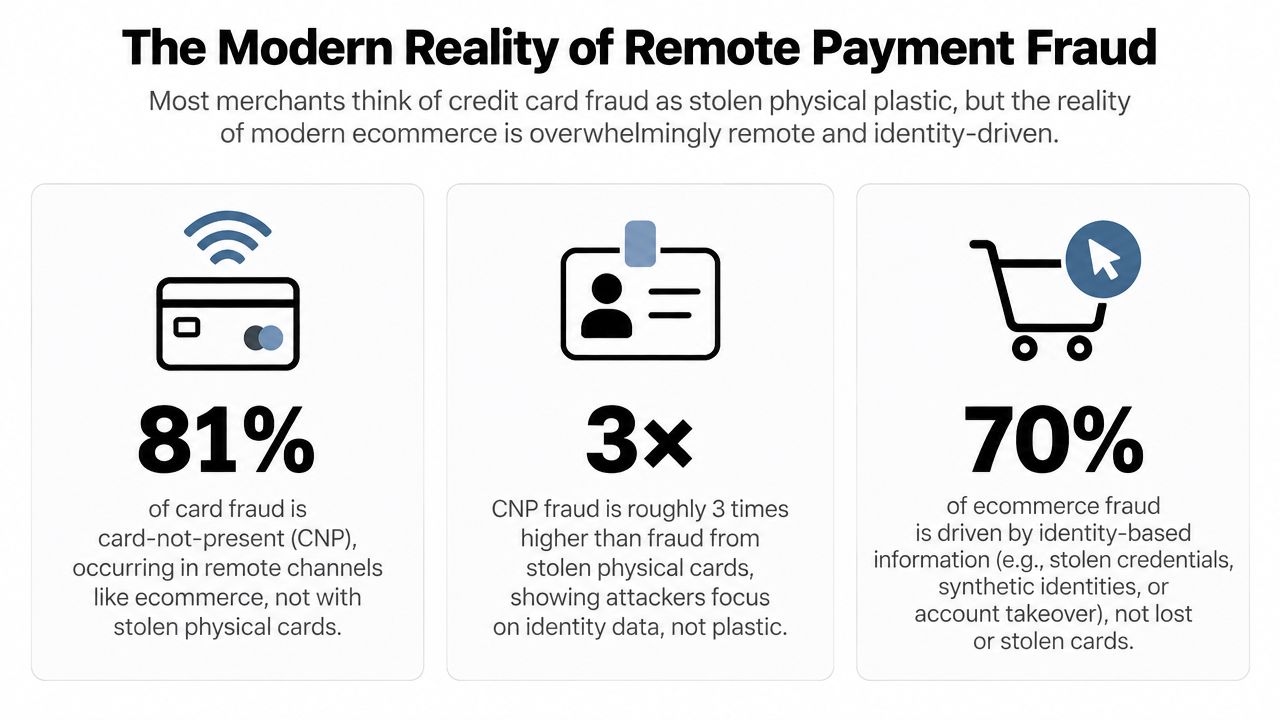
Why gateway rules miss the beginning
Gateway rules usually evaluate a payment after an attacker has already loaded products, created sessions, tested accounts, and reached checkout. That timing is late. By then, the same actor may have generated misleading funnel data, triggered customer-service activity, or tested multiple cards against your store.
A better operating model classifies traffic before checkout. Look for signals such as:
- Automated behavior: Repeated page requests, unnatural navigation paths, and rapid form completion can indicate scripted activity.
- Identity inconsistency: Billing, shipping, device, and account details that don't fit together deserve more scrutiny.
- Masked access: VPNs and proxies aren't automatically fraudulent, but they can hide the location and behavior of a risky visitor.
- Velocity: Multiple accounts, cards, or checkout attempts from related devices or sessions can expose testing activity.
- Session quality: Visitors that never behave like shoppers should not influence your conversion reporting.
The important distinction is between blocking suspicious traffic and rejecting every buyer who looks unusual. A traveler using a VPN isn't necessarily an attacker, and a genuine customer can place an order from a new device. Use upstream signals to assign risk and apply proportionate controls, rather than turning one indicator into an automatic decline.
For a practical overview of consumer and merchant safeguards, review this guide to stopping credit card fraud. Shopify operators can also use this Shopify fraud and bad traffic guide to assess where non-genuine sessions enter the funnel.
Implementing Step-Up Authentication at Checkout
Authentication works best when it adds friction only where the evidence justifies it. Sending every shopper through a challenge may reduce unauthorized payments, but it can also interrupt trusted buyers and lower completed orders. The operating target is risk-based decisioning, with smooth approval for normal sessions and stronger verification for suspicious ones.
EMV 3D Secure gives merchants a structured way to authenticate card-not-present transactions. Visa reports that authenticated transactions show about a 45% reduction in fraud, with approximately 11 basis points of fraud compared with 20 basis points for non-authenticated ecommerce transactions. Visa's 3D Secure guidance also supports separating fraud performance from approval-rate performance, because a security control that blocks good customers can damage revenue even when fraud declines.
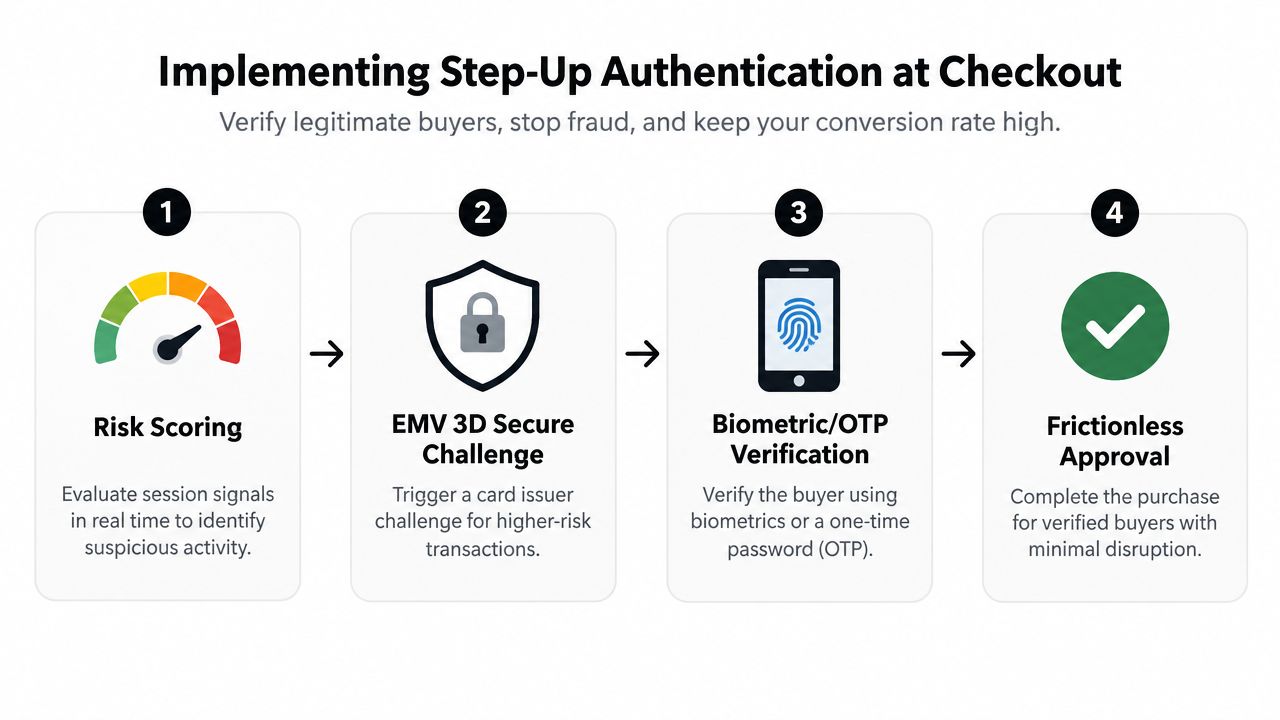
Route risk instead of applying blanket challenges
Start by sending your checkout events and available risk signals into a decision layer. The exact fields depend on your payment provider, but useful inputs include device history, account age, order behavior, shipping and billing alignment, prior disputes, and the quality of the session that produced the order.
Then define three outcomes:
- Frictionless approval: Use this for sessions with consistent identity, familiar device behavior, normal order velocity, and no material mismatch.
- Step-up authentication: Route uncertain or high-risk sessions into EMV 3D Secure, with the issuer deciding whether the buyer completes a challenge.
- Hold or decline: Reserve this for combinations of strong risk signals, such as repeated attempts, impossible account behavior, or clear payment testing patterns.
Measure each outcome separately. Track approval rate, authenticated approval rate, fraud rate, dispute rate, and challenge abandonment. Don't judge the control only by the number of blocked orders. A lower fraud rate paired with a sharp decline in legitimate approvals may indicate that your thresholds are too aggressive.
Challenge methods can include issuer-led verification, one-time passwords, or biometric confirmation. For a broader review of authentication options and their operational implications, see SupportGPT authentication insights for 2026.
Use a graceful fallback for customers who fail a challenge for technical reasons, but don't bypass every failed verification. A support review, alternate payment method, or delayed fulfillment can protect a good customer without treating an unverified high-risk order as normal.
The video below offers additional context on step-up authentication in payment flows.
Filtering Bad Traffic and Bot Signals Upstream
A suspicious checkout is often the visible endpoint of a low-quality session. The more useful intervention happens earlier, before the visitor consumes payment resources or distorts your reporting. Upstream filtering doesn't replace payment controls. It reduces the number of risky sessions those controls must process.
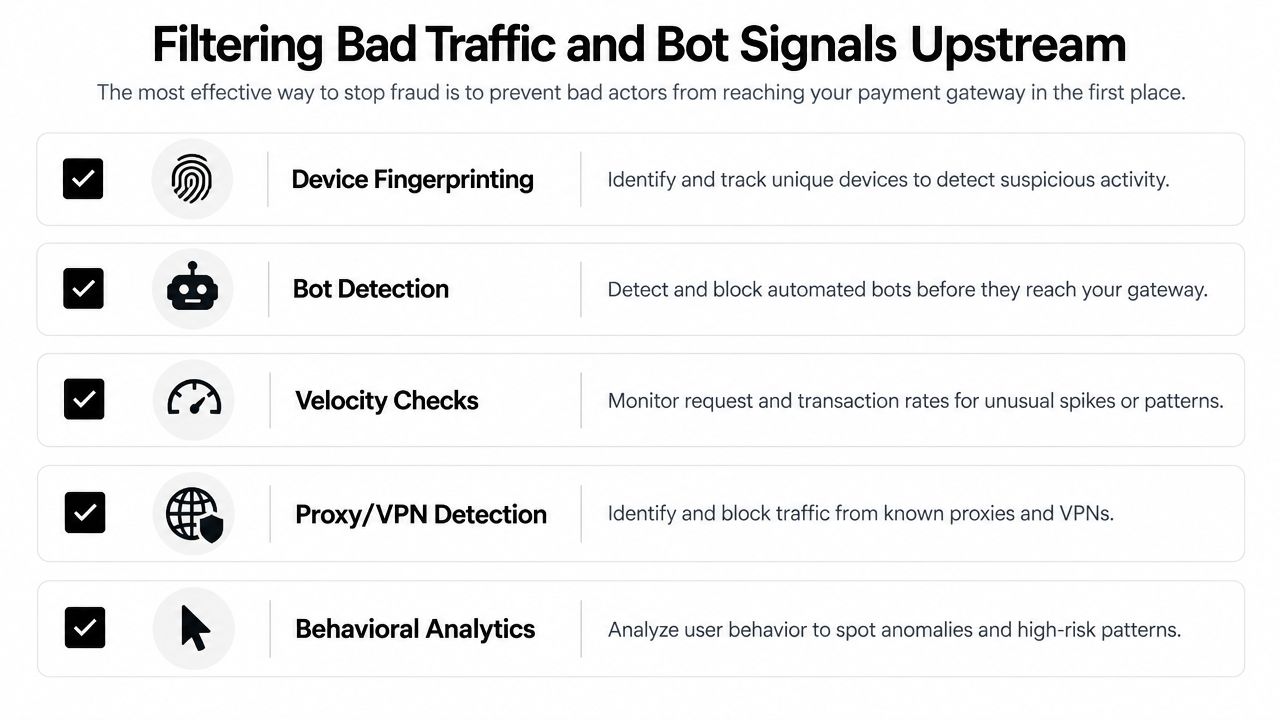
Build a signal stack
No single signal proves fraud. Combine signals, then choose an action that matches the confidence level.
- Device fingerprinting: Identify whether multiple accounts, cards, or orders share a device pattern. Use it as a relationship signal, not as a standalone ban.
- Bot detection: Separate search-engine activity and legitimate automation from aggressive scripts that scrape products, create sessions, or test forms.
- Velocity checks: Watch repeated logins, password resets, cart creation, coupon attempts, and payment submissions within a short operational window.
- Proxy and VPN detection: Compare the apparent location with billing, shipping, language, and prior account behavior. A mismatch should increase scrutiny, not automatically reject the order.
- Behavioral analytics: Examine mouse movement, navigation depth, time between actions, and repeated journeys. Human behavior varies, but automated behavior often repeats with unusual consistency.
For a Shopify store, practical rules should reflect the business model. If you don't ship to a particular country, blocking or challenging traffic from that location may protect checkout capacity, but first confirm that you won't exclude legitimate travelers or international customers. If catalog scraping threatens pricing or inventory decisions, rate-limit aggressive access to product and collection pages rather than disrupting ordinary browsing.
Keep controls proportional
Use a staged response:
- Allow normal visitors and trusted automation.
- Challenge sessions with mixed signals or unusual behavior.
- Throttle repeated requests that consume resources without showing shopping intent.
- Block clear automation, abusive scraping, or patterns tied to confirmed fraud.
This approach protects more than payments. Cleaner traffic improves attribution, keeps fake visitors out of email acquisition flows, and gives support teams fewer suspicious interactions to investigate. It also prevents a common analytical mistake, treating every session as evidence of buyer demand.
Shopify merchants evaluating VPN misuse and automated activity can consult this Shopify bot traffic and VPN abuse guide. In practice, the useful question isn't, “Can this visitor reach checkout?” It's, “Has this visitor demonstrated enough genuine intent to justify access to expensive downstream systems?”
Reducing Manual Reviews and Friendly Fraud
Manual review is necessary for some orders, but a queue filled with low-quality traffic is an operational failure. Teams waste time comparing billing details, checking addresses, reviewing device signals, and contacting customers whose orders were never likely to be legitimate. Filtering poor sessions before checkout reduces the number of ambiguous orders that reach that queue.
The connection is straightforward. If bots create accounts, test cards, trigger promotions, or submit repetitive orders, your fraud team sees the consequences rather than the source. Removing those sessions earlier gives reviewers a cleaner population and makes their decisions more consistent.
Operational rule: Review exceptions, not every order that happens to contain one unusual signal.
Friendly fraud needs an earlier response
Friendly fraud usually involves a legitimate cardholder disputing a transaction, whether because they don't recognize the descriptor, forgot a purchase, misunderstood a subscription, or intentionally seeks a refund through the dispute process. Merchant survey data reported that nearly half of respondents estimated friendly fraud represented 50% or more of their chargebacks, while surveyed merchants reported an 18% average increase in friendly fraud over the previous three years. The Merchant Risk Council's chargeback field report documents those findings.
Treat dispute prevention as part of checkout and fulfillment, not as a task that begins when the bank sends a notice. Clear order confirmations, recognizable billing descriptors, delivery updates, accessible cancellation paths, and fast support responses can resolve confusion before it becomes a chargeback. Your customer-service platform should give agents the order timeline, communication history, delivery status, and refund information in one place.
Screening should continue after authorization. Hold an order when the risk is uncertain, verify information through an appropriate customer contact process, and release it only when the evidence supports fulfillment. Don't ask support agents to make decisions from scattered browser tabs and incomplete notes.
Automate the evidence trail
Every fulfilled order should generate a usable record. Capture authorization results, authentication outcomes, customer communications, shipment events, delivery confirmation, refund actions, and product details. Automation matters because representment deadlines are unforgiving, and manual evidence gathering tends to produce inconsistent submissions.
The goal isn't to challenge every dispute. It's to identify which disputes have clear evidence, which require customer resolution, and which should be accepted to avoid spending more labor than the order warrants.
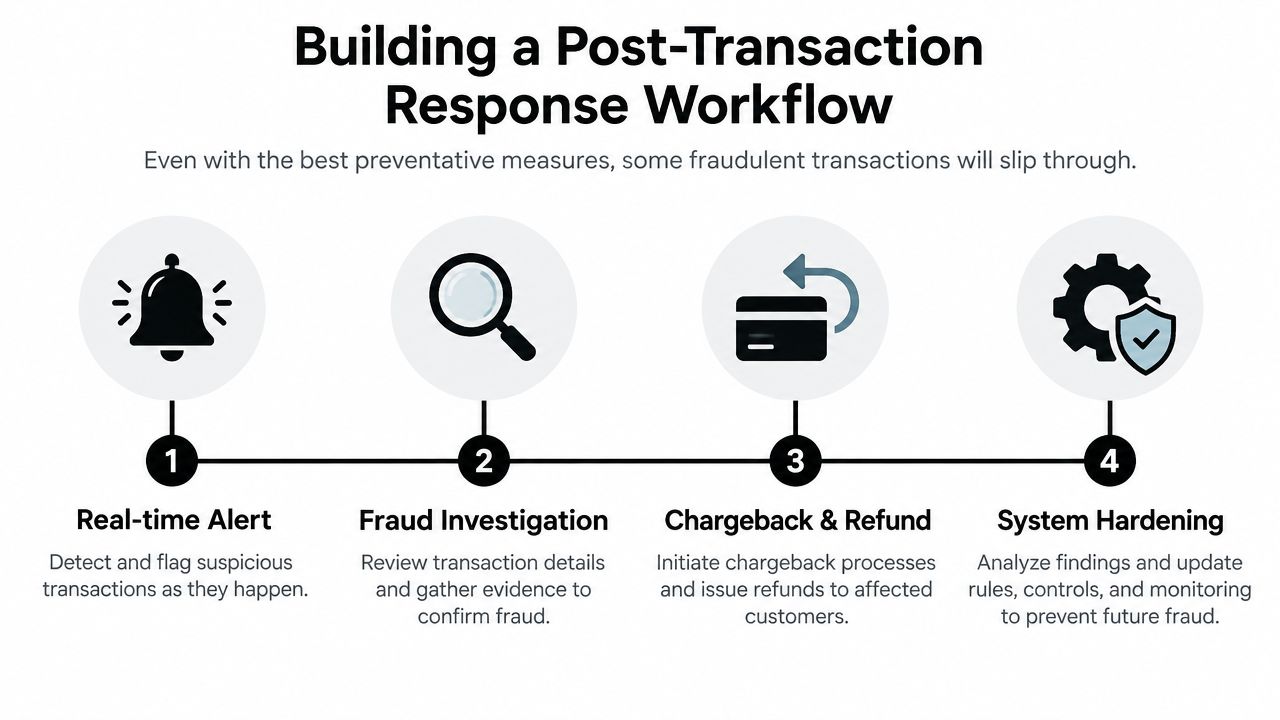
Building a Post-Transaction Response Workflow
Prevention lowers exposure, but no control catches every fraudulent order. A post-transaction workflow should move quickly from detection to investigation, customer action, evidence collection, and system improvement.
Start with real-time alerts. Route meaningful events to the people who can act, such as a sudden cluster of payment attempts, an account takeover signal, an unusual fulfillment destination, or a dispute tied to a previously flagged device. Avoid sending every low-confidence event to a shared inbox. Alert fatigue causes teams to ignore the signals that matter.
Connect investigation to action
When an alert arrives, create a single investigation record containing the order, customer account, device relationship, payment result, authentication status, shipping details, and relevant support conversations. Assign an owner and a status. A simple workflow might use new, reviewing, held, released, refunded, and confirmed fraud.
If the order hasn't shipped, place a fulfillment hold while the reviewer checks the evidence. If the buyer passes verification and the signals align, release the order. If the evidence points to compromise, cancel or refund according to your payment and customer-service policies, then record the indicators that should influence future decisions.
Chargeback mitigation needs to run in parallel with customer support and fraud screening. The chargeback fraud prevention workflow is useful when you're designing the handoff between operational investigation and dispute response.
Make evidence collection automatic
Your evidence package should answer practical questions:
- What was purchased? Include the order summary, product identifiers, and amount.
- Who placed it? Show account history, customer details, and authentication outcomes.
- What did the merchant promise? Preserve checkout terms, policies, subscription language, and delivery expectations.
- What happened afterward? Add fulfillment records, tracking, delivery confirmation, support replies, refund activity, and customer communications.
Integrate the payment, storefront, warehouse, and support systems so agents don't reconstruct the timeline by hand. A Gorgias workflow can help support teams see conversations alongside order details, while a payment platform should retain authorization and dispute events. Keep a record of recurring patterns, including devices, accounts, addresses, and behavioral indicators, but apply retention and access controls appropriate to the data you handle.
After each confirmed incident, change something specific. Tighten a rule, block a bot pattern, adjust authentication routing, improve a customer message, or revise a fulfillment hold. A response process that only recovers money but never updates prevention will repeatedly pay for the same weakness.
Auditing Your Storefront for True Conversion
A conversion rate is only useful when the sessions behind it represent potential buyers. Bots and fake visitors can inflate traffic, trigger product views, enter email forms, and distort attribution. If those sessions remain in the denominator, marketing teams may pause effective campaigns, increase spend on poor channels, or misjudge pricing and merchandising.
Start with a traffic-quality scan. Separate known crawlers, suspicious automation, masked access, repetitive sessions, and normal visitors. Compare the resulting segments against checkout starts, payment attempts, completed orders, support tickets, email signups, and review activity. The purpose isn't to make the conversion rate look better. It's to make the metric describe actual customer behavior.
Audit the full storefront path
Review each stage for contamination:
- Acquisition: Identify sources producing sessions with little shopping behavior or repetitive automated patterns.
- Product browsing: Check for aggressive scraping, abnormal request sequences, and catalog access that doesn't resemble customer research.
- Account creation: Look for disposable identities, repeated registrations, and clusters tied to shared devices or masked locations.
- Checkout: Compare payment attempts with session quality, authentication outcomes, and order history.
- Fulfillment and support: Match suspicious orders to holds, refunds, disputes, delivery complaints, and repeated contact patterns.
Use the audit to create a baseline, then apply controls gradually. If you block everything at once, you won't know which rule improved traffic quality or which one excluded legitimate buyers. Maintain a small review sample of allowed, challenged, and blocked sessions so your team can test whether classifications remain accurate.
Measure security and revenue together
A useful dashboard should show more than fraud losses. Track legitimate approval behavior, checkout completion, challenge abandonment, manual-review workload, dispute volume, support contacts, email-list quality, and the proportion of sessions classified as non-genuine. These measures help you see trade-offs instead of celebrating a lower fraud count that came from rejecting good demand.
The layered model is practical:
- Filter traffic before it reaches expensive systems.
- Score sessions and orders using multiple signals.
- Authenticate selectively when risk warrants friction.
- Monitor fulfillment and disputes after authorization.
- Feed confirmed outcomes back into rules and reporting.
Securify is one Shopify-focused option that classifies suspicious sessions, detects bot and VPN activity, supports geo-blocking and catalog protection, and connects with tools such as Shopify, Klaviyo, Gorgias, and Judge.me. The platform also offers a no-signup Store X-Ray scan for an initial traffic-quality assessment.
Run that audit before changing payment thresholds. Once your analytics reflect genuine visitors, your fraud team can focus on meaningful exceptions, your marketers can evaluate channels with greater confidence, and your checkout controls can protect revenue without treating every customer as a suspect.
Start with a Store X-Ray scan from Securify to identify bot traffic, VPN abuse, suspicious sessions, and analytics pollution across your Shopify storefront. Use the findings to tighten upstream controls before reviewing gateway rules, then connect the results to your fraud, support, and conversion workflows.